


Share
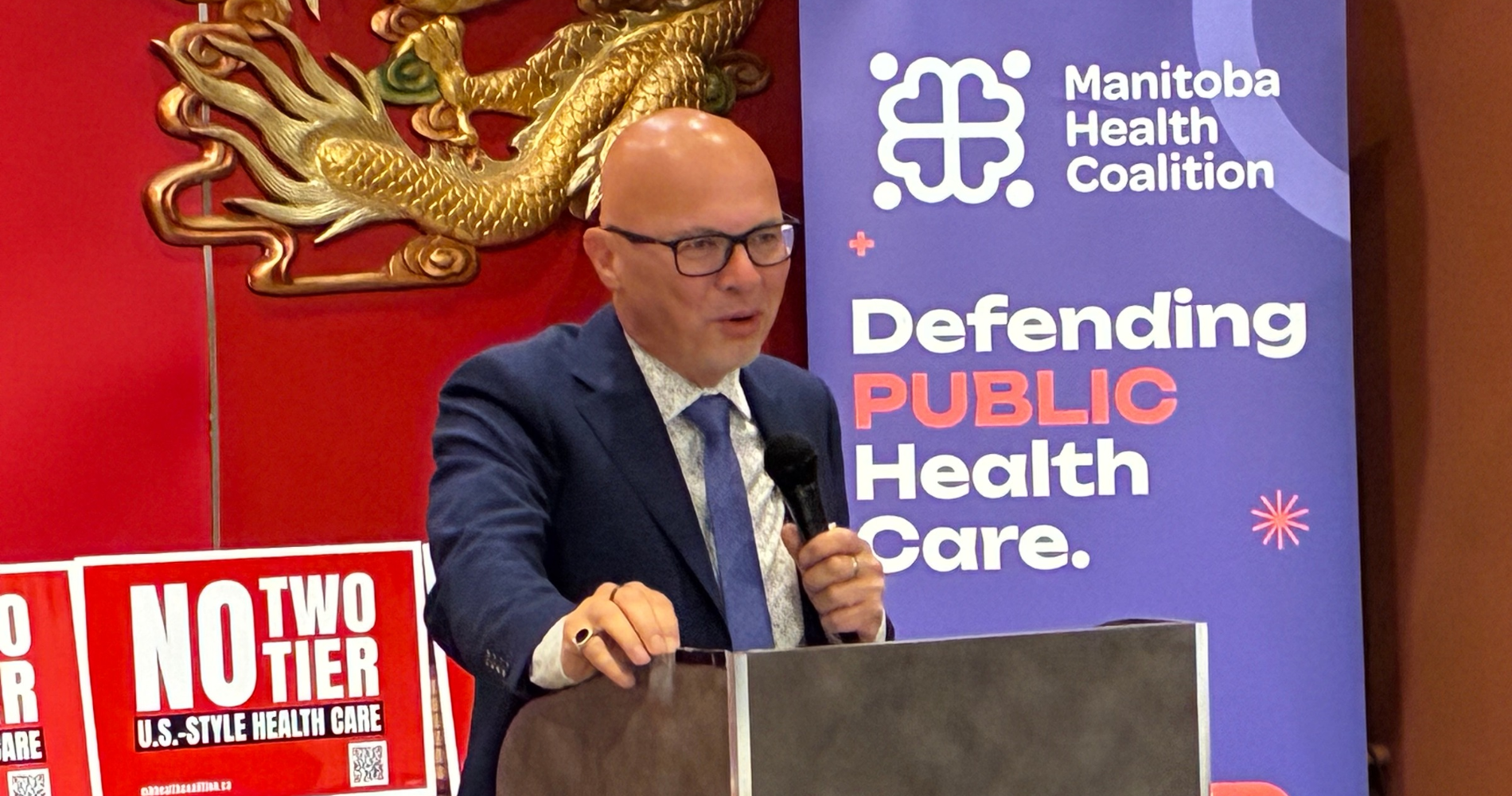
Editor’s note: These remarks were delivered by Steve Staples, National Director of Policy and Advocacy at the Canadian Health Coalition in Winnipeg on Oct. 8, 2026.
On Oct. 14, federal Health Minister Marjorie Michel announced a one-year extension of federal funding for home and community care, mental health and substance use services, worth $1.2 billion to provinces and territories, on the eve of the federal-provincial-territorial health ministers’ meeting in Winnipeg.
Good evening. Thank you, Noah, for that introduction, and thank you to Darlene Jackson and Michael Redhead Champagne for the invitation, and for everything the Manitoba Health Coalition does.
I’m honoured to be here on Treaty 1 territory and the homeland of the Red River Métis.
I bring warm greetings from Jason MacLean, the chair of the Canadian Health Coalition, and from our board, our staff and our member organizations across the country. Many of them, like the Manitoba Nurses Union, are in this room tonight.
Before I begin, I want to ask something of you.
In October of last year, a 22-year-old university student named Rodiyat Alabede went to a paid-plasma centre on Taylor Avenue, here in Winnipeg. During her donation, the machine sounded alarm after alarm. She went into cardiac distress, and about an hour later she died in hospital.
She should be alive today. I’d like to dedicate my remarks tonight to her memory, and to her family, who are still asking for answers.
Any Maritimers in the room tonight? I knew it. You’re everywhere.
I was born in Fredericton, and I come from a medical family. My grandmother was a nurse with the Victorian Order of Nurses. My mother was a nurse at the old General in Saint John. And my late father was a pharmacist. He ran Staples Drugstore in Fredericton, where the teenagers came in for sodas.
Growing up Gen X in a medical house was not easy. If you were sick, good luck finding an aspirin. We were sent to school with colds. A fever was the only thing that kept you home.
But I learned two lessons at that kitchen table. First, respect the power of medicine, because it will be there when you need it. And second, health care is not just about fighting disease. It’s about helping people.
Those lessons served me well. I went from the peace movement in Vancouver in the 1990s, to the streets of Seattle against the World Trade Organization in 1999, to what I call twenty years of hard labour in Ottawa, starting with Maude Barlow at the Council of Canadians.
And along the way, I had the privilege of meeting the remarkable Shirley Douglas, the daughter of Tommy Douglas, the premier of Saskatchewan and the father of Medicare.
Shirley once took me to lunch at the Kit Kat on King Street in Toronto. And she told me something her father used to say: “In America they have hawks and doves. But in Canada, we have a lot of parrots.”
I think about that a lot these days. The pressure to copy the United States has always been with us, especially when it comes to privatizing health care. And there are a lot of parrots out there right now.
You may remember that in 2004 the CBC asked Canadians to vote for the Greatest Canadian. And who won? Tommy Douglas. Not a hockey player. Not a prime minister. The man who gave us Medicare.
People sometimes ask me: why does a national coalition spend so much time on the federal government? Isn’t health care provincial?
The provinces deliver the care. But Ottawa sets the rules and pays a big share of the bill.
In the early 1980s, doctors in many provinces billed patients extra on top of what Medicare paid. It was getting out of control. Organized nurses, unions and community groups pushed back, and in 1984 Parliament passed the Canada Health Act unanimously.
The deal was simple. Ottawa sends money through the Canada Health Transfer. In return, every province runs a public plan that covers medically necessary care for everyone, on the same terms, with no extra billing and no user fees. Care based on need, not on your ability to pay.
When we talk about privatization, it helps to separate two things.
The first is private, for-profit delivery: a corporation running the clinic or the lab, even if your health card pays the bill.
The second is private payment: pulling out your Visa for care that should be covered. That is the line the Canada Health Act was written to protect. And that is the line Alberta has just crossed.
Alberta’s Bill 11 lets doctors work in the public system and, at the same time, charge patients privately for the same medically necessary surgery. No other province allows this.
You don’t need a metaphor to understand how it works. Dr. Braden Manns, a physician and health economist at the University of Calgary, explained it at a press conference with us. His public patients, he said, can wait nine months to see him. Under dual practice, he could hold back two or three appointment slots for people who’d waited only a week or two, “if they’re willing to pay four times as much.”
Every one of those slots comes out of the public line. Dual practice doesn’t add a single surgeon or a single operating room. It just moves them to the people who can pay, and everyone else waits longer.
And Manitobans don’t have to imagine it, because this province has already lived it. In the 1990s, Manitoba let eye surgeons do cataract surgery for both public and private-pay patients. People who paid privately waited about four weeks. Public patients of surgeons who worked only in the public system waited about 10 weeks. But public patients of surgeons who did both waited 23 weeks. When Manitoba ended the practice, the gap disappeared. Manitoba learned that lesson the hard way. Alberta is about to learn it all over again.
Our lawyers at Goldblatt Partners looked closely at the law. Their opinion is that there are very strong and compelling arguments that Bill 11 violates the Canada Health Act: its principles of universality, accessibility and comprehensiveness, and its ban on extra-billing and user fees.
Here’s the good news. Together with Friends of Medicare and our allies in Alberta, we have already forced Premier Danielle Smith to delay putting Bill 11 into effect twice. She even admitted she’s looking for “latitude” from Ottawa.
And she is losing the argument with Albertans. In our national Abacus Data poll this summer, 56 percent of Albertans opposed Bill 11, including more than a third of her own party’s voters.
We must be doing something right, because Alberta’s health minister is now publicly accusing the Canadian Health Coalition of fear-mongering. Friends, if telling people the truth about two-tier health care is fear-mongering, then I plead guilty.
This isn’t only Alberta’s problem. Across the country, 74 percent of Canadians are worried that policies like Bill 11 will spread to other provinces. And they’re right to worry. Your neighbour to the west, Saskatchewan Premier Scott Moe, has already mused about following Alberta’s lead. If it can happen in Edmonton, it can happen in Regina, and it can happen in Winnipeg.
So what has Ottawa done?
We did persuade federal Health Minister Marjorie Michel to say publicly that she doesn’t know how dual practice can work within the Canada Health Act. That matters. But she has not used the tools the Act gives her: formal consultations and penalties on the health transfer.
Why not? The trade war, the push for a united front with the premiers, and the separatist threat in Alberta all seem to be keeping the Prime Minister from backing his own minister. We’ve even heard reports that Liberal MPs, including doctors, have been told to keep their concerns about Bill 11 to themselves.
And it’s not just Bill 11. Look at the money.
The federal agreements that fund home care, mental health and addictions services, and drugs for rare diseases all expire on March 31 next year. That’s less than six months away. The premiers call it a fiscal cliff. Ottawa still won’t say whether the money will be renewed. Health Canada’s own plan projects its spending will fall by more than $3 billion over the next three years. And this government has introduced new co-payments on health care for refugees and asylum seekers.
You can’t run a mental health program, keep staff, or plan a waiting list on a maybe. Manitoba’s own health minister has said it plainly: longer-term, stable funding is what provinces need to plan, hire and deliver services.
Now I want to give credit where it’s due.
When the Pharmacare Act passed in 2024, Manitoba was the first province to sign a pharmacare agreement with Ottawa. Because of that, people in Manitoba can get contraception and diabetes medications free or at low cost. That’s real. That’s people not having to choose between their insulin and their groceries.
But here’s the problem. Since the 2025 election, Ottawa hasn’t signed a single new pharmacare agreement. Newfoundland and Labrador has written letter after letter asking to join and has been shut out. Only four provinces and territories are in, which means only about one in five Canadians benefit.
Our own board member, Dr. Joel Lexchin, one of the country’s leading experts on drug policy, put it bluntly last week. He said national pharmacare is “dead in the water” unless the government’s priorities change.
Well, that’s what we’re here to do: change those priorities. Because 80 percent of Canadians support a universal national pharmacare program. Manitoba showed the way. Now the rest of the country deserves the same.
Which brings me back to Rodiyat Alabede.
Grifols, a Spanish multinational, runs paid-plasma centres in partnership with Canadian Blood Services. Unlike Canadian Blood Services, it pays people for their plasma. And it advertises how much money you can make by selling it.
Three donors have died after donating at Grifols sites here in Winnipeg since 2018. In August, as the pressure built, Grifols paused collection across the country. Then, two weeks ago, Health Canada suspended the licence of the Taylor Avenue centre. It was the first time Health Canada has ever suspended a blood establishment licence.
That’s a start. But Grifols is already planning to reopen. Meanwhile, the company cut its official count of serious reactions and deaths among donors from 25 to six, and Health Canada accepted it. Ms. Alabede’s family is still asking for an investigation.
So our demands are clear. Keep every Grifols centre closed. End the contract between Canadian Blood Services and Grifols. And hold an independent public inquiry into these deaths. Canada’s plasma supply can be secured the way it should be: through voluntary donation. Blood is a gift, not a commodity.
So how do we win? The same way we always have: in Ottawa, and in the streets.
Our national campaign against two-tier, U.S.-style health care is doing both. On September 1, people rallied at more than 30 Liberal MP offices across the country. When MPs came back to Parliament last month, a billboard truck circled Parliament Hill to welcome them. This week, we’ve written to every health minister meeting here in Winnipeg, asking them to stand up for the Canada Health Act, to end the funding uncertainty, to restore pharmacare, and to end paid plasma.
And the Manitoba Health Coalition has been right there.
The polling tells us Canadians are with us. 91 percent are worried about the future of public health care. Eighty-five per cent say care based on need, not money, is a core Canadian value. And 80 percent believe our public system can meet our needs if governments invest in it.
But public opinion doesn’t win on its own. People do. So I’m inviting you to join us in Ottawa in February for our Parliament Hill Lobby, when about 200 of us will meet MPs and senators face to face. And between now and then, come out to the Manitoba Health Coalition’s town halls and actions, and bring a friend.
I’ll leave you with something I found in the Canadian Health Coalition archives.
Our coalition was founded in 1979, and Tommy Douglas was at our founding conference. In the archives, I found a speech he gave in the early 1980s, just before the Canada Health Act was passed. It’s called “We Must Go Forward.”
He was worried that extra-billing was spreading, and listen to what he said would happen. Doctors would favour the patients who pay extra. And then, in his words: “The well-to-do who can afford it will have one standard of health care and those less fortunate will have to accept a lower standard of health care.”
That was more than forty years ago. He could have been describing Bill 11.
He was in his late seventies when he gave that speech. And he said: “I helped to establish the first Medicare program in Canada, and even at my age I’ll trek this country from the Atlantic to the Pacific to stop this program from being destroyed.”
From the Atlantic to the Pacific. From Ottawa to the streets.
In the same speech, he told the room that Medicare was only the first step. He called for home care, for denticare, and for “pharmicare.” Forty years later, we finally have a national dental care plan. And Manitoba was the first to sign on to pharmacare. Tommy’s to-do list is getting shorter, but we’re not done.
He ended with words I want to leave with you tonight: “You can’t stand still. You can’t go back and you must go forward.”
So let’s go forward. Please give generously to the Manitoba Health Coalition tonight. Every dollar you give helps keep this fight going, here in Manitoba and across the country.
Thank you.