Share
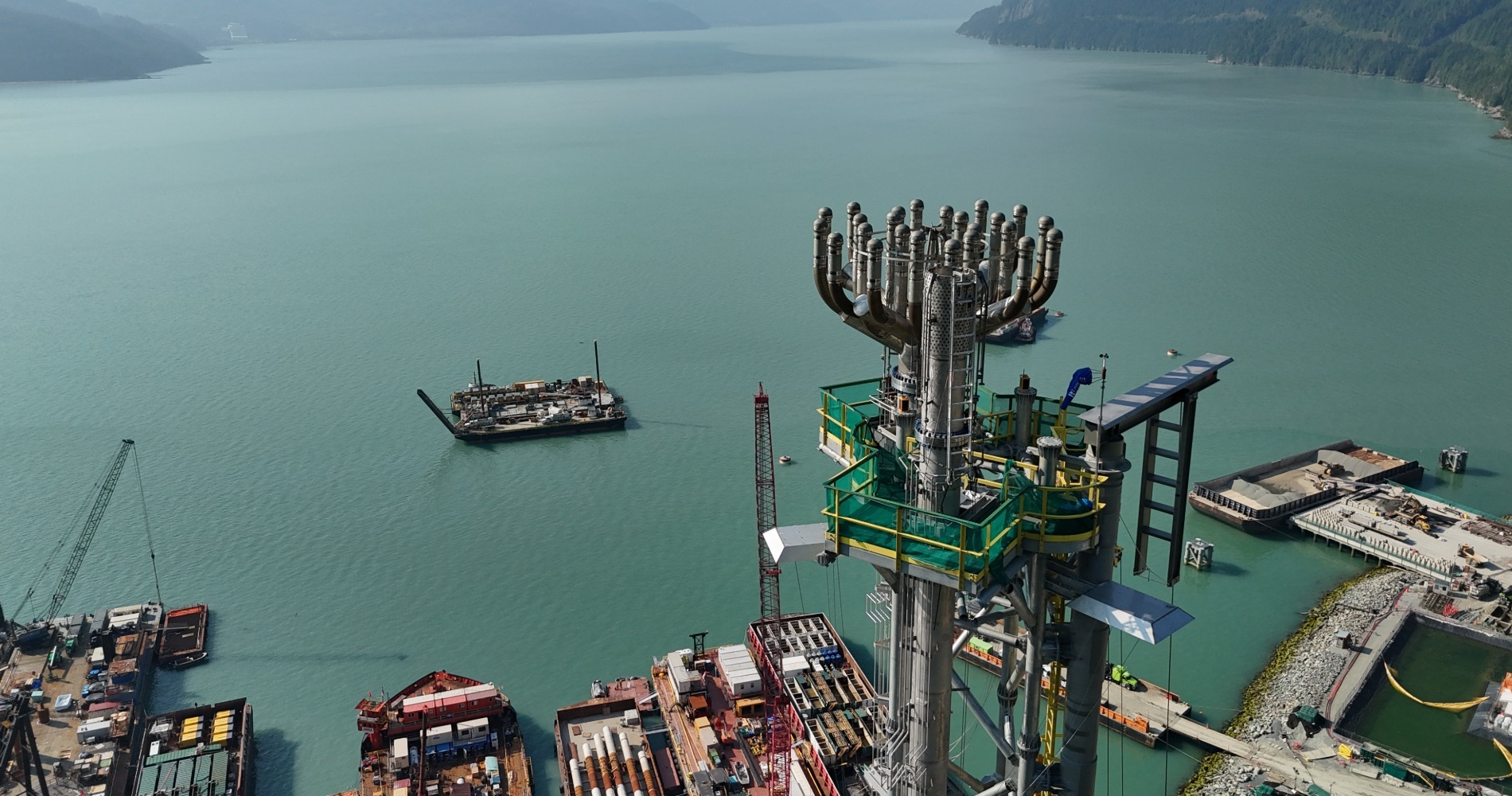
A report by the consultancy Deetken Insight, released in October 2026, purports to make an economic impact assessment of the Woodfibre LNG plant currently under construction near Squamish, British Columbia. Commissioned by Woodfibre LNG itself, the report comes up with highly exaggerated numbers, including a headline number of more than 52,000 person-years of employment during construction.
Usually, companies commission this type of economic impact report on the front end of a project in order to secure the necessary permit approvals from governments. By presenting large numbers that get quoted in government news releases and the mainstream media, they also seek to acquire social license for the project. The input-output approach employed has been criticized as “advocacy dressed up as analysis” because it only looks at economic benefits, not costs, and typically overstates those benefits.
Woodfibre LNG is already 60-70 per cent complete after three full years of construction. So the release of the study appears to be part of a bigger play towards a doubling or even tripling of Woodfibre LNG’s production, as part of the Prime Minister‘s “energy superpower” strategy. The federal government included the possibility of doubling Woodfibre’s capacity in the Canada Investment Summit “deal book” in September, at an estimated capital cost of $13.9 billion.
Before anyone gets too carried away by huge numbers, let’s take a closer look at the Deetken study and why we should be skeptical of its claims of economic benefits—in addition to some of the costs not included in the Deetken study. Most people in Metro Vancouver do not know what’s being built just up the coast. Once Woodfibre LNG is operational, and its downsides are more well known, it may be too late to stop Phase 2.
Construction and operations
The Deetken study looks first at the construction stage of the Woodfibre LNG terminal and the new Eagle Mountain pipeline using an input-output modelling approach. These models use data from the system of national accounts to estimate GDP and employment impacts from new investment or economic activity, but they can be easily mis-used.
Deetken then evaluates the benefit from Woodfibre LNG once it is operational based on its estimates of public returns in taxes and royalty revenue. This is because the oil and gas industry, and LNG in particular, is extremely capital-intensive, meaning the vast majority of the jobs are in the construction phase. Once operational, Woodfibre LNG will support only about 100 permanent jobs.
For the construction phase, an input-output model derives GDP and employment estimates by boosting the investment or output in one part of the economy (in this case, the new LNG facility and pipeline) and tracing its effects on the rest of the economy. These break down into direct effects of the new facility itself, as well as indirect effects from expenditures going to suppliers to the facility, and induced effects from workers spending their incomes in the local economy.
By design, input-output modeling assumes that workers hired would otherwise be unemployed, and are thus incremental new jobs that add to total B.C. employment. In reality, oil and gas construction workers would most likely be employed elsewhere if they did not work at Woodfibre LNG. Put another way, Woodfibre is competing for workers with other large oil and gas construction projects across the country, and this pushes up wages for various skilled trades workers.
Even if we put that aside and assume all Woodfibre jobs are new jobs, the Deetken estimates are way too large. They estimate 18,145 job-years in the direct construction of the LNG terminal and 37,643 job-years if we also include indirect and induced jobs. In addition, the Eagle Mountain pipeline would create 6,803 job-years from its direct construction and 14,760 job-years including indirect and induced effects. Together, these total 52,403 job years for both capital projects.
In contrast, Woodfibre LNG’s website states peak employment of 1,500 jobs during construction. Even if we stretch and assume six years of construction at the peak of 1,500 jobs, that is a maximum of 9,000 job-years of employment—less than half the 18,145 job-years of direct employment from the Deetken modelling exercise.
For the pipeline construction, it was estimated that employment would peak at 550 to 600 jobs. Again, if we assumed the full 600 jobs (the high end of the range) for the full six years, that is only 3,600 job-years. This is much lower than the 6,803 job-years of direct employment estimated by Deetken.
An important caution here is the difference between jobs and job-years: one person working a job for five years is five job-years. Politicians and commentators often conflate the two, so don’t be surprised to hear pro-LNG advocates saying 52,403 jobs rather than person-years. But that is the least of the problems with this study.
The input-output modelling approach is linear and static, so if direct employment numbers are two to three times too large, the same is true for the indirect and induced job numbers. This also applies to GDP estimates. Thus, Deetken’s estimate of $2.2 billion in direct construction GDP is probably closer to $1 billion or less, spread over six years. B.C.’s total GDP was about $450 billion in 2025.
Inputs and outputs
Given that construction is well underway, Deetken’s choice of using an input-output model, rather than actual data from Woodfibre LNG (who commissioned the study), is questionable. That Deetken’s approach produces jobs numbers that are two to three times too large should have been a big red flag.
While it makes sense that a new investment in LNG and pipeline capacity would increase employment and GDP, the extraordinarily large numbers are likely due to some key assumptions. Canada did not have any LNG production until July 2024 when LNG Canada started up operations, so LNG is not included in the latest version of input-output tables produced by Statistics Canada. Nor does the model have a detailed LNG sub-sector, as the input-output tables only go to a lower level of sectoral detail. Deetken would have had to model the sector itself or it could make estimates based on capital expenditure for the oil and gas industry as a whole, but it is not transparent about these assumptions.
As noted above, another assumption in the model is that direct construction workers would otherwise be unemployed. Additional difficulties arise when considering the indirect jobs in supplier industries that would benefit from the LNG investment. These will be much weaker for LNG than the oil and gas industry as a whole because the components for the LNG facility are almost 100 per cent imported from China and Korea, and just assembled on site. The indirect jobs are thus greatly overstated.
Even in the best of circumstances, input-output estimates for “induced jobs” are dubious. These reflect the expenditures that workers make when they spend their earnings in the local economy, at the grocery store or getting a tune-up, for example, and the taxes they pay that fund public services. Studies usually include induced jobs in input-output models to pad employment numbers. Because estimates are based on economy-wide averages, actual incremental induced jobs are probably close to zero.
In the case of Woodfibre, the situation is worse than normal because the bulk of employment is fly-in, fly-out workers who reside on two repurposed cruise ships anchored off the site when they are on the job. They have much less connection to the local economy in terms of living there and raising families. Indeed, many fly back to the Maritimes or other parts of Canada when they’re not working, rather than staying in British Columbia. A number of the workers are also temporary foreign workers (estimated pre-construction at 14 per cent of the total).
In sum, the study greatly overstates the GDP and employment numbers for constructing the Woodfibre LNG plant by using a model in problematic ways, including making heroic and unrealistic assumptions. In this model, cost over-runs are a good thing because they would boost employment and GDP even more. Indeed, another part of the inflated GDP and job numbers is that the project has seen massive cost over-runs, although Deetken do not disclose what capital expenditure they used for the modelling.
This exercise should not be used to proxy the potential benefits of a Phase 2 of Woodfibre LNG, as the numbers are so widely off the mark. Phase 2 would also not include a duplication of capital investment in the gas pipeline, as it would already be served by the Eagle Mountain pipeline.
Government revenue from operations
Once operational, the main benefit from Woodfibre LNG is not its 100 permanent jobs, but tax and royalty revenues to governments. For federal and provincial governments, the lure is potentially billions in royalties and corporate income taxes, as well as personal income tax paid by the workers. The District of Squamish, the local government, would also benefit from property tax revenue.
How profitable any LNG operation is a decade or two from now is anyone’s guess. Markets are volatile and the upfront capital expenditures for LNG are massive. Nonetheless, there will only be profits to tax if there are much higher LNG prices than have prevailed in recent years. The Deetken report is not transparent about its assumptions on future prices, profits and production volumes.
Indeed, there is a high likelihood that LNG plants lose money, operate under capacity or end up becoming a stranded asset. The major issue facing the industry is the plentiful new supply coming over the next five years, as new projects around the world get completed. Asia and Europe are the prime destinations for LNG exports, but both regions have accelerated the shift to renewables and electrification due to the energy price shock arising from the United States and Israel’s war on Iran, set against much lower costs for renewable technologies produced at scale in China.
In any event, the advent of immediate expensing and other tax credits means there won’t be profits to tax for a long time. The Deetken report admits as much: “corporate income taxes are expected to accrue only later in the project life once amortization and other early-year tax shields are exhausted.” Even at face value, the total estimated revenue for all governments is estimated to be $11.6 billion over 40 years, but only $3.2 billion of that in the first 20 years. The new federal productivity mega-deduction will make this situation worse in terms of revenue in the short term.
Even these numbers are based on the assumption that export quantities from Woodfibre LNG will come from incremental production in British Columbia. However, Woodfibre may simply be diverting supply that would otherwise go to the U.S. or Alberta. This was the whole point of LNG in the first place 15 years ago: to get higher prices in Asia for B.C. gas that sells cheaply in North America.
As for royalties, B.C. revenues have increased somewhat in recent years as production has surged, but they remain a fairly small part of the B.C. budget (about one per cent of revenues in 2025-26). Politicians talking about gas production and LNG paying for health care and education are vastly overstating the likely fiscal benefits.
The most likely candidate to deliver government revenues is property tax going to the District of Squamish. Earlier this year, Squamish council rejected a deal proposed by Woodfibre that would lock in their total property taxes at a low rate over 10 years. However, the property tax revenues would be two to three times higher if assessed at the levels previously applied when the Woodfibre site was a pulp mill (it closed in 2006).
Costs and benefits
The economic modelling is aimed at showing the benefits of Woodfibre LNG, and as noted, there are exaggerations at every step to inflate the benefits in terms of jobs and GDP. But there are also costs. The B.C. government’s environmental assessment report of Woodfibre LNG back in 2015 flagged a long list of adverse effects, all of which were worse for local First Nations, but nonetheless approved the project in spite of those concerns.
Top among these are environmental costs, starting with pollution in the local airshed, which will have adverse impacts on health. Ironically, LNG is supposed to help pay for hospitals (as noted above, it won’t) but any gains would be offset by increased health-related costs, including mortality.
Greenhouse gas emissions from the facility itself, upstream emissions from fracking and processing gas in northeast B.C., as well as combustion of the exported fuel elsewhere, total about 6.2 million tonnes of carbon dioxide per year (assuming all of Woodfibre’s production is incremental and the facility operates at full capacity). Based on the social cost of carbon, at a range of $200 to $500 per tonne, Woodfibre LNG would cause between $1.2 and 3.1 billion in economic damages per year (though these costs would be borne in the future and by people around the world, not just in BC).
In addition, tanker traffic in Howe Sound will be disruptive to ferry traffic and other economic activity in the area, such as fishing and tourism. The vast array of marine life, including endangered Southern killer whales, will also be affected by this and the cumulative impacts of additional oil tanker traffic from other sources like the expanded Trans Mountain Pipeline.
The reality is that once Woodfibre LNG is operational, these costs will be more widely visible. Local residents and First Nations would have a much stronger case against proceeding with a Phase 2. But if politicians believe the numbers in the Woodfibre LNG study by Deetken, they may rush ahead and approve Phase 2 before the costs of the first phase are widely understood.
When big numbers are tossed around to justify a megaproject, few people look to see exactly what’s behind those numbers. The Deetken study would never get published in an academic journal or pass a rigorous peer review. But that’s not the point: these studies are created to put numbers to something that self-interested, profit-seeking proponents want the public to believe.
About the author

Marc Lee
Marc Lee is a Senior Economist with the Canadian Centre for Policy Alternatives. Marc joined the CCPA’s British Columbia office in 1998, and is one of Canada’s leading progressive commentators on economic and environmental policy issues. From 2009 to 2015, Marc led the CCPA’s Climate Justice Project (CJP), which published a wide range of research on fair and effective approaches to climate action through integrating principles of social justice. Marc continues to write about climate and energy policy, strategies for affordable housing, federal and provincial budgets and macroeconomics. Marc has an MA in Economics from Simon Fraser University and a BA in Economics from the University of Western Ontario. Marc is a past chair of the Progressive Economics Forum, a national network of heterodox economists. He also served as a Visiting Professor at Simon Fraser University’s School of Public Policy in 2024 to 2025.