


Share
Over the last 50 years, women’s equality movements have had many important breakthrough moments, but economic gender inequalities have been very slow to change. Closing the wage gap has proved particularly challenging. This International Women’s Day, many women workers are struggling in low-waged sectors of the economy while those working in public services—where the majority of workers are women—have watched their wages stagnate year after year.
On average, women earn about 87 cents per hour for each dollar earned by men in Canada. The gender disparity in annual earnings is even more pronounced, with women earning 72 cents on the dollar.
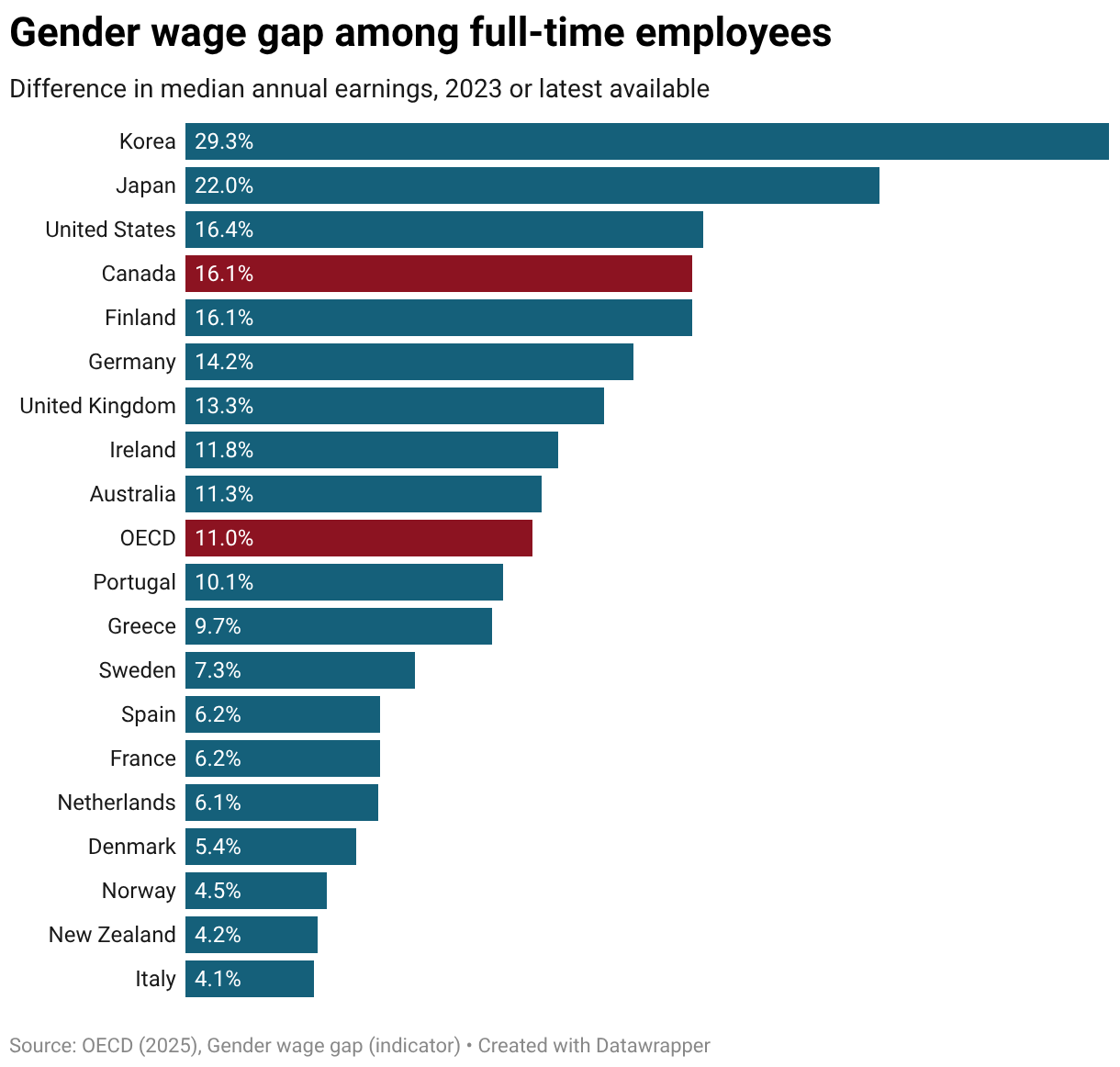
The gender pay gap has narrowed by 20 percentage points since 1977 when the federal government introduced Canada’s first pay equity provisions in the Canadian Human Rights Act. But it remains unacceptably wide—in fact it is one of the largest in the OECD, ranking 26th among 31 peer countries.
The gender pay gap’s huge toll
Women in Canada are paying a high price for this wage discrimination. In dollar terms, women are on average making $19,000 less per year than their male colleagues, the same among full-time workers too. This amounts to $200 billion in lost wages. Even modest pay equity adjustments could close those gaps and significantly boost Canada’s GDP.
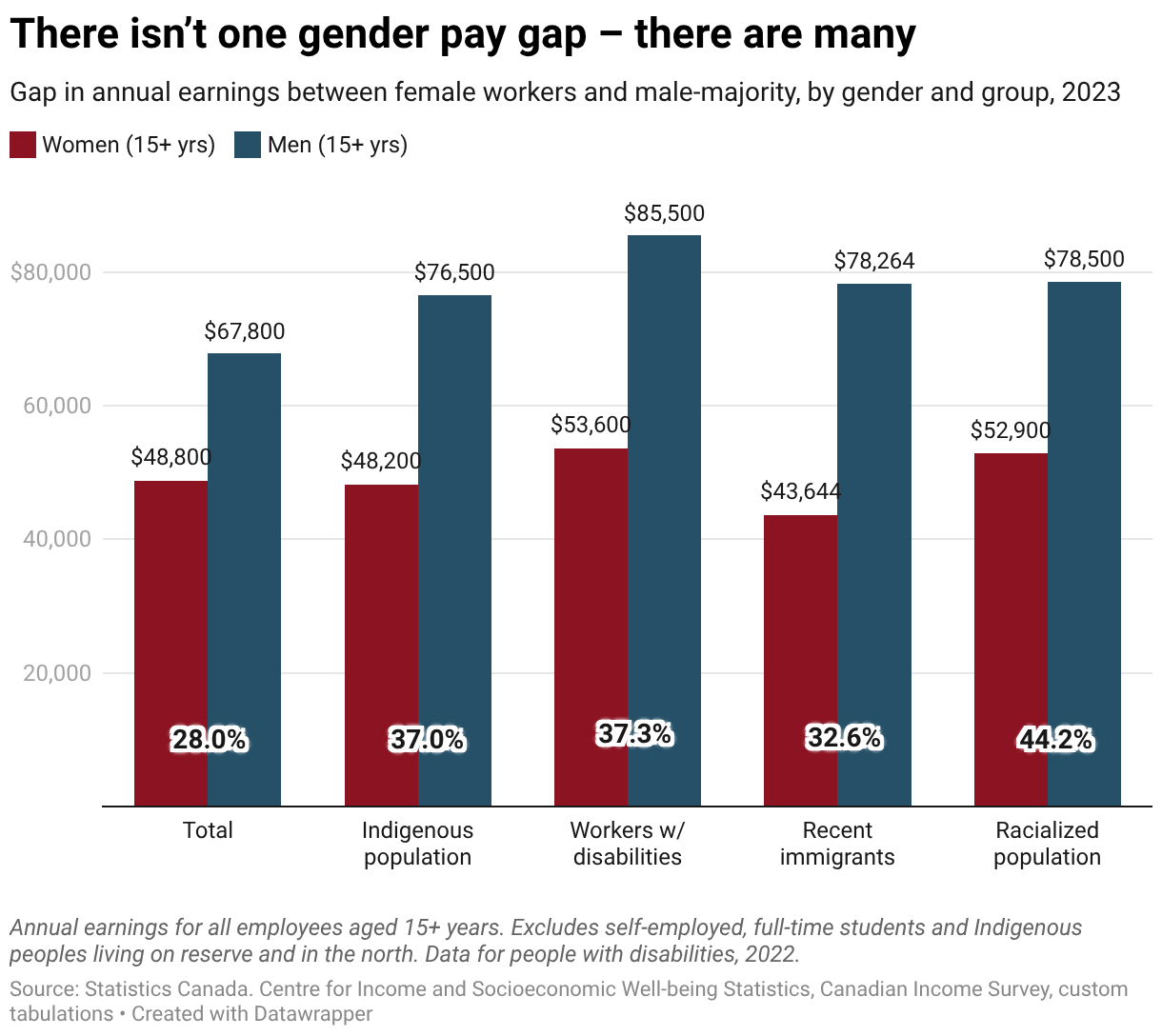
The gender wage gap’s especially high especially among Indigenous and racialized workers and those with disabilities compared to non-Indigenous, non-racialized male workers or those without disabilities, close to a 40 per cent gap of annual earnings.
Over a lifetime, the gender pay gap adds up to astonishing financial losses for women. According to U.S. research, the gender pay gap on average costs women more than half a million dollars in lost earnings over the course of 40 years and upwards of $1 million among Black, Hispanic, and Native American women.
Pay discrimination and earnings polarization
Progress has been made in narrowing the wage gap in the aggregate, but it remains hugely uneven, within a context of growing wage and earning inequality. The COVID-19 pandemic brought this reality home, its economic fallout shouldered by the most vulnerable workers and families, shining a light on deeply entrenched gender biases in Canada’s labour market.
The current situation of economic uncertainty and high living costs provides even stronger reasons for making gender equity a priority. School teachers, health professionals and community support workers, for instance, all experienced negligible wage growth between 2019 and 2025 taking inflation into account. Indeed, women working in nursing actually lost ground, their real wages falling by 1.3 per cent over the six years. Meanwhile, the incomes of men in senior management and finance have surged.
Francine Blau and Lawrence Kahn coined the term “swimming upstream” to characterize women’s pursuit of pay equality in the face of growing earning inequality. These authors were talking about the evolution in the gender pay gap during the 1980s, but the metaphor captures the present moment as well.

Current approaches fall short
Canada was an early leader in the introduction of pay equity laws aimed at eliminating the cumulative effects of occupational segregation and the undervaluation of “women’s work.” The first such legislation was introduced in Manitoba in 1986, followed by Ontario, Prince Edward Island, New Brunswick, Nova Scotia and Quebec over a 10-year period.
Yet, the gender pay gap persists, a reflection of the complex sources of gender discrimination in the labour market and the significant weaknesses and gaps in Canada’s current legal frameworks and our social safety net.
The wage penalty attached to motherhood; gendered and racialized norms, biases and stereotypes around competence, leadership and likeability; lack of access to attendant care, accessible transportation or other accommodations; and the inequitable treatment of foreign credentials and related work experience—these all contribute to wage disparities and diminish the value of women’s labour.
The upshot: women are channeled into lower-paying occupations and sectors of the economy, work presumed to align with their “natural” or “traditional” abilities and interests, and “self-select” into more flexible, invariably lower paying, work options to accommodate family needs. The chart below says it all.

Swimming upstream
In the face of Canada’s persistent pay gap, the federal government seems intent on re-creating the Canadian economy of the 1960s through investment in male-dominated industries and the expansion of the military.
This position reinforces the myth that women’s labour is not essential to the economy, that the care economy, where millions of women work, is not the foundation of a strong and resilient country, that gender pay discrimination and earning polarization isn’t a major threat to our collective well-being.
The response to the economic assault confronting Canada can’t be a raft of programs focused solely on displaced workers on the shop floor, as important as that goal is. It must take an inclusive approach that builds out essential community infrastructure, strengthens employment standards, fosters unionization, contains skyrocketing income inequality, and transforms compensation and hiring practices through proactive pay equity and gender pay reporting.
International Women’s Day is a time to recommit to ending pay discrimination and economic injustice. It’s a time to speak out loudly for a future that lifts up everyone.
About the author

Katherine Scott
Katherine serves as the director for the CCPA’s gender equality and public policy work. She has worked in the community sector as a researcher, writer and advocate over the past 20 years, writing on a range of issues from social policy to inequality to funding for nonprofits.