

Share
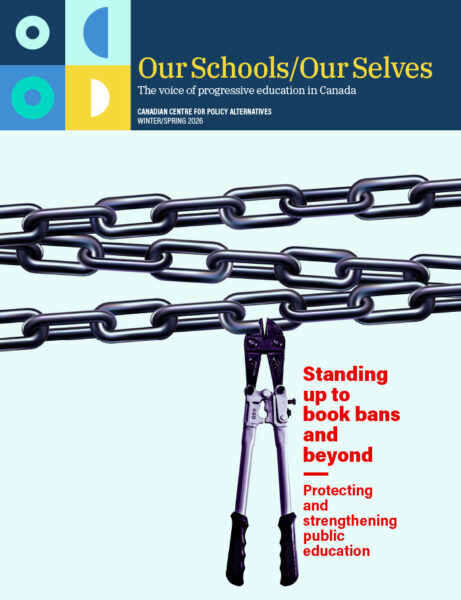
This is an article from Our Schools/Our Selves. Read the entire issue.
For the past several years, violence in Ontario schools has been discussed as though it were a series of isolated incidents: a child acting out, a classroom out of control, a teacher unable to cope. The dominant response has been managerial and individualizing—more reporting requirements, more surveillance, more discipline.
But violence does not emerge in a vacuum. It is produced. It accumulates. And when it becomes routine, it is often a signal that a system itself is under strain.
This is the central finding of a recent research project conducted with elementary educators in Toronto: what shows up in classrooms as “violent incidents” is, in many cases, the manifestation of chronic underfunding, staffing erosion, political neglect, and the offloading of social crises onto schools that are no longer equipped to absorb them.
This article is a report about that report—and a warning to the rest of the country.
A crisis years in the making
Since 2018, and after accounting for inflation, enrolment growth and unmet needs, the Ontario government has quietly removed billions of dollars from public education.
The political framing of education funding continues to rely on symbolic gestures rather than structural solutions. On March 10, Premier Doug Ford and Education Minister Paul Calandra announced a $750 annual “classroom supply card” for teachers, a policy framed publicly as support for students and educators. Yet the announcement came after years of cumulative funding erosion in Ontario’s public education system—estimated at more than $6.5 billion since 2018. While the program represents roughly $63 million in new spending, educators across the province immediately pointed out that the same funds could instead support meaningful structural improvements such as hiring additional teachers, educational assistants, child and youth workers, and mental-health professionals. The contrast illustrates a broader pattern: highly visible political announcements that do little to address the systemic conditions producing stress, conflict, and violence inside schools.
In Toronto, where I teach, schools have experienced the steady disappearance of the very adults who make classrooms safe and functional: educational assistants, child and youth workers, social workers, psychologists, and specialist teachers. Supply teacher shortages have become chronic, increasingly filled by non-certified staff asked to manage classrooms without the training, authority, or support required to do so safely.
At the same time, school buildings have deteriorated. Deferred maintenance has left many schools overcrowded, inaccessible, and physically unsafe.
These material conditions matter. They shape how students experience school, how educators respond under pressure, and whether conflict escalates or is de-escalated.
What the data now shows—and what educators have been saying for years—is that violence rises precisely where supports disappear.
What the research found
The violence research project led by Dr. Stephanie Fearon draws on educators’ collective narratives to document how teachers experience, interpret, and respond to violent incidents in schools. What emerges is not a story of “bad kids” or “failing teachers,” but of professionals navigating impossible conditions.
Educators described classrooms where students with significant unmet needs were placed without adequate support. They spoke of repeated violent incidents that were normalized, underreported, or quietly reframed as “part of the job.” Many described the moral injury of caring deeply for students while being denied the resources required to keep anyone safe—including the students themselves.
Crucially, the research documents how violence is experienced not only as physical harm, but as emotional, psychological, and cumulative. Teachers described hypervigilance, exhaustion, and fear—not because they lacked skill or commitment, but because the system had withdrawn its care.
Violence, in this framing, becomes a form of communication: a child’s last resort in a system that no longer responds to need with support.
The political context we cannot ignore
It is impossible to understand what is happening in Ontario schools without situating it within the broader political moment.
Across North America, we are witnessing a resurgence of right-wing populism that thrives on division, scapegoating, and austerity. Teachers, immigrants, trans communities, and public sector workers are increasingly framed as the problem—blamed for affordability crises and social instability that are, in fact, the result of deliberate policy choices.
In Toronto, this climate has been made visible through the repeated presence of far-right groups mobilizing under the banner of “re-immigration” and anti-trans panic. These groups rallied multiple times in public spaces—including Christie Pits Park, where my own child plays, as well as Queen’s Park and City Hall.
Each time, they were met by something just as important to name: a powerful public clap-back. Residents from across the city—parents, educators, neighbours, union members, students—consistently outnumbered them. The response was collective, grounded, and unmistakable: Toronto rejected the politics of hate.
And yet, at each of these mobilizations, the Toronto Police Service protected the far-right demonstrators while directing force toward counter-protesters. In one recent action, a counter-protester who was not resisting or threatening anyone suffered a broken hip during a police intervention. In this case, no meaningful public accountability followed. More broadly, despite repeated documentation of disproportionate police force against Black, Indigenous, and racialized communities in Toronto and across Canada, structural accountability remains limited. Investigations occur; systemic consequences rarely do.
The pattern is not invisible; it is tolerated. Accountability remains absent.
The dynamic extends beyond far-right mobilizations. On March 5, 2026, hundreds of students gathered at Queen’s Park to protest the Ford government’s planned cuts to post-secondary student grant funding and changes to tuition policy. Organizers from the Canadian Federation of Students—Ontario later reported that Toronto police used force while dispersing demonstrators, arresting two students and, according to witnesses and circulating video footage, striking at least one young protester who had been participating peacefully. Police later stated that officers were responding to vandalism and interference with arrests, but the images of officers using force against students protesting education cuts quickly spread online. Whether interpreted as crowd control or excessive force, the incident reinforced a troubling perception among many young people: that political dissent around education funding is met with repression rather than dialogue.
This contradiction matters because it reshapes the conditions in which public institutions operate. When communities see force used disproportionately and accountability diluted, public trust erodes. When educators watch colleagues disciplined for raising equity concerns, morale weakens. And when already marginalized students experience over-surveillance outside school and under-support inside it, systemic inequality deepens. These dynamics are connected, not coincidental.
Recent developments at Queen’s Park illustrate this democratic erosion in real time. The Ontario government has proposed retroactive changes to the province’s Freedom of Information and Protection of Privacy Act that the Information and Privacy Commissioner warns would prevent the public from accessing government records held by the Premier, cabinet ministers, and political staff. The move follows a court ruling ordering the release of call logs from Premier Doug Ford’s personal phone used for government business—and signals a troubling willingness to change transparency rules when independent oversight challenges political power.
Schools do not exist outside this climate. They absorb its consequences. When housing is unaffordable, when mental-health services are backlogged, when child and youth workers are cut, when families lose income supports, the crisis does not disappear—it relocates. It arrives in classrooms. And without adequate staffing, psychologists, social workers, or educational assistants, classroom teachers are left to manage failure as if it were an individual shortcoming.
Who benefits from the blame game
Right-wing populism depends on misdirection. Working—and middle-class families—struggling with affordability, housing, and precarity are told that the problem is trans people, immigrants, or teachers. In this narrative, teachers function as a proxy for public sector workers more broadly: visible, unionized, and therefore politically useful as scapegoats.
But the math does not lie.
The real beneficiaries of austerity are Canada’s billionaire class: figures like Galen Weston, the Irving family, and real-estate and grocery conglomerates whose profits have soared while public services have been stripped bare. Violence grows not because communities are too diverse, but because wealth is hoarded while care is defunded.
Violence as a policy outcome
One of the most important contributions of the research on violence is its refusal to treat violence as a behavioural anomaly. Instead, it positions violence as a predictable outcome of policy decisions.
When supports are removed, when class sizes grow, when children’s mental-health needs go unmet, when families are pushed into precarity, schools become the place where all of that pressure surfaces. Teachers are asked to compensate for failures in housing, healthcare, social services, and income support—without training, staffing, or authority.
Violent incident reports, then, are not simply records of harm. They are data points that map the consequences of austerity.
The Ontario Human Rights Commission has already documented this reality. In its report Dreams Delayed, the Commission details how chronic underfunding, inadequate staffing levels, oversized classes, and the erosion of student supports contribute to systemic anti-Black racism and unsafe learning environments across Ontario’s public education system.
The report calls for conditions that allow educators to build relationships, respond to student needs, and intervene early—including sufficient staffing, manageable class sizes, and the resources required to create safe, inclusive schools. These recommendations are not optional. They are human rights obligations, and the Ford government has largely failed to act on them.
When governments fail to implement human-rights guidance and then express surprise at rising violence, what we are witnessing is not mismanagement. It is negligence.
Control, fear, and the erosion of democratic schools
The situation in Ontario has been further exacerbated by provincial interventions into school boards, including Toronto’s. Framed as fiscal necessity, these moves function as political control: sidelining local governance, narrowing debate, and creating a culture of fear.
As Vice-President of the Elementary Teachers of Toronto, I speak daily with educators across the city. What they describe is consistent and alarming: fear of naming racism, fear of being publicly mischaracterized or privately disciplined. Since the Education Minister appointed Rohit Gupta to the position of Toronto District School Board’s supervisor, that fear has intensified. Reporting violence is encouraged rhetorically, but in recent cases I am directly involved in as a union representative, educators who reported systemic anti-Black racism or raised concerns about unsafe conditions found themselves facing investigations, professional complaints, or administrative retaliation. While formal processes are ongoing and confidentiality must be respected, the chilling effect is unmistakable. When speaking up carries professional risk, silence becomes self-protection.
A culture of fear does not need to be formally declared to be real; it only requires enough examples to reshape behaviour.
Most recently, the Minister reversed trustee decisions and increased class sizes—a move that directly contradicts both research and lived experience, and one that predictably intensifies stress, conflict, and unmet need inside classrooms.
Why I believe this so deeply
I write this not only as a union leader, but as someone shaped by this system.
I was born in Kingston, Jamaica, and immigrated to Toronto as a baby with my parents. I went from Kindergarten through Grade 12 in the Toronto District School Board. Years later, I returned as an elementary school teacher, teaching in the same working-class communities that raised me—including Greenholme Junior Middle School in Rexdale, a neighbourhood shaped by immigrant families doing everything they can to make life work with dignity.
I have seen this system from the inside and the outside: as a student, as an educator, as a parent, and now as an organizer. I am also President of the Urban Alliance on Race Relations, an organization that has spent more than 50 years documenting how racism, austerity, and state neglect intersect. That intersection is not theoretical. It is what shows up in classrooms every day.
Through tools like the Building Better Schools funding cuts calculator, we can trace exactly how much funding has been stripped from individual neighbourhood schools—millions of dollars removed from communities that need investment the most, even as provincial rhetoric insists restraint is unavoidable.
The violence documented in this report is not abstract to me. It is personal—and it is political.
A national warning
Ontario is not unique. What is happening here is a preview.
In Alberta, teachers and parents organized around class size, complexity, and safety—only to have their rights curtailed through the use of the notwithstanding clause. Rather than address the substance of educators’ concerns, the government chose coercion.
When governments respond to social crisis by suspending democratic norms instead of funding solutions, we should name that trajectory honestly.
Resistance, organizing, and the way forward
The final—and perhaps most important—finding of the violence research is that educators are not passive. Despite fear, injury, and exhaustion, they continue to organize, document, and advocate—not for punishment, but for care.
The same spirit of resistance is visible beyond classrooms as students, parents, and communities mobilize to defend public education—even when those mobilizations are met with hostility or force.
Teachers are demanding smaller classes, more adults in schools, robust mental-health supports, and systems that respond to harm with repair rather than denial. They are building collective strategies through unions, health-and-safety committees, and community alliances.
This is where hope resides.
Violence in schools will not be reduced through surveillance, discipline, or silence. It will be reduced through investment, solidarity, and democratic accountability.
The violence report offers documentation—but it is also an invitation: to listen to educators, to follow the data, and to refuse the lie that austerity is inevitable.
If we ignore what schools are telling us now, the costs will only grow—not just for teachers, but for children, families, and the democratic institutions that public education is meant to sustain.
About the author
Nigel Barriffe
Nigel Barriffe is Vice-President of the Elementary Teachers of Toronto and President of the Urban Alliance on Race Relations. A Toronto District School Board educator, he writes and organizes at the intersection of public education, anti-racism and democratic accountability.