
- Home
- Topics
- Regions
- Magazines
-
-
-
The Monitor
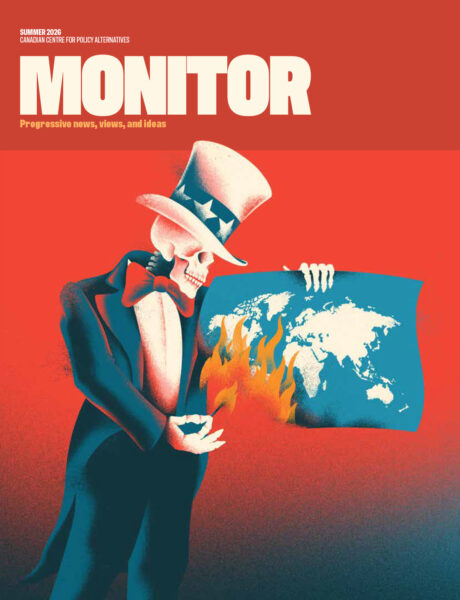
While world leaders are increasingly saying out loud that the postwar liberal world order is dead, the ruling classes in the Global North have an answer for what will come to replace it: fascism. Will they be able to implement their vision?
-
-
-
-
Our Schools/Our Selves
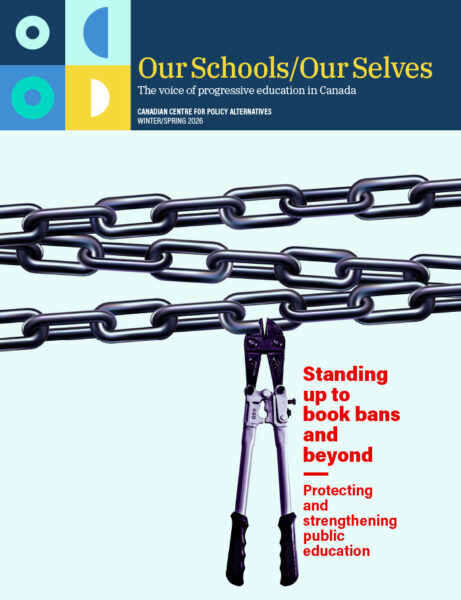
A guide to standing up to book bans and beyond, and how to protect and strengthen public education in Canada
-
-
-
-
- Media Inquiries
- Subscribe
- Legacy Gifts
- About
- Contact
- Donate Now
- Donate Now
Search results for “site/economics of childcare”
-

The budget is a first step to better the lives of women in Canada
Men and women are different. That shouldn’t be news, but today it is. Today, the government released the first federal budget that includes a look at the differences between men and women. Differences like the fact that women are twice as likely to work part-time, do more hours of unpaid…
-

Time to end profit-making in seniors’ care
The coronavirus pandemic has shone a light on serious problems in Canada’s seniors’ care system, as nursing homes quickly became the epicenters of the outbreak. These problems are not only due to the greater vulnerability of seniors to the disease, but also to how care is organized and staffed. In…
-
CCPA Review: Critics of Hydro/Government plans for Bipole III lack credibility
Last month the Winnipeg Free Press published a full page of criticism regarding the decision to run the Bipole III transmission line down the West Side of Lake Winnipeg. The critique consists of two parts, namely, an open letter by 18 retired engineers titled, “Engineers united on east side,” and…
-
Albert Lynn / Flickr” style=”border-radius:0px;–objectFit:cover;–imagePosX:50%;–imagePosY:50%” decoding=”async” srcset=”https://www.policyalternatives.ca/wp-content/uploads/2025/04/policynote-april2017-climate-energy-bc-election-platforms-300×133.jpeg 300w, https://www.policyalternatives.ca/wp-content/uploads/2025/04/policynote-april2017-climate-energy-bc-election-platforms-768×341.jpeg 768w, https://www.policyalternatives.ca/wp-content/uploads/2025/04/policynote-april2017-climate-energy-bc-election-platforms.jpeg 900w” sizes=”(max-width: 300px) 100vw, 300px” />
Climate change and energy issues in the 2017 BC election platforms
From the fracking fields and Site C dam in BC’s northeast to an LNG terminal and Kinder Morgan’s pipeline and tanker expansion in the southwest, energy issues should figure prominently in BC’s 2017 election campaign. Climate change, the result of all that pollution from dirty energy development here and elsewhere,…
-
Fracking ban warranted to protect some of British Columbia’s biggest dams, FOI documents reveal
(Vancouver) Fracking should be immediately banned close to BC Hydro’s two existing Peace River dams as well as the Site C dam construction project until a full public inquiry determines whether a comprehensive ban is warranted, the BC office of the Canadian Centre for Policy Alternatives says. The CCPA issued…
-
-
Tackling poverty in BC: Celebrating how far we’ve come and looking ahead
As I flipped my calendar over to a new year, I thought about the work the current provincial government has done: 2018 was a year where many initiatives were introduced—initiatives that provide steps along the path to an accountable, bold and comprehensive poverty reduction plan. This is something to celebrate.…
-
Ce qu’il reste de l’université publique
Les universités québécoises sont en crise, et ce, depuis longtemps. Jamais, dans notre histoire récente, n’avons-nous pu leur donner une orientation claire. Voulons-nous des universités pour participer à l’éducation de notre peuple? Pour former à l’esprit critique? Pour diplômer massivement des étudiant·e·s? Pour répondre aux besoins du marché du travail?…
-
It’s a housing crisis. Why are cities like Vancouver still banning apartments in most areas?
Vancouver is the epicentre of BC’s housing crisis and shortage. So why does the city still effectively ban new apartment buildings on most of its residential land, reserving it exclusively for low-density housing?
-
UNSPUN: Who’s Doing What About Poverty Reduction
For Manitoban’s concerned about poverty, there will be much to consider when sorting through political party platforms and promises in search of a meaningful poverty reduction plan. Poverty alleviation is a long-term proposition. No provincial political party can end poverty in the short term and certainly not in isolation of…


 Albert Lynn