
- Home
- Topics
- Regions
- Magazines
-
-
-
The Monitor
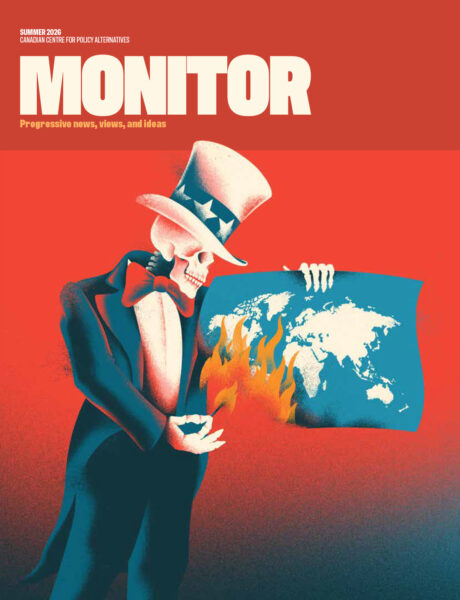
While world leaders are increasingly saying out loud that the postwar liberal world order is dead, the ruling classes in the Global North have an answer for what will come to replace it: fascism. Will they be able to implement their vision?
-
-
-
-
Our Schools/Our Selves
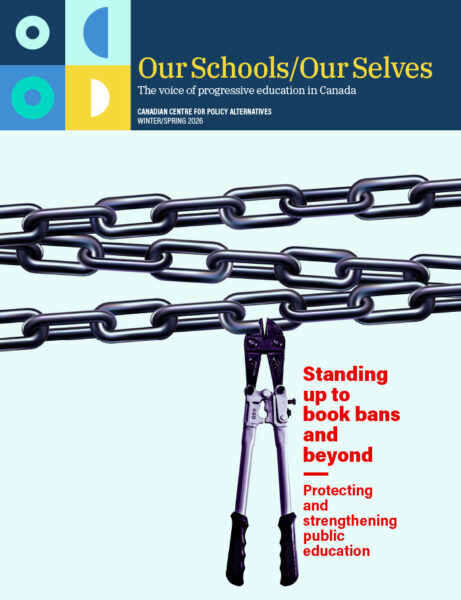
A guide to standing up to book bans and beyond, and how to protect and strengthen public education in Canada
-
-
-
-
- Media Inquiries
- Subscribe
- Legacy Gifts
- About
- Contact
- Donate Now
- Donate Now
Search results for “site/human rights”
-

UNSPUN 2019: Meth, Harm Reduction spark debate this Manitoba Election
Recent attention to issues of addiction in Manitoba has shifted from concern over opioids to methamphetamine use. Questions about government response have remained a hot topic during the run up to the provincial election. As a result harm reduction is starting to become a part of the public discourse. The…
-
Rolling Back Human Rights in BC
An Assessment of Bill 53 – the Government of British Columbia’s Draft Human Rights Legislation Download 156.51 KB23 pages
-

A Critical Assessment of Virtual Mental Health Care for Rural Nova Scotians
Download 1.17 MB8 pages The COVID-19 pandemic has had devastating impacts on mental health and healthcare systems across Nova Scotia and the country. While demand for mental health services escalated in response to the pandemic, many in-person services were shut down (MacIvor 2021; government of Nova Scotia 2022b; Pulok et…
-
Maher Arar
Fragile Rights: The erosion of our human rights and civil liberties in the name of national security On February 12, 2009, Maher Arar spoke at a benefit for the CCPA’s BC Office. Watch his speech, Fragile Rights: The erosion of our human rights and civil liberties in the name of…
-
Secret Surveillance Targets Civil Society
Much of Canada’s spying is done on behalf of corporations I spy, you spy. . . In the world of big mining and big oil companies, it would seem that everybody spies. Canadians were profoundly shocked to learn that the Canadian government had been spying on the Ministry of Mining…
-
No Fairness For Temporary Workers
Employers still allowed to mistreat, underpay foreign “help” The Harper government’s April 26 announcement of yet another change to the deeply flawed Temporary Foreign Worker Program will not benefit any workers or communities. Ministers Diane Finley and Jason Kenney revealed that employer applications for temporary migrant workers will be fast-tracked…
-
The false hopes and empty promises of investment treaty modernization
A Canadian company’s successful challenge to a precautionary mining ban in Colombia shows how little investor–state dispute panels care about the right to regulate.
A Canadian company’s successful challenge to a precautionary mining ban in Colombia shows how little investor–state dispute panels care about the right to regulate.
-
Food for Thought
Hennessy’s Index: A number is never just a number Hennessy’s Index is a monthly listing of numbers, written by the CCPA’s Trish Hennessy, about Canada and its place in the world. For other months, visit: http://policyalternatives.ca/index 1948 The year the UN General Assembly adopted the Universal Declaration of Human Rights,…
-
Our Schools/Our Selves: Winter 2001
Public Education and Moral Monsters: A Conversation with Noam Chomsky It is startling to learn that amidst the volumes of literature which addresses current trends in public education, a serious consideration of the implications of Noam Chomsky’s thought to schooling is almost entirely nonexistent.1 Noam Chomsky is a pioneer in…
-
Trading Sovereignty for Surveillance
Danger rises of state interference with information flow In June 2010, the Harper government released a consultation paper which asked Canadians to comment on the possible impacts of increased foreign direct investment in the Canadian telecommunications sector. Although the paper clearly promoted potential economic benefits, the potential risks (which would…
-
Fast Facts: Time to move forward with respect
First published in the Winnipeg Free Press June 5, 2019 For the last 100 days Camp Morningstar has nurtured a sacred fire on Hollow Water First Nation traditional territory in order to provide balanced information to counter the one-sided proposals and outdated scientific research presented by Canadian Premium Sand (CPS). …
-
Un nouveau rapport met en lumière l’état de l’industrie des combustibles fossiles dans l’Est du Canada – une région négligée dans les débats sur les politiques énergétiques
CLIQUEZ ICI POUR CONSULTER LE RAPPORT [HALIFAX/ Kjipuktuk, 6 juin 2023]: Bien que l’Est du Canada soit fortement investi dans la production pétrolière et gazière, cette région est souvent omise des discussions sur la politique énergétique, qui s’axe surtout sur les provinces de l’Ouest. Un nouveau rapport fait l’état des lieux…