


Share
My grades took a dive in grade six. I was caught up in social dynamics, too preoccupied to notice the slip—but Madame Guth did. I was wandering back to homeroom, riding an adrenaline rush after disrupting my music class until I was sent to the hall, when she pulled me aside. We locked eyes as she said “you can do better,” snapping me out of a stubborn spell of contrarianism.
Public school teachers change the trajectory of children’s lives, yet their value is undermined by profit-fuelled fantasies of big tech. While shielding their own offspring from screens, tech leaders claim AI is the panacea for a broken system. Fear not, their personal AI tutors are coming to save those of us too poor for “intentionally low-tech” Waldorf Schools.
This vision is built on a lie. Tech won’t save our school systems. AI tutors can’t substitute the care of a human teacher. Nevertheless, opting out of a digitalized education is becoming a luxury good.
Just use AI
Despite evidence to the contrary, tech companies pitch their products as indispensable to modern learning. Administrators rely on PowerSchool to house student data despite a massive Canadian breach. Educators use AI to generate lessons, subverting their own professional judgement. Students tethered to Chromebooks are given access to AI chatbots regardless of impacts on critical thinking.
Results in K-12 schools are not promising. Stanford researchers examining AI tutor use in elementary schools found low engagement and no academic benefits. Yet, most companies avoid any accountability for learning outcomes. Their insider knowledge may explain why tech executives shelter their own from the same platforms they peddle to public schools.
What science actually shows is that learning is relational. Students thrive when they have positive, trusting relationships with trained educators. AI companies claim their products are not meant to supplant teachers. In practice, replacement is the economic logic behind their pitch. Why bother funding a professional teaching workforce, if an AI tutor can offer something vaguely resembling an education to those with no better option?
Anthropic frames teachers as “co-architects shaping how AI develops.” The company just announced Claude for K-12 teachers, a sweeping move to weave their tool into educators’ pedagogical practice, scaling rapidly without sound evidence of outcomes.
Microsoft—as the lead partner on the American Federation of Teachers’ (somewhat controversial) National Academy for AI Instruction—positions their commitment to “enhance, not replace, the educator’s role in the classroom.” This conflicts with their founder’s view that it’s only a matter of time and private investment until AI tutors match the efficacy of human teachers.
Sal Khan, founder of Khan Academy, was an early champion of AI as an opportunity to realize personalized tutors and teaching assistants. Yet, after scaling his own AI tutor, Khan walked back his vision, suggesting it serves, at best, as a passable tool for already-motivated students. According to Khan, the educational revolution will not be driven by AI, but “investing in the human systems.”
Oppressive dependence
Amidst the hype, we rarely hear from public educators on the front lines. In spring 2026, the Canadian Teachers’ Federation surveyed over 6,000 K-12 teachers across the country, asking what worried them most about their profession.
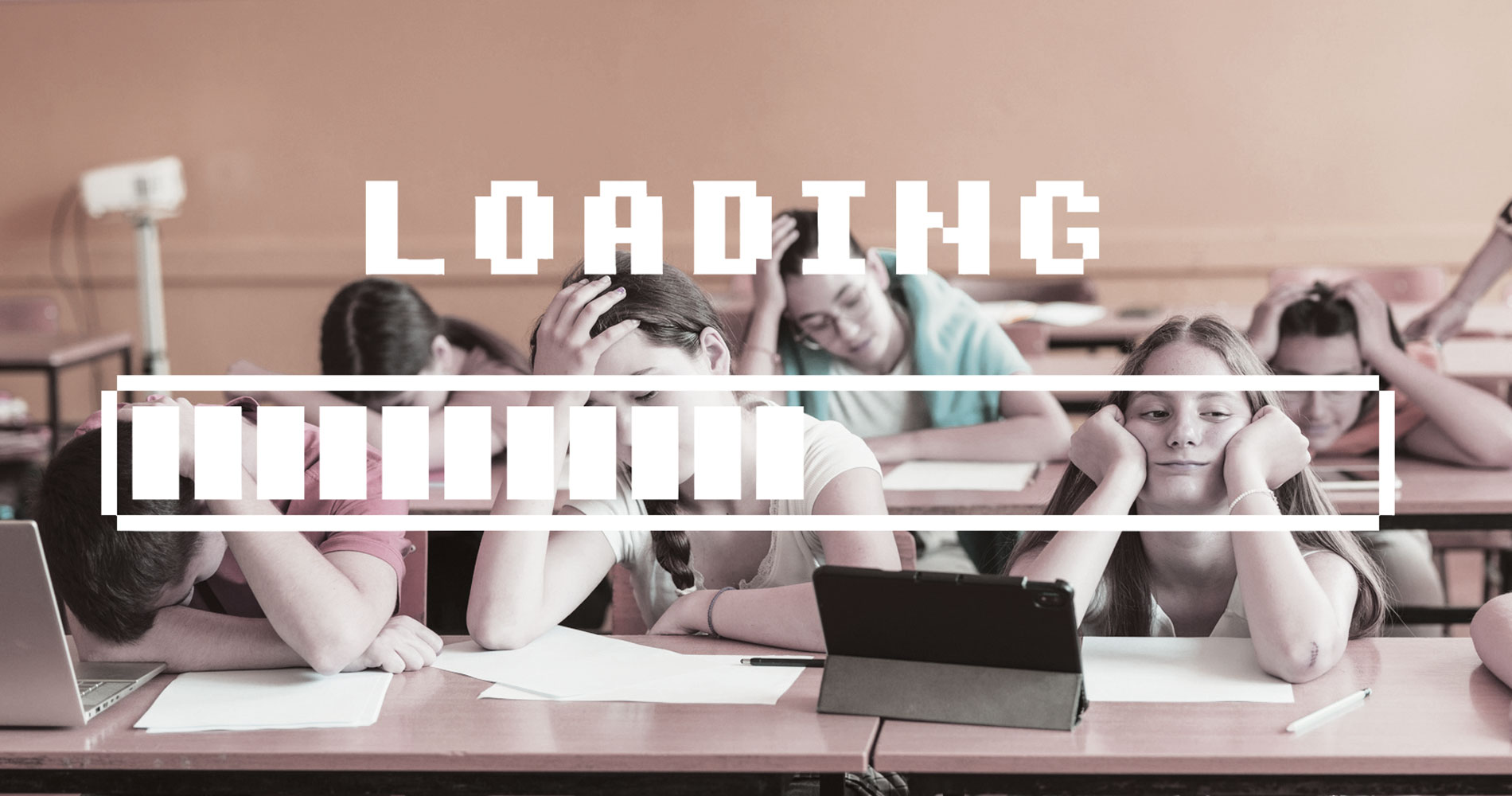
Their responses tell a very different story than big tech’s. Educators described watching AI erode the capacities that schools exist to foster, “taking away the opportunity to think, process, analyze, and create,” warning that “we are training a generation of non-thinkers and everyone seems happy to go over that cliff.”
Others described threats to their profession—“AI is taking our place”—with one educator predicting “AI programs will be implemented to deliver individual lessons on a device and the teachers will become underpaid babysitters.” Many described the burden of adapting their pedagogy to prevent cognitive offloading, while bracing for when “the government will tell society that teachers are not needed and we can do this all with AI.”
These are not testimonials from technophobes, but professionals watching AI systems reshape their jobs.
More families are pushing back on digitalized education. Jonathan Haidt’s The Anxious Generation compelled many parents to demand phone-free schools, a policy adopted across Canada.
Now, Canadian families are raising concerns about widespread AI adoption in schools. But there is a risk that even the tech-free movements in public education become segmented by class. Sociologist Annette Lareau’s Unequal Childhoods documented how middle- and upper-class parents advocate vocally for their children’s education, while working-class families are less likely to do so. Common Sense Media found that children from lower-income households were exposed to double the amount of screen time as those from higher-income families.
Movements alone are not enough. To protect universal, human-centred public education from untested, unregulated tech, we need policy.
Go where the money flows
Two policy levers stand out as opportunities for the public to challenge tech power.
The first is EdTech procurement. Vast sums of public money flow to tech companies, yet processes are fragmented across boards, provinces, and territories. National EdTech procurement standards designed for the AI age would help ensure the platforms that make it into schools are safe—and actually work. Standards could force companies to complete privacy and human rights impact assessments; demonstrate efficacy for teaching and learning; and meet high bars of algorithmic transparency and explainability.
Second, The Safe Social Media Act (Bill C-34) should be amended to address online harms in K-12 public education. If passed, the Digital Safety Commission will develop age-appropriate design standards for regulated services—currently, social media platforms and AI chatbots. The bill should also explicitly regulate AI platforms used in K-12, given the risks to children’s privacy, safety, and cognitive development. This upstream mechanism would hold vendors accountable for designing safer products from the outset, including avoiding engagement-maximizing and anthropomorphic features known to harm young people.
These policies would create a more responsible pipeline that keeps shoddy tech from flooding public schools, while leaving room for the thoughtful integration of tools with genuine benefits. Crucially, educators, students, and families must be given time and space to define the boundaries of technology in public school classrooms. Where technology isn’t a solution, the government must make broader systemic fixes, like smaller class sizes, more teacher prep time, and better mental health supports.
Confronting power
I’ve been researching AI in public education for three years. Early on, I noticed a trend—that concerns about AI in education are often frontloaded with an acknowledgement of potential benefits. This is a symptom of our wider power struggle.
We need to flip this, and demand our government take harms in education seriously before acknowledging alleged opportunities. For this to work, we also need a renewed consensus about the purpose of public education, and what it is we’re defending. bell hooks’ theory that education is the practice of freedom is worth revisiting, one which can liberate us from the notion that data-driven, algorithmically powered public schools are our only option.
About the author
Mia Travers-Hayward
Mia Travers-Hayward is a researcher and policy analyst at the Canadian Teachers' Federation (CTF/FCE).