


Share
Summary
Massive and deep cuts are coming across a wide array of federal services as a result of the Comprehensive Expenditure Review (CER), which pile onto previous federal cuts from the last few years. While the federal government has spun these cuts as “efficiencies” whose effects will be softened with AI, a look at the numbers shows wide and deep cuts to services and offloading of costs to cities.
At Immigration, Refugees, and Citizenship Canada (IRCC), the cuts threaten to hollow out significant parts of Canada’s immigration system. The cuts will target four key areas:
- Refugee health care: The largest cut, at $829 million over four years, is to health care for refugees and asylum seekers. We analyzed these cuts in greater detail in a previous analysis, which is available here.
-
Settlement Program: The IRCC’s Settlement Program ensures that economic immigrants are able to use their skills to improve the Canadian economy—for example, by ensuring that doctors are not driving taxis. It manages credential recognition and language programs, among other things.
- The CER threatens to slash $686 million from the program over four years.
- This category of immigrant is one of the few where the Canadian government is actually planning on increasing, by five per cent by 2027-28.
- Combined with previous cuts, the entire Settlement Program’s budget will fall by a third, which will ensure that these immigrants—who are selected for their skills—are not able to use those skills in a productive way.
-
Asylum Housing: The Interim Housing Assistance Program (IHAP) is an IRCC mechanism that refunds municipal governments that pay for emergency housing for asylum seekers experiencing homelessness. The CER plans to eliminate IHAP funding.
- In 2025-26, the federal government paid 95 per cent of the costs for asylum-seeker housing, while municipalities paid five per cent. The ratio appears that it would have been 50/50 by 2027-28, but now federal funding will fall to zero.
- Half of the entire homeless population in Toronto consists of asylum seekers, as is 42 per cent of Ottawa’s homeless population.
- Four municipalities—Toronto, Peel region (Toronto suburbs), Ottawa, and Montreal—account for nearly all IHAP funding, and those municipalities will now be forced to either pay the costs of refugee housing themselves, or accept a sharp increase in homelessness.
- Basic Service levels: A surge in staffing in 2023 and 2024 managed to get immigration application backlogs under control. However, major staffing cuts starting in early 2025 meant that by December 2025 no application stream was meeting its service goals. Decisions on applications are now languishing and more often ending up in federal court.
The areas outlined above comprise the vast majority of cuts to IRCC. All of them will coincide with a major reduction in services and service quality. In the case of housing, they will transfer massive costs to already-strained municipal governments. It’s a humanitarian crisis in the making.
Introduction
The 2025 federal budget introduced major cuts to almost all federal departments’ funding. Affected departments were expected to cut $56.7 billion over the next four years largely as part of the Comprehensive Expenditure Review (CER), a truly staggering cut. These cuts, though, should really be thought of as transfers, not cuts on their own. In the same budget, the Department of National Defence saw an increase in its funding of an almost identical $58.8 billion also over the next four years.
With any cut, particularly with ones this large, governments will try to appear as if they are minimizing the service impacts through the use of neutral language. They’ll avoid details on the specifics of what exactly is going to be lost and use words like “efficiency” and “back-office”. With this round of cuts, they have also been suggesting that Artificial Intelligence (AI) can be a way of maintaining service levels.
In the case of the Department of Immigration Refugees and Citizenship Canada (IRCC), the CER cuts from November 2025 will actually be cut on top of previous cuts that started in early 2025.
Beyond the spin of “efficiency” and AI, the government is cutting specific programs and services inside the IRCC. The analysis below goes into detail of where, exactly, those cuts will take place—and how much is on the chopping block.
Naming the services to be cut
To date, the actual dollar amounts to be cut as well as the staff to be lost have been reasonably transparent. What the federal government has not yet done is to actually name the services that that money and staff represent—which specific programs and services will be cut?
Through different sources examined below, we’ve been able to uncover all of these details at IRCC.

Worth $829 million over four years, the biggest cut is to asylum and refugee preventive health care. These cuts are simply making asylum seekers and refugees pay 30 per cent of preventive services like dental care and co-payments for prescription drugs.
The second largest cut is to the Settlement Program worth $686 million over four years. This cut is to services that help economic migrants rapidly integrate into Canada’s society and economy. As we’ll see below, this is only about half the value of the cut in this area.
The third largest cut is a downloading of housing costs to four municipalities. IRCC is booking $256 million over four years in “savings” here, but the net result as we’ll see is those cities spending between $150 million to $252 million out of their own pockets.
The fourth largest cut is worth $138 million over four years and involves reductions in services due to Canada accepting fewer migrants. But, as we’ll see, previous cuts have already substantially worsened application backlogs at the department. Service levels are already well below the department’s own standards and further cuts will deteriorate them further, often pushing applications into federal court.
The remaining seven per cent of the cuts involve shutting down smaller programs (“sunsetting” them) and having Employment and Social Development Canada (ESDC) do some of IRCC’s workplace inspections.
What’s clear from naming the cuts is that they aren’t about internal efficiencies, they are just old fashioned service cuts to health, integration, and anti-homelessness programs for new Canadians, transferring costs to four cities and major service degradation.
Let’s go through the details:
Asylum seekers and refugee health care cuts
I have examined the cuts to refugee health care in more detail in a previous analysis. By 2028-29, these cuts will amount to almost a quarter billion a year from asylum seekers and refugees who aren’t yet eligible for provincial health care systems. Starting May 1, 2025, they’ll be forced to pay 30 per cent of dental and other preventive health services along with a new co-pay for prescription drugs.
While we’ve come a long way in Canada with the new Canada Dental Care Plan, we’re stripping asylum seekers and refugees of this coverage.
Asylum seekers and refugees fleeing violence at home don’t have an extra quarter billion a year to spend so instead they’ll likely just skip dental care and prescription drugs, end up in emergency rooms for which IRCC will actually pay 100 per cent of the coverage.
This cut alone will make up 40 per cent of the total “cost savings” of the IRCC’s cuts.
The Settlement Program
Canada accepts “economic migrants” every year—that is, people who want to come to Canada who aren’t fleeing persecution but instead have skills our economy needs. We can determine exactly how many economic migrants we want to bring in annually.
As part of bringing in these new Canadians we want to ensure they’re rapidly integrated into Canadian life getting credentials recognized, improving language skills and rapidly gaining high quality employment. By doing this we can quickly take advantage of these new Canadians’ skills and see economic growth as a result.
We don’t want a newly immigrated family physician languishing as a cab driver. Instead we need to have credentials rapidly recognized, language skills improved and a new practice rapidly set up, not just for the new Canadian, but for the benefit of all Canadians who badly need a family doctor.
The “Settlement Program” is the main way that IRCC attempts to accomplish economic integration. Unfortunately, IRCC is planning major cuts to it.
The latest 2026-28 Immigration Levels plan significantly cuts student and temporary workers. However, it actually plans to increase the acceptance of economic migrants by five per cent between 2025-26 and 2027-28, rising from 232,150 a year to 244,700. Unfortunately, while taking in more people on an annual basis, IRCC now plans to cut the budget for integrating them by $338 million a year or 30 per cent over that same period (falling from $1.125 billion in 2025-26 to $787 million in 2028-29).

Roughly half of this cut in support is from CER cuts accounted for in Figure 1. The CER cuts are actually on top of previous rounds of cuts resulting in this massive decline in support for integration of 30 per cent or about a third of a billion dollars a year.
These cuts will only happen to programs outside of Quebec. The funding for the Settlement Program within Quebec is protected due to the Quebec-Canada Accord on immigration. Instead of the federal government managing the Settlement Program and resettlement assistance in Quebec, the province manages those programs. One of the provisions of the Accord is that the amount transferred can never go down, thus insulating Quebec from the CER cuts.
The Resettlement Assistance Program (RAP) providing similar services for government assisted refugees and the francophone support programs are also protected. This was a choice of the department to maintain these programs while cutting other programs more to cover them.
IRCC has suggested that cutting off economic migrants from integration supports after five years can achieve most of these cut goals. But this isn’t nearly severe enough. IRCC will have to squeeze settlement agencies, likely using a “cost per client” approach which would penalize agencies paying fair wages. Settlement programs in larger centres like the GTA and Vancouver will likely see disproportionate cuts.
There are employment implications of the Settlement Plan cuts specifically for racialized women. They’ll remain unemployed for longer without rapid integration. The focus on saving jobs and ensuring employment for vulnerable populations is lost in these cuts conversations.
Settlement agencies, separate from the federal government, are generally the ones delivering the integration services. As such, they may well wear the blame for cuts in eligibility and programs instead of the federal government who funds the system.
It is inevitable that these deep cuts will slow the integration of new Canadians into our economy and society. We accepted these new Canadians due to their skills, and we’ll not capitalize on them through rapid integration.
This round of Settlement program cuts amounts to 33 per cent of the CER cuts at IRCC.
Asylum seekers homelessness
A shocking 50 per cent of the homeless population in the City of Toronto is actually asylum claimants, the proportion is 42 per cent in the City of Ottawa. The lack of affordable housing places a heavy burden on municipal governments who are the first payers when it comes to housing the homeless. In fits and starts, the federal government has attempted to offset these costs primarily through the Interim Housing Assistance Program (IHAP).
The IHAP is an ad hoc program that isn’t consistently funded as shown in Figure 3. The cities incur the expense of housing asylum seekers and then send the receipts to the federal government which may or may not cover them. It was unfunded for two years, 2021-22 and 2022-23. The only reason there was spending in 2022-23 was a reprofiled of funds from 2020-21.
Even before the CER cuts were announced, the IHAP was scheduled for a massive cut from $400 million this year (2025-26) to $267 million in 2026-27. The CER cuts revealed that the government had penciled in $81 million a year afterwards, although this had yet to appear in any budget documents. That $81 million a year that was nominally there in 2027-28 and afterwards, has now been cut making up the “savings” of IHAP.
But the cities are going to be out much more than that.
In 2025-26 the cost sharing with the cities for housing asylum seekers was 95 per cent federal and five per cent municipal. Even before the CER, this was planned to fall to 75 per cent federal / 25 per cent municipal in 2026-27 but plans for future years were in limbo. It now appears that IRCC wanted to move to 50 per cent federal / 50 per cent municipal, before the CER cuts that is. However with the CER cuts, the feds will stick cities with the full cost. In 2026-27, the federal government is arbitrarily deciding that it will cover $15 million fewer receipts that it receives from the cities, dropping its spending in that year from the planned $267 million to $252 million.

Regardless of how IRCC accounts for these massive cuts to the asylum housing program, the costs of keeping these folks off the street won’t go away—it will just become a municipal problem.
IRCC has argued that reduced asylum claims means housing cost will decrease, which may be true, but they won’t be zero. There has been a marked decline in claimants in 2025 compared to 2024. IRCC plans to have claims plummet even further in 2026 and beyond.
However, unlike economic migration, IRCC can’t cap asylum claims at a specific number. As a signatory to the 1951 Refugee Convention and its 1967 Protocol, Canada can’t send asylum seekers back to a country if they face persecution, torture or death. Furthermore, Canada’s Supreme Court has ruled that anyone present in the country is entitled to a fair hearing of their claim. While IRCC might want the asylum claims to be cut in half from 113,000 in 2025 to 56,200 in 2026, this may be more dependent on wars and dictatorships elsewhere than IRCC’s immigration level plans.

Even if IRCC’s projections of asylum claims come to pass at roughly 55,000 a year, this still implies major costs to cities that the feds will no longer help with. If we calculate the average IHAP cost per asylum claimant between 2023-24 and 2025-26 we can estimate that it will cost between $150 and $160 million a year depending on the year at the much lower asylum claim count. Prior to the CER cuts the feds had planned to contribute $81 million towards that cost, from 2027-28 and beyond. But it now appears that the feds will dump the entire cost onto the cities as they reimburse nothing starting in April 2027. No matter how IRCC accounts for this as “savings” it is really just downloading costs onto four cities.
And that’s if the projected asylum claims are accurate. The big risk for the cities is if these asylum claim estimates are overly optimistic. What if claims fell from 113,000 to only 90,000, like we saw in 2022. This would still be a drop but would be far above the roughly 55,000 projected by IRCC. If there were 90,000 claimants, it would cost the cities $250 million a year to house them. Not only are the housing costs transferred to the cities, but the CER cuts ensure that all risks of higher asylum claims are also passed off to the cities.
There are really only four municipalities that are footing the bill for asylum seeker’s housing and who bear the risk if claim numbers come in high: Toronto, Montreal, the Peel Region and Ottawa.
Toronto received 60 per cent of the IHAP funds over the past three years given how large the homeless asylum seeker population is there. The cost to the city alone past March 2027 for asylum housing could be $91 million to $151 million if that proportion of funds remains and depending if we see 55,000 asylum claims or 90,000 in future years.
The Region of Peel, a municipality in the suburbs of Toronto, has received 10 per cent of the funds covering the construction of its new reception centre, but now the Region will be expected to operate it from its own funds. It could be on the hook for $15 to $27 million a year after March 2027 if that proportion of funds remains consistent.
Cities in Quebec don’t receive funds directly from the federal government, instead it is routed through the province, but 14 per cent of IHAP funds have gone to Quebec, mostly to Montreal’s municipal government. That city could foot an annual bill of between $21 and $35 million.
Finally the City of Ottawa has received 10 per cent of the IHAP funds, it initially cancelled a reception centre of its own, but now seems to be moving forward on a new site. Once ready, it seems the city will now have to pay for its operation completely out of their own funds starting in 2027-28.* The cost housing asylum seekers at this new site and elsewhere could amount to $15 to $25 million a year.
These four cities have received 94 per cent of IHAP funding over the past three years and no other individual municipality has received more than two per cent of IHAP funds between 2022-23 and 2024-25.

The CER cuts will almost certainly put the nail in the coffin of this program and download those costs to four cities to house homeless asylum seekers in the future. The nascent plans to renew this program in the future with a 50/50 split are almost certainly dead now.
Staffing cuts
As noted above, the CER staffing cuts at IRCC thus far are fairly small—eliminating the positions of 328 workers. However, the CER staffing cuts are being piled upon much larger staff cuts that started earlier in 2025.
In January 2025, the IRCC sent an internal email noting it was planning on cutting 3,300 jobs over the next three years, with 20 per cent being indeterminate and 80 per cent being term or casual employees. The departmental report published in June 2025 notes a reduction of full time equivalents (FTEs) over three years from 13,319 to 11,257 or 2,026.
Given the timing, much of the term and casual employees would have been laid off by March 31, 2025, when the IRCC job snapshot was taken. And indeed we find that there were 1,826 fewer term and casual employees in 2025 than 2024 in the job snapshot data. There would have been further job losses after March 31 2025, for indeterminate employees whose layoffs take longer. The extent of those further job cuts have yet to be included in departmental counts and would be over and above the CER and other cuts. Therefore the staffing cuts in this analysis are going to underestimate the final count.
Broadly the federal government plans to cut its workforce by 10 per cent between 2024 and 2028-29. However, the staff cut suffered at IRCC will be at least 17 per cent, almost twice as much as the general cut. And when the final count is made, it will likely be several percentage points higher, likely closer to 20 per cent.
If we take the full picture from 2024 through the full CER implementation, the IRCC head count falls from 13,092 people in 2024 to a projected 10,820 following the CER staffing cuts or a 17 per cent reduction.
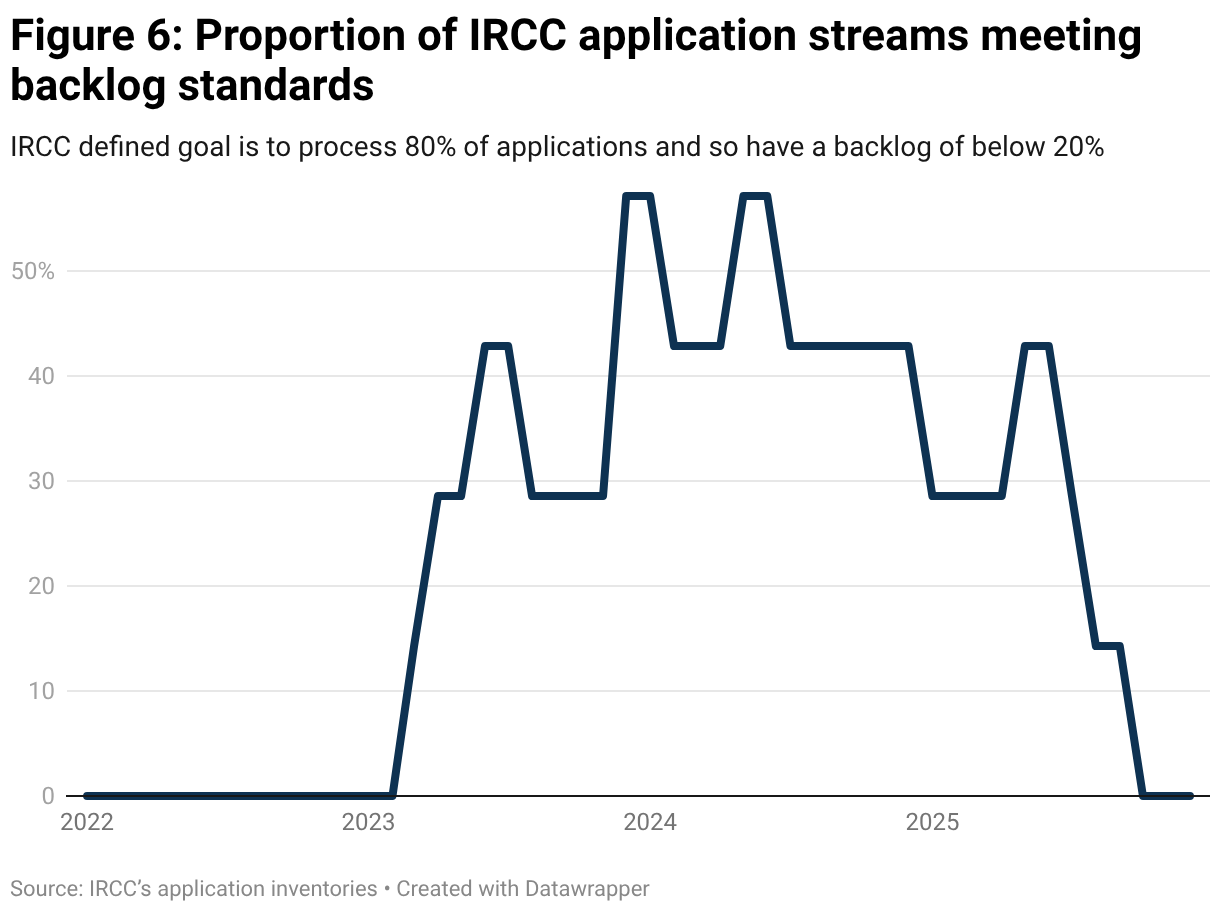
The term and casual employees who were already cut were reducing critical backlogs. Figure 6 shows the proportion of application types where 80 per cent of applications were processed. With the extra help in 2024, several application types actually managed to successfully process at least 80 per cent of applications including: the federal high-skilled (Express entry) application; spouses, partners and children (outside Quebec) applications and citizenship grant applications. The surge of workers in 2024 meant that roughly half of the application types were keeping backlogs at bay.
However, once the mass layoffs started in 2025, the department was no longer able to keep backlogs at bay and service quality plummeted.
In December 2024, three application types had backlogs below 20 per cent. By December 2025, none of the application types were hitting their goals. These backlogs are already leading to more federal court applications either for judicial review or mandamus (forcing a decision because of the backlog) pushing the backlogs at IRCC into an increased case load in federal courts.
While the department is clearly saving money by laying off 17 per cent of its workers, the result is just lower service levels and major backlogs in applications.
Summary
We now have the details on the CER cuts at IRCC. These are anything but back office efficiencies relying on AI, instead they are old-fashioned service cuts and downloading costs to big cities.

Two fifths of the CER cuts are health care cuts for asylum seekers. A third of the cuts are to the Settlement Program that helps new Canadians integrate more rapidly, gain employment and contribute to Canada’s economy. The staffing cuts from the CER come on top of much larger cuts that happened in 2025 that allowed backlogs to balloon again.
A further 12 per cent of the cuts is just cancelling any support for the cities who house otherwise homeless asylum seekers. No matter how IRCC accounts for it, these four cities will likely face $150 million to $250 million annually to house asylum seekers.
And despite all the federal talk about using AI to streamline services, AI can’t house the homeless. These cuts are almost entirely straightforward service cuts.
* 2026-03-13 Clarification on the date of the end of IHAP funding for the City of Ottawa of 2027-28, as highlighted earlier in the analysis. Clarification on the nature of the Ottawa reception centre being a building purchase, not new construction as included in the previous hyperlink.
About the author

David Macdonald
David joined the CCPA as its Senior Ottawa Economist in 2011, although he has been a long time contributor as a research associate. Since 2008, he has coordinated the Alternative Federal Budget, which takes a fresh look at the federal budget from a progressive perspective. David has also written on a variety of topics, from child care to income inequality to federal fiscal policy. He is a regular media commentator on national policy issues, often speaking to the CBC, Globe and Mail, Toronto Star and Canadian Press. David received his BA from the University of Windsor and his MA from the University of Guelph, both in Philosophy. Follow David on Bluesky at @davidmaccdn.bsky.social

