



Share
In summer 2025, Women and Gender Equality Canada (WAGE) was facing an 80 per cent drop in its funding by 2027-28 as several funding programs were set to expire. WAGE is one of several departments that relies on time-limited funding vehicles to finance departmental programming. In the context of the federal expenditure review, these programs are easy pickings. Programs simply expire, the funding, supports and program staff along with them. Spending cuts by stealth.
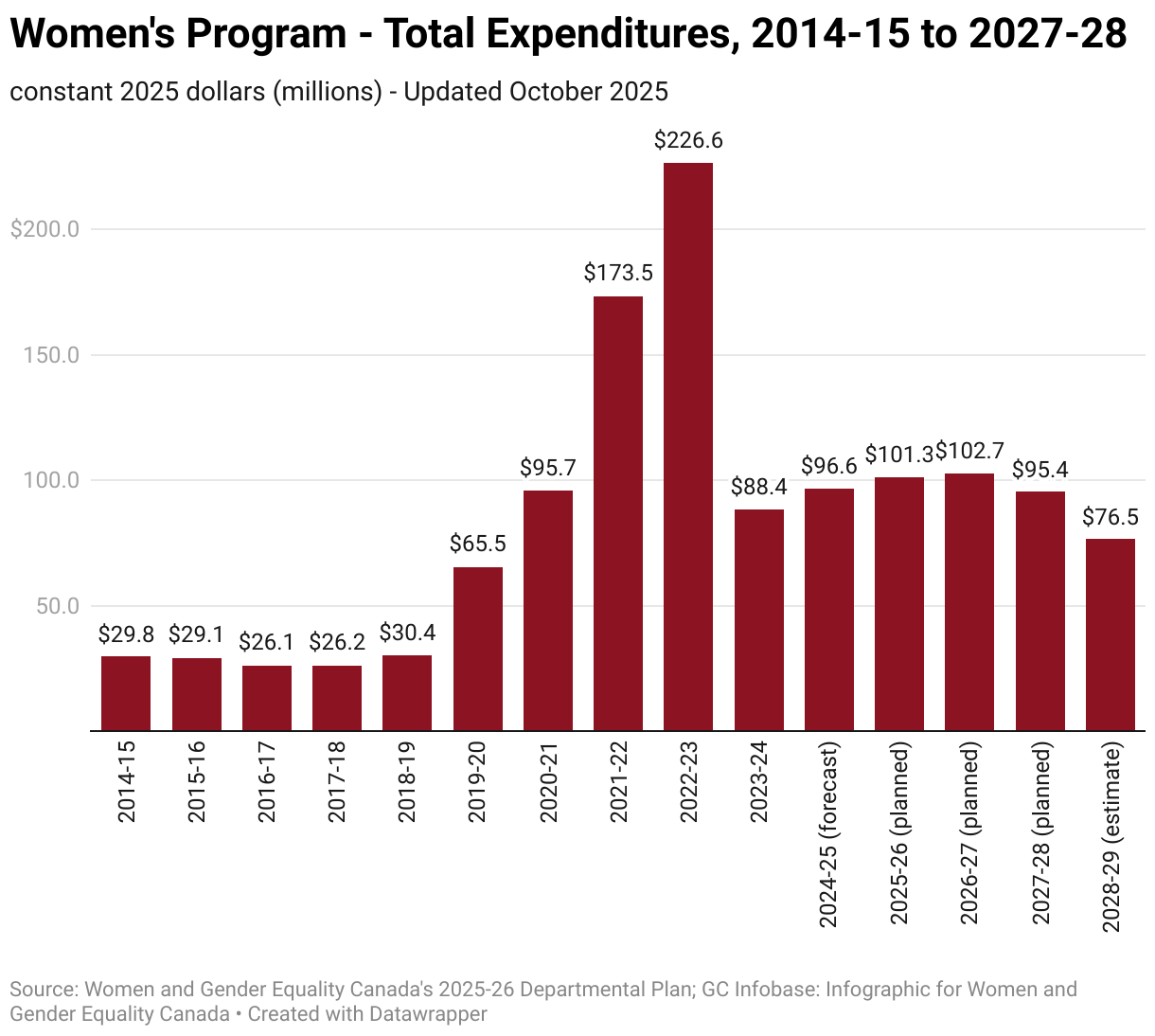
If these cuts had been implemented, the women’s movement would have been thrown back to the wrenching Harper years when then minister for Status of Women Canada, Bev Oda, famously excised the word “equality” from the agency’s mandate, arguing it wasn’t needed any more. Indeed, funding for the Women’s Program was set to fall to $18.9 million in 2027-28, 36.5 per cent lower than it was in 2014-15.
Alive to the threat, gender equality organizations rallied across the country to save critical community services and supports along with the national infrastructure that has been key to advancing gender equality in Canada over the past four decades, calling out a government that used to brand itself “feminist.”
On October 29, 2025, the Carney government blinked. New funds were announced for the three grants and contributions programs hosted by WAGE: the Women’s Program (including the Women’s Economic and Leadership Opportunities Fund); the Sex, Sexual Orientation, Gender Identity and Expression Program (including the 2SLGBTQI+ Community Capacity Fund); and the Gender-based Violence Program—a total of $660.5 million to be spent over five years, with $132.1 million ongoing.
This was an extraordinary win for the women’s movement and a testament, as a coalition of gender equality organizations wrote in a public statement on October 31st, “to generations of people who have fought to build a country where care and equality are cornerstones of public life.”
With the publication of the 2026-27 Departmental Plan in March 2026, we now have a better understanding about how these funds are being allocated, including the monies being set aside for grants and contributions in support of organizations working to advance gender equality. In late May, Minister for WAGE, Rechie Valdez, announced a one-year project funding extension for almost 400 organizations. The next section unpacks the funding announcements and sets the figures in historical context.
At the same time, while the government has renewed investments in groups working to advance gender equality, it’s hard not to question the government’s commitment to gender equality as dozens of programs such as pharmacare, long term care, and child care are on the chopping block, set to quietly expire in the next couple of years. There was no word on the fate of these programs in the Spring Economic Update (SEU) released on April 28th—or on the National Action Plan to End Gender-Based Violence and the Federal 2SLGBTQI Action Plan. Meanwhile women and gender diverse people continue to wait.
Unpacking the October 2025 funding announcement
Historically, the Women’s Program has been the largest funding program at WAGE. Last year, in early 2025, grants and contributions awarded under this program were set to decline by over 90 per cent from a high of $226.3 million in 2022-23 (in constant 2026 dollars) to $18.9 million by 2027-28. With the October 2025 announcement, $76.5 million of new annual funding will now be available over the next five years, to be continued thereafter, for “time-limited” projects “that address systemic barriers to women’s equality in Canadian society.”
What will this mean for gender equality organizations? Last year, in 2025-26, just over $100 million was budgeted for grants and contributions under the Women’s Program, an increase over 2024-25 but much reduced from the post-pandemic high ($226.3 million) in 2022-23 when the government flowed critical emergency support to gender-based violence organizations and others. This year (2026-27), $97.3 million is being allocated for grants and contributions, falling to $90 million for 2027-28 and 2028-29. At $90 million, funding for external organizations will be roughly one-third higher (37.3 per cent) than it was before the pandemic in 2019-20—and about three times higher than the funding provided in 2014-15 (here including funds for GBV programs).
It is important to note, however, that overall funding for the Women’s Program including research, expertise and outreach, and grants and contributions is being reduced at the same time. The total program budget is forecast to fall by $42.3 million between 2026-27 and 2028-29, from $149.1 million to $106.8 million—a decline of 28.4 per cent. At that point, grants and contributions will account for almost all of the program’s funds, the government’s own capacity to invest in research, new data, community engagement, and so forth severely reduced.
Under the 2025-26 Departmental Plan, grants and contributions under the Equality for Sex, Sexual Orientation, Gender Identity and Expression Program were set to fall effectively to zero by 2027-28 with the expiry of provincial and territorial agreements under the National Action Plan to End Gender-based Violence ($539.3 million over five years) and the Federal 2SLGBTQI+ Action Plan ($100 million over five years) in March 2027. (The Menstrual Equity Fund pilot was also delivered through the SSOGIE program. It was a $60 million two-year initiative that ran from 2023 to 2025, extended until March 2026.)
In October’s announcement, $54.6 million over five years, with $10.9 million ongoing, was allocated to renew funding for 2SLGBTQI+ programming, including the 2SLGBTQI+ Community Capacity Fund, which aims to build the capacity of 2SLGBTQI+ community organizations and networks to protect rights and advance equality across Canada and support for security at Pride festivals.
With the increase in funding, there will be a boost in grants and transfers from $207.7 million in 2025-26 to $219.0 million in 2026-27. Funds are then expected to drop sharply with the expiry of the NAP and Federal Action Plan funds to $26.9 million in 2027-28 and 2028-29—instead of the $1.9 million allocated in last year’s departmental plan. This new level of funding is an increase over 2019-20 levels ($2.1 million in 2026 dollars) but still a very modest sum given the scale of need and urgency of the challenges confronting 2SLGBTQI+ communities.

Additional funding was also made available to the Gender-Based Violence Program. Budget 2025 included $223.4 million over five years, with $44.7 million ongoing, “to strengthen federal action in response to gender-based violence (GBV).”
Grants and contributions provided through the program were expected to fall to $10.7 million in 2027-28. With the new funding, available support for external organizations is now forecast to be $29.2 million per year for the next three years. This is a decline of roughly $10 million from 2023-24 but higher than before the pandemic when funding under the GBV Program was just $12 million (in constant 2026 dollars).
Please note that, over recent years, gender-based violence groups received significant funding support through the Women’s Program and through the National Action Plan to End Gender-based Violence via provincial and territorial governments. And the bulk of funding dedicated to implementing the Calls for Justice of the National Inquiry into Murdered and Missing Indigenous Women and Girls is delivered by Indigenous Services Canada. Many of these programs are set to expire too.
At this juncture, gender-based violence groups are facing a huge funding cliff in the face of persistently high rates of violence. While Budget 2025 stated the government’s intent “to continue the important ongoing work with the provinces and territories to end gender-based violence—including through the current bilateral agreements that enable these jurisdictions to fund essential prevention services and direct support for survivors,” no details were provided about what form future support might take. The 2026-27 Departmental Plan is similarly vague about what support financial or otherwise might be on offer and how it will deliver on its commitments after March 2027.
There’s a growing national crisis that demands urgent, co-ordinated action from all levels of government. Women’s Shelters Canada is now calling for $360 million over three years to stabilize the violence against women shelter and transition-house sector and address fundamental funding gaps in services, as well as $200 million annually to support the continued efforts of provinces and territories through a renewed National Action Plan.
WAGE’s total budget set to decline
Last year’s 2025-26 Departmental Plan presented a bare-bones budget, setting a target of $76.3 million in 2027-28 for meeting its mandated obligations, including a radically-reduced combined pot of $31.5 million for grants and transfers under WAGE’s three grants and contributions programs. According to this year’s Departmental Plan, $146.1 million has now been allocated for grants and contributions in 2027-28, significantly higher than the $31.5 million proposed in the 2025-26 departmental plan and almost twice the level it was in 2019-20 before the pandemic.
But WAGE’s overall budget is set to decline once funding for the NAP, the Federal 2SLGBTQI Action Plan and other time-limited programs expire—and planned cuts to operations totalling $24 million over the next three years are implemented, part of the austerity program announced by the federal government in July 2025. In total, WAGE’s budget will fall by half from $414.6 million in 2026-27 to $206.2 million in 2027-28, and then $205.7 million in 2028-29.
Staffing levels are projected to decline as well from a high of 475 posted in 2023-24 to 359 by 2027-28. (In the 2025-26 Departmental Plan, staffing levels were forecast to fall even more steeply to 254 by 2027-28.) These figures suggest that while increased financial support for national and community organizations is now available, the overall size and capacity of the Department is still on a downward track.


One step forward, two steps back
There is much on the table this coming year—including the renewal of the Health Accords and fate of the Canada-wide Early Learning and Child Care (CWELCC) program and the national pharmacare plan The new WAGE funding to stabilize organizations working to advance gender equality has been positive, but there are real concerns about the government’s commitment to gender equality in light of the massive cuts to federal programming across the board, hitting sectors like immigrant settlement and Indigenous services particularly hard.
The Carney government continues to make nods to Trudeau-era programs, noting child care’s positive impact on women’s labour force participation in the SEU for instance, but its embrace of austerity—quietly targeting time-limited programs for cuts as it re-directs critical programming dollars to the military and physical infrastructure—speaks volumes about its actual commitment to gender equality and the scale of the challenge ahead for feminists to protect and build upon hard-won gains.
Many will remark on the notable shift in tone and priorities between the Trudeau and Carney governments, but there are important similarities as well. The Liberal government of 2015 to 2025 acknowledged and celebrated the contributions of women and gender diverse people but all too often the time-limited policies on offer failed to deliver a truly transformational approach to gender-based violence, the division of caring labour or access to economic security—especially for the most marginalized.
This is why we are at a crisis moment with the national child care program because the government failed to plan and resource the expansion of quality services while lowering fees—opening the door to criticism and attack from right-wing politicians and for-profit business interests seeking to expand their market share.
Neither the Trudeau or Carney governments have treated gender equality organizations and service providers as the essential services that they are with long-term resourcing tailored to demonstrated need. The new funding will certainly make a difference, but their efforts can only be truly successful within the context of high-quality public services, an inclusive labour market, strong social safety net, and a vibrant democracy.
Gender equality organizations, as Lindsay Tedds writes, will be expected to thank the government for walking back the funding cuts to civil society organizations. Likewise, 2SLGBTQI+ community centres will be expected to thank Ottawa for being allowed to apply to the $75 million Canada Community Security Program and disability groups for streamlining the Disability Tax Credit application process for 43 specified medical conditions, the key to accessing the new Canada Disability Benefit.
But that’s the problem. Because “the gratitude performance” gets read as file closed, the structural reforms that didn’t get done—like pharmacare—get pushed out of public view. “And because the alternative — saying “this isn’t enough” — gets you characterized as never satisfied, as moving the goalposts, as the constituency that can’t be pleased,” driving the issue of access to reproductive health care in this example even further from sight. This funding dance is particularly toxic for women, constrained by gender stereotypes, expected to go along to get along.
Gender equality organizations understand these power dynamics. They also understand the stakes in rolling back welfare state and institutional architecture sustaining the pursuit of gender equality in Canada for the lives of women and gender diverse people in Canada. Which is why tomorrow they’ll continue to push for a society where all can thrive.


About the author

Katherine Scott
Katherine serves as the director for the CCPA’s gender equality and public policy work. She has worked in the community sector as a researcher, writer and advocate over the past 20 years, writing on a range of issues from social policy to inequality to funding for nonprofits.