Share
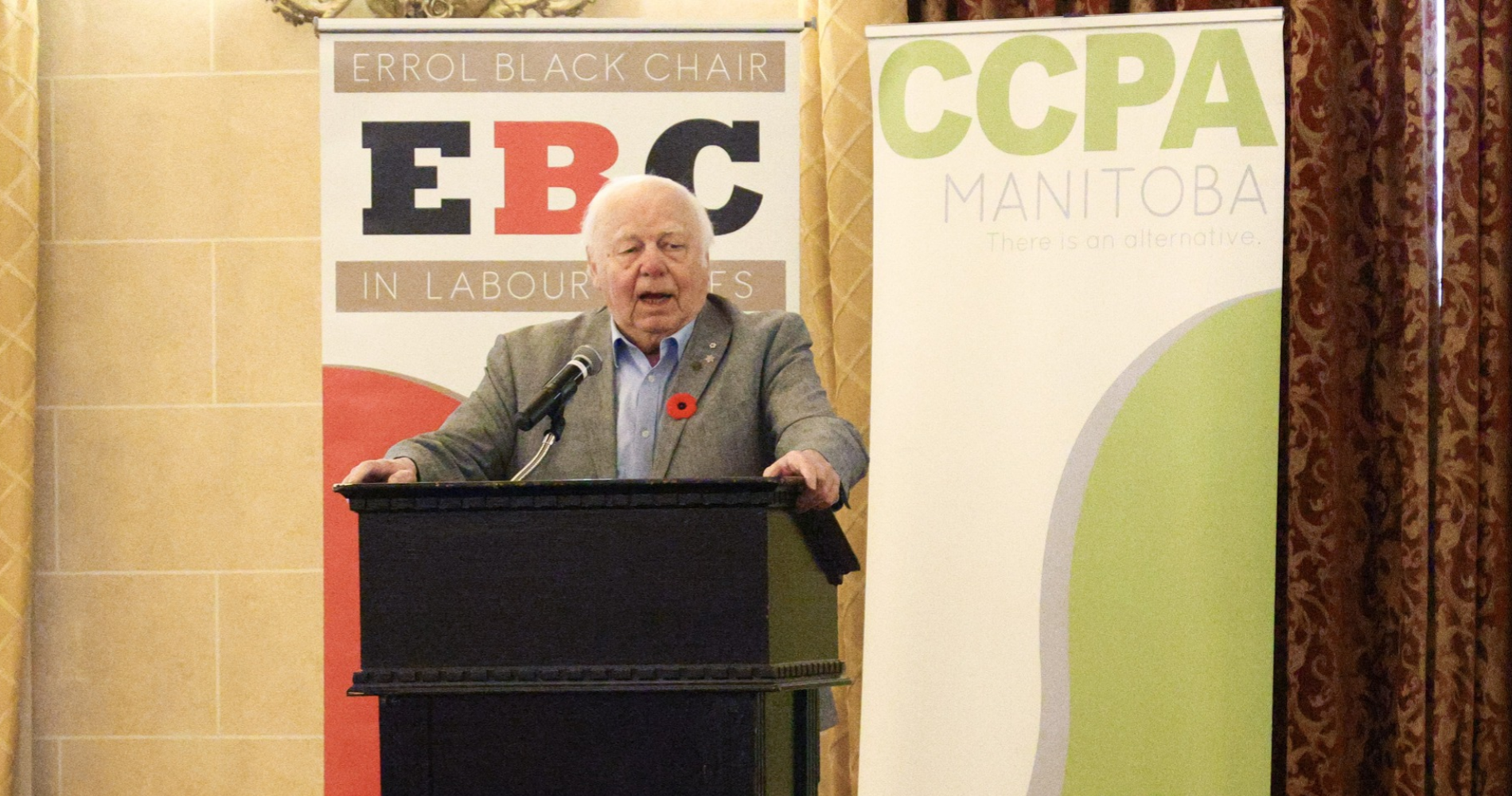
15th Annual Errol Black Chair in Labour Issues Fundraising Brunch – November 8, 2026
Today, we are proud to honour the Right Honourable Ed Schreyer, Manitoba’s 16th Premier, a world-class leader whose vision, courage and commitment to public service and greater equality shape the province we know today.
It is particularly fitting to recognize the Right Honourable Ed Schreyer at the Errol Black Chair in Labour Issues Fundraising Brunch. Errol Black believed in the power of research, ideas and collective action to build a more just and equitable society. He understood that economic policy is never simply about numbers. It is about people: their opportunities, their working conditions, their families and their ability to live with dignity.
Ed Schreyer was born in 1935 in Beausejour, one of six children. He grew up on the family farm after the Great Depression. He attended the tiny Cromwell Public School and Beausejour Collegiate, then United College (now the University of Winnipeg) and the University of Manitoba. In addition to his BA, he later earned degrees in education, a Master of Arts in international relations, and a second MA in economics.
At 18, he joined the Co-operative Commonwealth Federation (CCF), precursor to the New Democratic Party (NDP). In 1957, he worked as campaign manager for Jake Schulz, who was elected a CCF member of Parliament in that year’s federal election. Three years later, Schreyer married Schulz’s daughter Lily. Together they would have four children. Lily, of course, has been an essential part of Ed Schreyer’s life and success.
In 1958, at age 22, he became the youngest member of the Manitoba legislature, representing the rural riding of Brokenhead, which included his family’s home district. Schreyer served for seven years as an opposition MLA, first as a CCF and then an NDP member.
At 29, he entered the federal arena, becoming the NDP member of Parliament for the riding of Springfield in the 1965 federal election. He was re-elected in 1968, this time as the member for Selkirk. In 1969, midway through his second term, Schreyer was persuaded to return to Manitoba to run for the leadership of the provincial NDP. He won the contest and was immediately thrust into a provincial election campaign, winning a minority government. At 33, he became Manitoba’s youngest Premier.
That government represented a new chapter in Manitoba’s history. It was the province’s first social democratic government, led by a group who believed government could—and should—play an active role in improving society.
He and his government led with social democratic principles. What are these? According to Stanley Knowles:
“Democratic socialism is not a condition, but a process. Indeed, it is an endless process, a social direction rather than a static or final goal. The objectives of that process are greater equality, social justice, economic as well as political freedom, and dignity for all. It is the objectives that count, and these objectives determine the extent to which democratic socialists advocate public ownership or other ways of enlarging the public sector of our economy.”
The Schreyer government set out to make change happen, which was not easy as a social democratic party, particularly in a small province like Manitoba, surrounded by other economic and political institutions controlled by people with a very different set of values. Or, as T.C. Douglas referred to Saskatchewan, “a beachhead of socialism on a continent of capitalism.”
Under Premier Schreyer, Manitoba expanded the public sector’s role in shaping the economy and delivering essential services. His government introduced public automobile insurance through Manitoba Public Insurance, eliminated provincial Medicare premiums, established Canada’s first comprehensive province-wide home care program, expanded public housing, and introduced pharmacare.
These were transformative decisions. They reflected a fundamental belief that access to essential services should not depend on how much money someone earns, and that public institutions could deliver better, more affordable and more equitable services.
Creating Manitoba Public Insurance was about more than automobile insurance. It was about creating a Crown corporation that not only kept fees low and reduced administrative inefficiencies, but also kept capital in Manitoba by investing premium revenues in our own economy and ensuring drivers benefited from a public system. Another example under his leadership: the Manitoba Development Corporation provided financing support to Flyer Coach, which became New Flyer and continues to innovate, creating buses and good jobs here in Manitoba.
The expansion of Manitoba Hydro and public ownership of essential green infrastructure reflected a similar conviction: that Manitoba’s natural resources and economic assets should serve the public interest.
Schreyer’s government also understood that building a strong economy meant investing in people and communities, particularly those historically left behind.
Through the Department of Northern Affairs, the government expanded roads, airstrips, housing, training and basic services in northern Manitoba. Programs such as the Brandon University Northern Teacher Education Program, BUNTEP as it was called, helped train northern residents to become teachers and teaching assistants, eventually expanding into health care training. These investments recognized that northern communities deserved the same opportunities and services that people in southern Manitoba often took for granted.
Schreyer’s government led the amalgamation of 13 surrounding municipalities into Unicity, the City of Winnipeg as we know it today, and focused on poverty and deprivation in Winnipeg’s core.
He took the long view, even when it was not politically popular. His vision was to bank agricultural land in the four quadrants of the City and keep it out of the hands of private developers who would have increased prices. This meant that, 20 years later, when the Doer NDP government was in power, it could develop this land into mixed-use and multifamily development in Waverley West and Royalwood. This enabled land prices to be controlled and, as some believe, kept Winnipeg’s homeownership prices below those of comparable cities to this day.
Schreyer’s governments also ran important experiments in economic and social policy. The Guaranteed Annual Income experiment, known as Mincome, launched in Dauphin in partnership with the federal government, explored what it would mean to provide people with a guaranteed income. Decades later, this Manitoba experiment continues to inform international debates about poverty, income security and the future of social policy.
The government also committed to planning. Guidelines for the Seventies, published in 1973, set out a longer-term vision for Manitoba’s development. It demonstrated a belief that governments should not simply react to immediate pressures, but should plan for the future and use public policy to address structural problems.
Schreyer’s government created the first provincial daycare office. He spoke about reducing income disparities, strengthening labour standards and rewarding the dignity of work. He challenged the enormous gap between the incomes of ordinary workers and those at the top of the economic ladder.
As he argued in 1976, the dignity of work is not respected when someone working full-time in a packing house, steel mill or smelter earns a fraction of what someone in an executive or professional position receives.
Social democracy is about expanding services and distributing economic power, valuing workers’ contributions, and enabling working people to share in the prosperity they create.
Of course, remembering this legacy also means ackynowledging its complications. Manitoba’s Hydroelectric development brought enormous benefits to our province. The Schreyer government reduced the scale of the Churchill River Diversion project planned by its predecessor, yet the project impacted particular northern Indigenous communities’ land, waterways and traditional ways of life. We celebrate what hydroelectric development has made possible for Manitoba while also recognizing its implications for Indigenous communities in the north.
Errol Black and Jim Silver, in their article Manitoba’s NDP: Time to Return to Its Social Democratic Roots, remind us that the NDP Schreyer and Pawley governments were willing to challenge prevailing economic and political ideas. They understood that governments could be a positive force for reducing inequality, strengthening unions, expanding public services and building a more cooperative economy.
Schreyer later became Governor General of Canada and served as Canada’s High Commissioner to Australia. His volunteerism includes founding the Canadian Shield Foundation, serving as its chairman, volunteering for Habitat for Humanity, teaching in the Geography Department at the University of British Columbia and serving as Chancellor of Brandon University. He is an energy economist and renewable energy expert, and he has also volunteered and advocated on mental health issues.
We are living through another period of profound economic and social change. Affordability pressures, massive poverty, growing inequality, housing insecurity and the changing nature of work demand bold thinking and a willingness to challenge conventional wisdom.
The questions that drove Schreyer’s government remain: Who benefits from economic growth? How can governments promote greater equality? How do we ensure that working people and communities have a meaningful say in the decisions that shape their lives?
Ed Schreyer’s legacy reminds us that progressive governments can make a difference. It also reminds us that governments can build institutions that last for generations. Investments in people, communities, and public services are not simply expenditures; they are long-term investments in a stronger, fairer society.
Today, as we honour the Right Honourable Ed Schreyer, we also celebrate an important tradition in Manitoba’s political and economic history: the belief that our province can be better, that inequality is not inevitable, and that collective action can create meaningful change.
Thank you, Ed, for your leadership, vision, and many contributions to Manitoba and Canada.
Please join me in recognizing and celebrating the Right Honourable Ed Schreyer.
Sources:
Errol Black and Jim Silver. (2012). Manitoba’s NDP: Time to Return to Its Social Democratic Roots
James McAllister. (1984). Government of Edward Schreyer: Democratic Socialism in Manitoba McGill-Queens Press.
Canadian Encyclopedia. (2017). Ed Schreyer. https://thecanadianencyclopedia.ca/en/article/edward-richard-schreyer
Manitoba Historical Archives. https://www.mhs.mb.ca/docs/people/schreyer_er.shtml
Governor General of Canada. (n.d.). https://www.gg.ca/en/governor-general/former-governors-general/edward-richard-schreyer
A View from the Ledge.
About the author

Molly McCracken
Molly McCracken (she/her) is the Director of the Canadian Centre for Policy Alternatives–Manitoba office. Her research and commentary focuses on social inclusion and climate action. Molly holds a Masters degree in Public Policy and Administration from Carleton University and an undergraduate honours degree in Sociology and Womens Studies. She is a member of the Make Poverty History Manitoba Steering Committee.