




Share
Summary
The most recent federal budget sets out a plan to make Canadians “masters of our destiny,” replete with photos of hydro dams, cargo docks, construction workers and naval submarines.
Where are the women in this picture?
The budget builds on a narrow list of “nation-building” priorities introduced last year, which are focused largely on investments in resource and trade-oriented industries—and the male-dominated workforce that propels them.
We love trades workers—they’re fundamental to Canada’s economy—but so are nurses, teachers, and the (mostly women) workers who take care of our children and of us, once we become seniors needing long-term care.
Women’s work is essential to building a strong economy
Why do governments only prioritize men’s jobs when trying to grow the economy in hard times?
Here’s what they’re missing.
Health care, social assistance, and educational services generate 13.5 per cent of Canada’s GDP: All women-dominated fields.
Women’s work is treated as “nice to haves”, but tell that to the millions of nurses, personal support workers, early childhood educators, teachers and shelter workers who’ve been running flat out for the last six years.
Tell that to the millions of people seeking care and support in our hospitals, schools, long-term care homes, immigrant settlement agencies, food banks, employment service hubs and supportive housing providers.
We ignore the care economy at our peril
Canada may face a gap of more than 20,000 skilled trades workers per year, without action.
To put this into perspective, there were 113,835 vacancies in health care and social assistance and educational services in 2026, including 26,435 nursing vacancies.
The federal government’s current workforce development agenda overlooks the significant and growing challenges in health care, education, and community social services.
Let’s compare support for carpenters vs. nurses
1. Nurses
Nursing students studying away from home can expect to pay a minimum of $30,000 per year for their studies—which amounts to $120,000 over four years.
Most nurses are on the hook for the total cost of their education and, with school and unpaid placements, have a limited window for generating earned income to pay for school and support themselves.
2. Carpenters
Carpenters, by contrast, graduate with no debt and money in the bank—thanks to paid practical training on job sites, government supports such as the Red Seal Completion bonus and loan forgiveness programs, as well as the ability to collect Employment Insurance during short blocks of classroom training.
No wonder nurses are worried
82 per cent of nursing students are concerned about their finances.
28 per cent have considered dropping out of their nursing studies because of financial difficulties.
Why this matters
A comparison of nurses and carpenters says something about the value that the government attaches to the labour of nurses and care workers.
This is not to argue that investing in the construction trades is not crucial to Canada’s future prosperity and well-being—but that our collective future also depends on the vitality of our care economy and well-being of care workers as well.
The predominant focus on male-dominated occupations to support the resource-extractive and defence industries fails to support a strong Canada, for all.
The federal government is handing over nearly $6 billion over five years to the skilled trades.
Meanwhile the only federal program supporting students in caring professions is receiving a stingy $372 million through the Canada Student Loan Forgiveness program—which is only available to a handful of graduates in rural and remote areas.
Three solutions
- Introduce grants for nursing students and other care workers to offset the costs of full-time, unpaid training
- Improve Canada Student Loan Forgiveness
- Offer income tax deductions to nursing and health professional students in rural, remote, and northern placements
Introduction
Federal budget 2026 sets out a plan to make Canadians “masters of our destiny,” replete with photos of hydro dams, cargo docks, construction workers and naval submarines. It builds on a narrow list of “nation-building” priorities introduced last year, which are focused largely on investments in resource and trade-oriented industries—and the male-dominated workforce that propels them.
There’s no mention of the commensurate investments needed to sustain and enhance Canada’s care economy or the health and social services that we all rely on, sectors where women workers predominate.
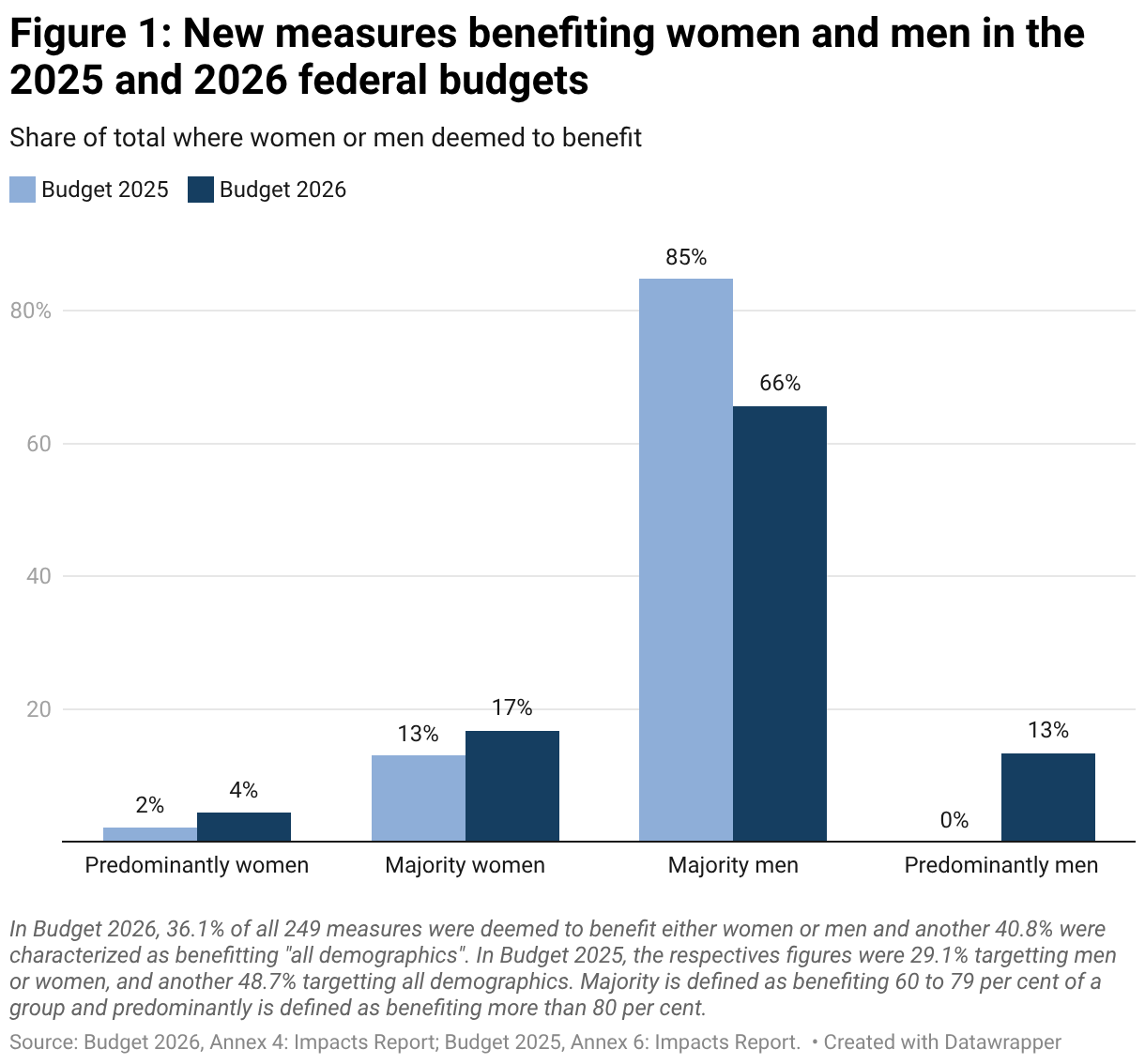
Indeed, 78.9 per cent of all new budget measures deemed to benefit one gender over another favour men, and mostly high-income men, through massive tax cuts to big business, including the budget’s flagship $36 billion Productivity Mega Deduction (Figure 1).
The budget upholds and reinforces the idea that the economy and society are separate and distinct, that male-dominated manufacturing and natural resources drive the show, that vital social programs and health care are secondary or “nice-to-haves,” that fundamental issues of equality are divorced from the health of the economy.
Tell that to the millions of nurses, personal support workers, early childhood educators, teachers and shelter workers who’ve been running flat out for the last five years. Tell that to the millions more seeking care and support in our hospitals, schools, long-term care homes, immigrant settlement agencies, food banks, employment service hubs and supportive housing providers.
The case for investing in Canada’s care economy is equally compelling and pressing. A 2025 Canadian Federation of Nurses Unions (CFNU) member survey found that 37 per cent of practising nurses plan to leave the profession or their job or retire within the next year. Forecasting models have predicted that the shortage of nurses in Canada could climb to 117,000 by 2030. In the second quarter of 2026, there were 26,435 nursing vacancies, according to Statistics Canada.
As well, shortages of allied health professionals, including medical radiation technologists and medical laboratory technologists, are also widespread across the country. The shortages of personal support workers results in inadequate direct care hours in long-term care and chronic burnout. Health care workforce shortages contribute to longer wait times and service closures, including emergency departments.
In the child care sector, Employment and Social Development Canada projects that there will be 162,000 job openings for early childhood educators through 2033. In 2025, provinces and territories were short 57,030 spaces, based on the number of promised spaces that would be built with federal money. Too many families cannot access affordable child care, in part, because of educator shortages. In the K-12 system, teacher and educational assistant shortages, too, result in larger class sizes and unmet support needs.
Despite these pressing workforce challenges, one group of workers is prioritized for action by the federal government, the other invisible.
Comparing federal supports for the trades and care economy
In the Spring Economic Update, the federal government announced “Team Canada Strong,” including nearly $6 billion of new funding for trades apprenticeship programs (Figure 2). These initiatives include significant new funding over five years (2026-27 to 2030-31):
- $3.4 billion for the Apprenticeship Training Grant and completion bonuses;
- $2 billion for the Team Canada Strong Youth Placements and Build Canada Apprenticeship Service for employers;
- $880 million for the Team Canada Strong Youth Placements for employers to support young workers with entry-level placements; and,
- More than $430 million for the Union Training and Innovation Program.
As the Spring Economic Update notes, Canada may face a gap of more than 20,000 skilled trades workers per year, without action. To put this into perspective, there were 113,835 vacancies in health care and social assistance and educational services in the second quarter of 2026.
To be clear, new federal investments in trades apprenticeship programs are welcome, but the predominant focus on male-dominated occupations to support the resource-extractive and defence industries fails to support a strong Canada, for all.
The federal government’s current workforce development agenda overlooks the significant and growing challenges in health care, education, and community social services.
The only significant federal support for students in caring professions is through the Canada Student Loan Forgiveness program, which was established in 2012, to provide partial student loan forgiveness to eligible family doctors, nurses, and nurse practitioners in under-served rural and remote communities.
Beginning in 2025, this program was expanded to include dentists, dental hygienists, early childhood educators, pharmacists, midwives, teachers, social workers, personal support workers, physiotherapists, and psychologists. Compared to the nearly $6 billion over five years for the Team Canada Strong trades apprenticeship programs, the Canada Student Loan Forgiveness program represents a much smaller federal commitment of $372 million (Figure 2).
While the loan forgiveness program provides important financial support to recent graduates and helps to expand access to critical health and social services, it only reaches a minority of the care workforce because it is limited to designated rural and remote communities with populations under 30,000. Loan forgiveness, as currently designed, is only one part of what should be a comprehensive strategy to attract and retain care economy workers.
The federal government has committed billions to bolstering the skilled trades over the next five years. So where’s the plan for nurses and other care workers to meet Canada’s growing care needs?

Let’s compare: Nurses vs. carpenters
Nursing students generally pay up front for college or university degrees, a process that typically takes four years of full-time study and upwards of 1,000 hours of unpaid clinical placements to complete, followed by licensing exams.
Nurses finance their multi-year degree through a mix of student loans, scholarships, grants, and paid hospital clinical externships, where available. The majority (68 per cent) also seek paid work to make ends meet during the course of their studies,1Eyasu Yakob, 2025, Investing in the future: Eliminating financial barriers for nursing students, Canadian Federation of Nurses Unions. squeezing in hours around academic semesters and unpaid clinical rotations.
Some provinces offer “up front” grants to help offset the cost of tuition and books for students studying in selected service regions, such as Ontario’s Learn and Stay Grants and Saskatchewan’s Health Sciences Bursaries.
Students can also apply for paid externship programs, depending on the province. Ontario’s externship program, for example, was introduced in 2021 to provide support to full-time health care staff at the height of the pandemic. The program was made permanent in 2024 and currently supports over 5,000 health care students (including nurses) per year in hospital settings.
However, the bulk of financial support that is available to Canadian nursing students doesn’t arrive until after graduation, through federal and provincial loan forgiveness programs and then only to nurses who commit to working in rural, Northern or high-needs communities for a set number of years.
Under the federal Canada Student Loan Forgiveness program, for example, RNs, RPNs/LPNs, Registered Psychiatric Nurses, and Nurse Practitioners can receive up to $30,000 in federal loan forgiveness over five years by providing at least 400 in-person service hours per year in rural areas or population centres with fewer than 30,000 people. Provincial return-of-service tuition reimbursements are also tied to multi-year rural or public-sector placements.
Here’s a reality check: According to the Canadian Institute for Health Information (CIHI), just 7.6 per cent of all licensed nurses in Canada, around 35,000, worked in rural areas in 2024.2CIHI defines a rural/remote area as being outside of a census metropolitan area (CMA) or census agglomeration (CA), in Metropolitan Influenced Zones (MIZs) 4, 5, 6, 7, 8.
And of the group working in Canada’s smallest communities, just 4,673 received assistance from the Canada Student Loan Forgiveness program to retire some portion of their student debt in 2023-24, at a total cost of $18.8 million.3ESDC, 2025, Statistical Review 2023-2024: Canada Student Financial Assistance Program. Nurses make up 81.7 per cent of all those in receipt of the loan forgiveness support through the program targeting doctors and nurses.
Now let’s take a young person training to become a carpenter. It also takes about four years (or roughly 7,200 total hours) to become a Red Seal General Carpenter. In Ontario, this includes 6,480 hours of practical work experience (typically spread over three to four years), 720 hours of technical classroom instruction, and the time involved in taking final licensing exams.
But here is where the similarities end. Whereas nurses shoulder all of the costs of training up front and typically take on debt to pursue their degree, skilled trades apprentices support themselves through paid employment through their practical training and rely on Employment Insurance (EI) and various provincial stipends during the short blocks of classroom time.
Moreover, apprenticeship supports have been enhanced as part of the new Team Canada Strong initiatives, as outlined above, including the new Apprenticeship Training Grant—an additional $400 per week on top of regular EI benefits while attending classes—and an unconditional $5,000 federal Red Seal Completion Bonus—regardless of where the apprentice lives or works.4Interest-free loans are available through the Canada Apprentice Loans program, along with Specialized Tradesperson’s Tools Deduction, Apprentice Mechanic Tools Deduction, and Labour Mobility Deduction (up to $10,000 per year for temporary relocations 120+ km from home).
The provinces and territories also offer financial support to employers to hire and mentor apprentices through their training. In Ontario, employers receive up to $10,000 to hire first-year Red Seal apprentices as well as the Apprenticeship Job Creation Tax Credit (up to $2,000 per year), and provincial milestone payouts of up to $17,000. In another example, Manitoba provides Paid Work Experience Tax Credits worth up to $5,000 for eligible employers, plus targeted tool/grant assistance programs.
It all adds up
Tuition alone for a four-year BScN degree in Ontario costs an average of $7,000 per year and over $8,000 per year at schools like the University of Toronto and Western University. Students must also pay another $3,000 in compulsory student fees and program-related costs for scrubs, lab kits, books, certifications, and then a raft of fees associated with writing licensing exams and applying for licensure. In total, over four years, a nursing student can expect to pay upwards of $40,000 for their training, and oftentimes, considerably more.
Students must then cover living expenses, including the very high cost of housing and food, especially in large urban centres. The University of Toronto, for example, advises students to budget between $26,000 and $46,000 per year for living expenses. In smaller centres, living costs are lower, but still a sizable financial obligation for students with little room for manoeuver.5In Kingston, for example, students can expect to pay between $16,000 and $24,200 per year according to the Queen’s University Registrar, https://www.queensu.ca/gnds/cost-living-kingston. The cost of travelling to clinical placements, for example, can quickly upend any student’s budget.
Adding it up, nursing students studying away from home can expect to pay a minimum of $30,000 per year for their studies—which amounts to $120,000 over four years.
Full-time low-income students are eligible for the Canada Student Grant (up to $4,200 per year). And those students living in provinces that provide targeted assistance with tuition and books tied to a lengthy service commitment can claim a rebate for tuition and books.6If students do not fulfill their service commitment, the grant is converted into a repayable loan, https://www.ontario.ca/page/ontario-learn-and-stay-grant.
These are important programs, but only reach a limited number of students across the country. Most nurses are on the hook for the total cost of their education and, with school and unpaid placements, have a limited window for generating earned income to pay for school and support themselves. The majority (58 per cent) have no choice but to take on debt to complete their studies.7Eyasu Yakob, 2025. Carpenters, by contrast, graduate with no debt and money in the bank.8An apprentice carpenter living in the Greater Toronto Area starts generating income almost immediately, their hourly wage rising from $20+ per hour in Year 1 to $45+ per hour by Year 4. Add in 24 weeks of Employment Insurance benefits at 55 per cent of weekly earnings plus the new $400 per week top up to cover the time in class and other grants for tools, etc. and apprentices are well on their way financially. https://theccat.ca/general-carpenter-apprenticeship/.
It is no surprise that the large majority (82 per cent) of nursing students are concerned about their finances, and that more than one-quarter (28 per cent) have considered dropping out of their nursing studies because of financial difficulties.9Eyasu Yakob, 2025.
Why this matters
A comparison of nurses and carpenters says something about the value that the government attaches to the labour of nurses and care workers. This is not to argue that investing in the construction trades is not crucial to Canada’s future prosperity and well-being—but that our collective future also depends on the vitality of our care economy and well-being of care workers as well.
The government’s economic plan reinforces the myth that women’s labour is not essential to the economy, when nothing could be further from the truth. Paid and unpaid care work is the foundation upon which all human activity rests, the provision and organization of which is hugely consequential for the development, good health and well-being of all people.
It is also hugely consequential for the economy, not only directly facilitating the labour force participation of all workers but driving economic innovation and growth.
The care economy itself is a major employer and source of economic activity. In 2025, health care and social assistance and educational services constituted 13.5 per cent of Canada’s GDP (considerably larger than construction at 7.2 per cent). It represents more than one in five jobs: over three-quarters of which—3.4 million—are held by women.
Despite its economic heft, the care economy continues to receive short shrift from governments, in the face of pressing concerns. The COVID-19 pandemic highlighted the care economy’s critical role, but also the critical weaknesses in Canada’s system of care.
Canada’s care workforce continues to struggle to meet the demand for care, under persistently poor working conditions, facing an aging population and greater needs among those seeking care.10In 2025, 73 per cent of charities said demand for services exceeded their capacity, while 75 per cent reported significantly higher demand than the previous year. Charity Insights Canada Project, 2025, High Demand and Constrained Capacity in Canada’s Charitable Sector, Carleton University. The federal government isn’t only facing a crisis in building out new physical infrastructure over the next decade. The crisis in the care economy is here now.
Just ask anyone struggling to find a family doctor, spending endless hours waiting in emergency rooms, waiting potentially years for a $10-a-day child care spot, or praying for more hours of subsidized home care in order to age at home, dreading the alternative.
Care costs individuals and families. It costs communities and employers. And it costs the larger economy in lost working hours, lower productivity and weaker economic growth.
What should be done for nurses and care workers
The federal government has an important role to play in addressing urgent workforce challenges in the care economy and improving access to health care, child care, education, and community social services. Here are three policy recommendations:
Introduce grants for nursing students and other care workers
The federal government has offered grants to trades apprentices to complete their training, in addition to claiming EI while attending courses. This type of assistance should be provided to nursing students and other students training for occupations in the care economy. For students in nursing and other health care professions, the grant could align with the start of the practicum to help offset the lost income and expenses incurred during full-time, unpaid training. Ninety-two per cent of nurses responded to a Canadian Federation of Nurses Unions (CFNU) survey supporting paid clinical placements. The federal government could also provide transfers to provincial and territorial governments to implement paid practicum placements in health care, education and early learning, and other parts of the care economy.
Improve Canada Student Loan Forgiveness
Currently only a portion of federal student loans may be forgiven each year. For nurse practitioners, registered nurses, registered practical nurses, midwives, teachers, social workers, and physiotherapists, the total amount of loan forgiveness is $30,000 spread over a maximum of five years. For family physicians, dentists, psychologists, and pharmacists, the total increases to $60,000, but for early childhood educators (ECEs) and personal support workers (PSWs), the maximum is $15,000.
As a CFNU report notes, the federal government could increase the amount of loan forgiveness and expand eligibility to urban areas also facing shortages. The federal government could also support provinces to reduce or eliminate tuition fees in care economy occupations. Nursing education in many EU countries is free or very low cost. For other occupations, such as ECEs and PSWs, which face much lower pay compared to other health professionals, total loan forgiveness would go a long way to reducing financial barriers and addressing shortages.
Offer income tax deductions to students in rural, remote, and northern placements
Nurses and other health professionals often complete clinical placements in rural communities, often adding significant personal expenses for housing and transportation. Construction apprentices receive federal income tax deductions for the costs associated with completing training in areas away from their residence. Similar deductions could be introduced for students in nursing and other care economy occupations.
The federal government committed $5.9 billion to train and support up to 100,000 skilled trades workers over five years, but offered nothing to address the fraying of Canada’s care economy, which is both a major economic driver and essential to building a healthy, prosperous society. Canada needs a plan—rooted in gender equity—to foster a resilient care economy to meet Canada’s growing care needs.
About the authors

Katherine Scott
Katherine serves as the director for the CCPA’s gender equality and public policy work. She has worked in the community sector as a researcher, writer and advocate over the past 20 years, writing on a range of issues from social policy to inequality to funding for nonprofits.

Andrew Longhurst
Andrew Longhurst is a senior researcher and political economist, with a focus on health policy, at the Canadian Centre for Policy Alternatives. He holds an MA from Simon Fraser University where he is a PhD candidate. He is the author of over 45 publications on public finance, health services, and the care economy.