

Share
In response to disappointing results on literacy and numeracy tests, the Ontario government has announced a review of the province’s standardized testing system, the EQAO (Education Quality and Accountability Office). Instead of chasing elusive explanations for low test scores, the government should focus on the basics: reducing and capping class sizes.
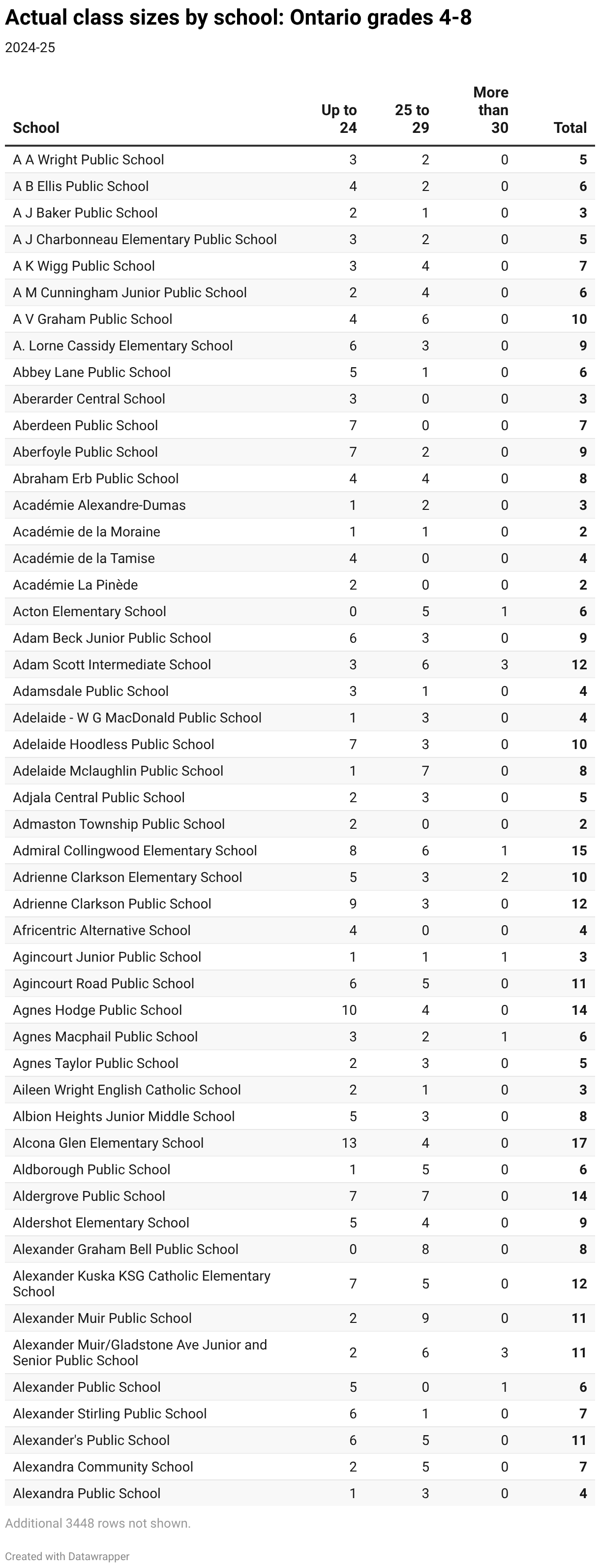
Drawing on the best available data, the tables below provide a breakdown of actual class sizes at the provincial, board, and school levels, for grades one to four.
In the 2024-25 school year, only 52 per cent of grade four to eight classes had fewer than 25 students, 45 per cent had between 25 and 29 students, and four per cent had more than 30 students.
While four per cent might seem small, in Ontario’s large education system, it means that nearly 1,100 grades four to eight classes in the province have more than 30 students.
Some boards are more impacted than others.
In the Toronto District School Board (TDSB), 42 per cent of grade four to eight classes (1,420 classes) had between 25 and 29 students, and nine per cent (313 classes) had 30 students or more.
In turn, the much smaller Nipissing-Parry Sound Catholic District School Board had the largest share of classes, with more than 30 students in the province: 21 per cent, although it represented a small total number of classes, 10.

How come so many classes are above the known class size limits?
Parents hear that class sizes are limited to 20 students for grades one to three, 24.5 for grades four to eight, and 23 for Grades nine to 12. Yet their children are in much larger classes than these limits allow, and so are half of the children in the province. How is that possible?
The short answer is class-size caps.
Only grades one to three have hard caps. In any school board in Ontario, 90 per cent of classes must have 20 students or fewer, and the remaining 10 per cent may have up to 23 students.
For grades nine to 12, the ministry funds class sizes for an average of 23 students per class, and boards are required to uphold this overall average. In most subjects, class sizes are controlled by maximum limits, which were traditionally negotiated locally between teacher unions and boards.
For grades four to eight, class sizes are stipulated as the average at the board level. This means that if some classes are smaller than the target average, other classes can be larger. How large? There are no caps. And it is the absence of caps that allows for the extraordinary share of large classes.
Another crucial piece of the puzzle is class complexity, according to Nichole Grant, Research Director at the Canadian Teachers’ Federation (CTF). For her, class sizes must take into account special education needs. In a weighted analysis, students without special education needs would be assigned a weight of 1, while other students would be assigned higher weights (e.g., 1.2, 1.5). If the Education Ministry made the necessary data available for this type of assessment, the numbers in the tables above would be considerably higher and better reflect the classroom experience.
Reducing class sizes through class caps would have an immediate and positive impact on the classroom experience in Ontario and on student achievement. We know it already. We don’t need EQAO reviews or long-winded consultation processes. We need the Ontario government to stop making excuses and invest in schools.
About the author
Ricardo Tranjan
Ricardo Tranjan directs the research program for the CCPA-Ontario. Ricardo’s expertise centres on Ontario public finances and the political economy of social policy, especially public education funding, income support programs, and rental housing. He is the author of multiple books, including The Tenant Class (2023).