



Share
Across Canada, rents are out of control.
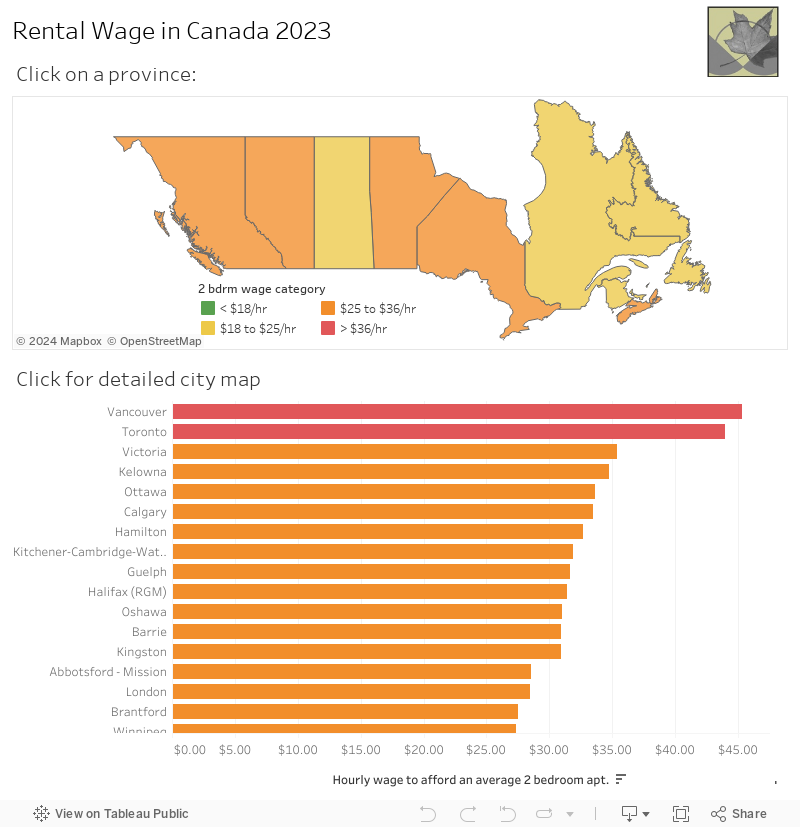
In 2019, the Canadian Centre for Policy Alternatives introduced the concept of the “rental wage” to Canada. The rental wage is the hourly wage required to pay rent while working a 40-hour week, 52 weeks a year, and spending no more than 30 per cent of one’s income on housing. Put simply, the rental wage is the wage people need to earn in order to pay their rent without sacrificing other basic needs.
What about your city? We made this map to help you answer that question.
To get started, click on a province to filter to the cities within it. Click on a city to jump to its neighbourhoods map. Hover over anything for additional information. To reset the map, reload the page. The map may take a moment to load.
Click here to read the full report that this map is based on. To see older data for comparison, click here to look over our equivalent map from 2023.
Our content is fiercely open source and we never paywall our website. The support of our community makes this possible.
Make a donation of $60 or more and receive The Monitor magazine for one full year and a donation receipt for the full amount of your gift.
About the authors

David Macdonald
David joined the CCPA as its Senior Ottawa Economist in 2011, although he has been a long time contributor as a research associate. Since 2008, he has coordinated the Alternative Federal Budget, which takes a fresh look at the federal budget from a progressive perspective. David has also written on a variety of topics, from child care to income inequality to federal fiscal policy. He is a regular media commentator on national policy issues, often speaking to the CBC, Globe and Mail, Toronto Star and Canadian Press. David received his BA from the University of Windsor and his MA from the University of Guelph, both in Philosophy. Follow David on Bluesky at @davidmaccdn.bsky.social

Ricardo Tranjan
Ricardo Tranjan directs the research program for the CCPA-Ontario. Ricardo’s expertise centres on Ontario public finances and the political economy of social policy, especially public education funding, income support programs, and rental housing. He is the author of multiple books, including The Tenant Class (2023).