


Share
B.C.’s election got really interesting with an out-of-the blue NDP proposal to hike income taxes for the top earners in the province. This reflects Premier David Eby’s broader pivot to more populist meat-and-potatoes issues, a populist rebranding that is in striking contrast with Eby’s four-year track record as premier. Not to be outdone, the Green Party has proposed an even more audacious wealth tax aimed at B.C.’s super-rich.
When campaigners invoke the term “taxing the rich,” it’s important to distinguish between wealth (holdings of assets like cash, real estate, stocks and bonds net of debts/liabilities) and income (the annual flow from wages and salaries, plus interest, dividends and rent arising from the ownership of assets). Property taxes already are applied to B.C. real estate, so wealth taxation is largely about taxing holdings of financial assets. Linda McQuaig and Neil Brooks’ recent Rosenbluth lecture highlights the need for a wealth tax, although they argue it should be national in scope.
Let’s take a closer look at the proposed NDP upper-income tax increase. Asking the most well-off to pay a bit more should not be a hard sell at a time when our province is mired in a trade war, and has many pressing challenges that need public support. There is a lot of misinformation about taxes in B.C., and who pays what. Prepare for an offensive from top earners in B.C. against this tax proposal, which should otherwise be fairly popular among voters.
Tax increase details
B.C. currently has five tax brackets with progressively higher rates applied to income above certain thresholds. The term “progressive tax system” means that the higher up the income distribution you go, the greater the share of income paid in tax. This income tax structure is central to keeping inequality in check as the distribution of market incomes is highly unequal. B.C.’s brackets ensure the highest income households pay higher tax rates and the NDP proposal would increase that progressivity even further.
Table 1 shows the current income brackets and the changes proposed by the NDP. In short, the rates on the top two brackets each would go up by two percentage points and a new bracket is created for income above $1 million. The brackets themselves would normally increase in line with inflation, but the 2026 B.C. budget paused those annual adjustments—a stealth tax increase because incomes tend to rise over time, pushing more individuals over the threshold. Nonetheless, this simplifies things because the brackets for 2026 will be the same in 2027 and subsequent years.
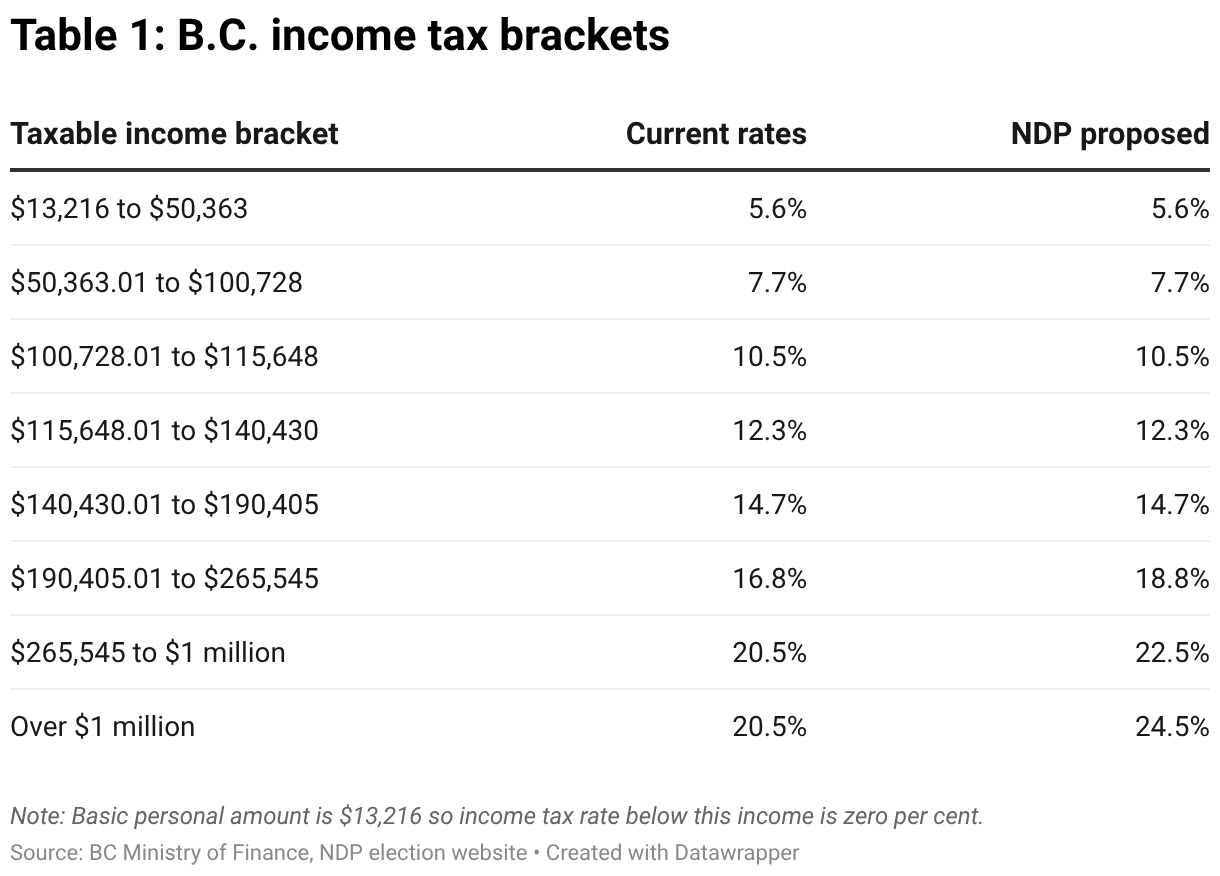
Note that the rates in the table only apply to income above the threshold for the bracket (called marginal tax rates). The vast majority of British Columbians would not be affected by the higher income tax rates. Individuals with income below $190,405 would not see a cent of tax increase from the NDP proposal. Because taxes are based on individual income, a two-earner family with each earning $190,405—for total household income of $380,810—would also pay no additional tax.
The NDP tax proposal is thus laser-focused on the top three per cent of individual income earners in British Columbia. Table 2 gives a sense of the magnitudes: someone with a taxable income of $250,000 would pay only an additional $1,192 in income tax, rising to an additional $6,192 for income of $500,000. These numbers are likely to be maximum amounts, as they do not factor in the various ways the truly rich can use charitable donations or other tax credits to reduce their tax bills, as well as only being required to claim half of any realized capital gains as income for tax purposes.
Table 2 shows taxes as a share of income—the average tax rate. There is often a lot of confusion and misinformation that the marginal rate for a person’s income applies to all income, when it only applies to income above the bracket threshold. The average rates in the table show that tax rates increase more steeply as income rises, but even at the new proposed NDP tax rates, a very high income of $5 million income would pay 23.5 per cent in taxes, up 3.5 per cent of income relative to the current structure.

In terms of revenues, CCPA’s David Macdonald ran the new brackets through Statistics Canada’s Social Policy Simulation Database and Model, and estimates the tax increase would raise an additional $750 million per year in 2027, less than the NDP’s headline claim of $1 billion in new revenues. Of that amount, the top one per cent of earners would pay 86 per cent, and those with more than $1 million in annual income would pay 54 per cent. That said, some caution is needed here as estimating revenues at the very top of the income distribution is a challenging exercise. But the overall shift in the provincial income tax system is quite clear.
Any revenue gains from higher income taxes will also be affected by other election promises. In particular, the NDP announced a 10 cent reduction in provincial fuel taxes, which would cost about $670 million on an annual basis, close to our estimated amount for new income tax revenue. This fuel tax reduction would have a much greater benefit for low- and middle-income earners. Thus, these combined measures would have little impact on the BC deficit but would constitute a more progressive tilt in the overall tax system toward greater equality.
Pushback on higher income taxes
British Columbians should expect a lot of resistance from the high-income individuals that would be most affected by the higher rates. While many of these individuals might threaten to leave, this is not a credible threat as most would still pay less income tax in B.C. And they would stay because B.C. is an incredible place in the world with a high standard of living, in big part because taxes support good public services and infrastructure. People move for many reasons and family and home would keep them rooted.
It’s worth noting that B.C. has the lowest income taxes in Canada for most households. The Figure shows Statistics Canada data for different income groups, for Canada as a whole and different provinces. B.C.’s average income tax rates (combined federal and provincial) compare favourably with Alberta, even at the very top, and are consistently less than Ontario and Quebec. Top income rates are lower in both Saskatchewan and Manitoba, but few suggest top earners in B.C. will be moving there.

Taxes on top earners used to be much higher up to the 1980s, and were high through the “golden age” period after World War II, with top marginal rates of 80 per cent or higher in the 1960s. These higher tax rates were associated with very strong economic growth in B.C. and Canada. There’s a good reason for that in that income earners at the very top of the ladder put an increasing share of their income towards saving. That money goes into speculative investments in stocks, real estate or Picassos. Taxing that income and using it to deliver public services and build out public infrastructure both creates public sector jobs and provides social and economic benefits to British Columbians.
That said, for the very top earners, tax avoidance strategies are inevitably going to be part of the mix. That is not a reason to stop trying to tax the rich, it’s an argument to close up loopholes that allow legal forms of evasion. It’s also a good reason why B.C. also needs to tax corporations effectively so that income cannot be accumulated indefinitely to the benefit of major shareholders.
Differing tax proposals
The biggest challenge for the NDP is not whether taxing higher incomes is the right move, but whether voters believe this type of tax increase would actually be implemented should the NDP win the election. In the 2024 election the NDP promised a middle class tax cut or “grocery rebate“ and then failed to deliver in the 2025 budget.
The change in tone and priorities from the incumbent NDP government is notable. Back against the wall, having potentially made a catastrophic error in calling a provincial election, Premier Eby has shifted the NDP campaign into populist mode. Whereas just a month ago he was a pro-business, status quo manager with limited ambition for changing the province, apart from luring more mining and LNG projects, the premier has rediscovered the common touch in a bid to return to government.
The Conservatives have yet to table a more comprehensive plan besides categorically refusing any tax increases and cutting the provincial sales tax on alcohol, a measure estimated to cost $250 million per year. Seeking to lower liquor prices seems of dubious benefit for the province. If anything, the intent of the cut should be to provide additional income to the sellers of alcohol (adversely affected by the U.S. trade ban) rather than lowering prices.
The Green party’s wealth tax for B.C. comes in two parts: a one-time tax of five per cent on net wealth above $50 million, 10 per cent above $100 million, and 20 per cent above $1 billion; and an ongoing wealth tax of two per cent, three per cent and five per cent respectively on the same thresholds. While well-intentioned, this would be extremely difficult to implement in B.C. The obvious challenge is how this would be implemented in a provincial jurisdiction and whether that would actually make sense given federal regulation around finance. Wealth taxes or inheritance taxes are best implemented on a national or federal level for this reason, and that the federal government could levy an exit tax on those wishing to leave the country. This would not be possible at the provincial level.
Nonetheless, there are now some clear distinctions in the political choices facing British Columbians, and there’s still lots of campaign to go. All parties will need to table costed plans for their policy recommendations and how they link taxes, public spending and budget deficits. But if British Columbians want a lower deficit and greater equality, upper-income tax increases make a lot of sense.
About the author

Marc Lee
Marc Lee is a Senior Economist with the Canadian Centre for Policy Alternatives. Marc joined the CCPA’s British Columbia office in 1998, and is one of Canada’s leading progressive commentators on economic and environmental policy issues. From 2009 to 2015, Marc led the CCPA’s Climate Justice Project (CJP), which published a wide range of research on fair and effective approaches to climate action through integrating principles of social justice. Marc continues to write about climate and energy policy, strategies for affordable housing, federal and provincial budgets and macroeconomics. Marc has an MA in Economics from Simon Fraser University and a BA in Economics from the University of Western Ontario. Marc is a past chair of the Progressive Economics Forum, a national network of heterodox economists. He also served as a Visiting Professor at Simon Fraser University’s School of Public Policy in 2024 to 2025.