


Share
The following is a re-print of the July 2026 edition of Shift Storm, the CCPA’s monthly newsletter which focuses on the intersection of work and climate change. Click here to subscribe to Shift Storm and get the latest updates straight to your inbox as soon as they come out.
The proliferation of artificial intelligence systems is exacerbating every problem that these systems are purported to solve.
For readers of this newsletter, the climate and labour concerns of the AI boom are likely front of mind.
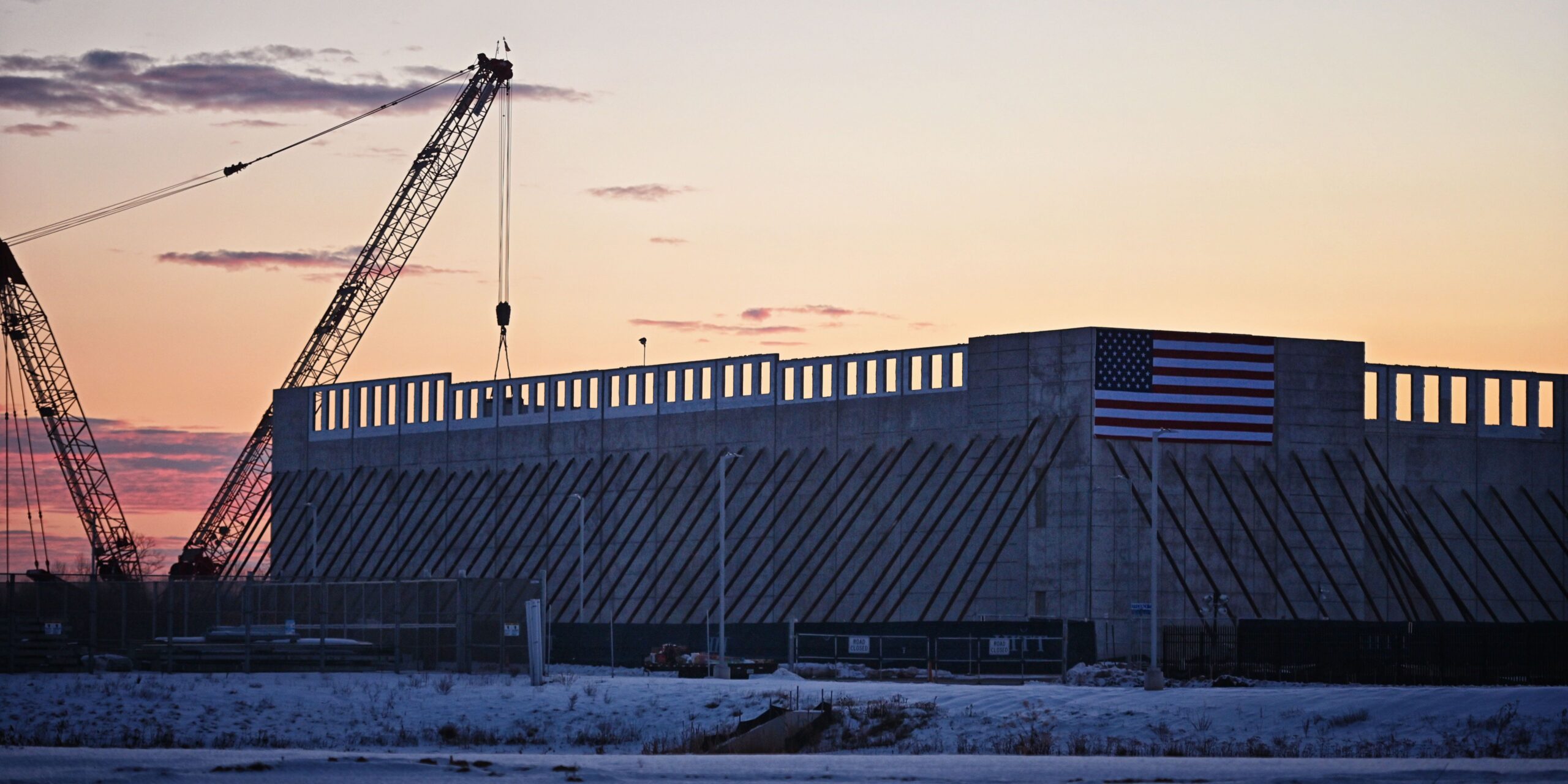
Far from solving climate change, the staggering global rush to build gas-powered AI data centres is reversing emissions reduction progress across sectors and jurisdictions. That has pulled the interests of big tech and the fossil fuel industry into an unholy alliance that puts future climate action at risk, as my colleague Simon Enoch writes for the CCPA.
And rather than empowering workers, the deployment of AI in workplaces is undermining the privacy, autonomy and dignity of experienced workers while hiring for entry-level workers dwindles. The AI “invasion” of workplaces, as Fred Wilson wrote recently for the CCPA, is also being used by employers as a tool to weaken worker power—with unions on the back foot.
Unfortunately, the (predictably) perverse consequences of AI for climate and labour only scratch the surface of the harms and risks posed by the AI rush. It is a similar story for human cognition, human rights, public services, democratic institutions, scientific research, digital sovereignty, Indigenous rights and more. In each of these areas, AI holds theoretical promise. In practice, it is causing serious, demonstrable harms.
That progressives need to take all of these issues seriously—and confront them—is the central plea of my latest major research report, Think Twice: A citizen’s guide to artificial intelligence in Canada, co-authored with my colleague Rachel Pettigrew. Canadian civil society organizations, on the whole, lack the capacity or expertise to meaningfully engage on AI issues. We hope this paper will contribute to more coordinated, strategic and nuanced advocacy moving forward.
If there is one message to take away from our new report, as I argued in the National Observer this week, it is that Canada needs to slow down on AI adoption.
Artificial intelligence, as a category of related technologies, holds genuine potential in many areas, from energy efficiency to medical research to agriculture. A pro-worker AI is possible, and there is a path forward for sovereign data centres that are built with clean power and community consent. AI need not be a threat to everything.
But the current race to adopt commercial AI systems indiscriminately across every sector of society and the economy—as the federal government is encouraging—is both baseless and reckless. It reflects a willingness to accept real human harm in exchange for speculative economic benefit, and it ultimately serves no one but the mostly-American corporations pushing AI products.
The CCPA is in the AI fight for the long haul, so stay tuned for more research in this area. But fear not for Shift Storm, which will continue to be primarily focused on climate and labour issues. You may also be interested in One Picket Line, a new research series from the CCPA on worker movements in Canada. Check out the latest issue here.
And if you’d like to come work with me(!), check out the job listing for the Errol Black Chair in Labour Issues, which is based in the CCPA’s Manitoba office.
Now let’s get into this month’s research.
Storm surge: this month’s key reads
Pipeline proposal is everything wrong with Canada’s industrial strategy
The finalized memorandum of understanding between Alberta and the federal government includes a commitment to building a new, million-barrel-per-day West Coast Oil Pipeline at a cost of $35-44 billion with 90 per cent public ownership. The announcement breaks two prior promises: that any pipeline would not be funded with public money, and that any pipeline would be paired with offsetting emissions reductions. On the latter point, the heavily-subsidized Pathways carbon capture project is going ahead, but with half the capacity that was previously suggested.
My colleague Marc Lee writes about these issues—as well as the side deal negotiated between BC and the federal government—in more detail. From a climate perspective, this new pipeline is a dismal development that will increase global emissions while locking Canada into even deeper fossil fuel dependency.
Why do Canadian governments continue to double down on planet-destroying megaprojects instead of investing in a diversity of value-added industries? That is precisely the question that Brandon Haley tackles in a valuable new report published by the Centre for Industrial Policy. There is a lot of useful history in this brief paper, which helps us to make sense of the economic trap of resource dependency.
If Canadian governments invested in and subsidized other sectors—especially value-added industries like technology and manufacturing—the same way they do fossil fuels, we could have a more productive, cleaner and future-oriented economy. As it stands, we are sinking into the past as other countries race ahead.
Research radar: the latest developments in work and climate
Carney formally abandons Canada’s climate targets… In a recent Youtube video Canada’s prime minister confirmed that we will not meet our medium-term emission reduction targets. Canada remains committed, in principle, to achieving net-zero emissions by 2050, but there is no plan to do so. This would be bigger news if not for the year-long backslide on climate policy that inevitably led to this conclusion.
…and Canadians are noticing. New polling from the Angus Reid Institute finds that Canadians’ concern about climate change is rising once again, driven in part by the terrible wildfire season engulfing the world. That is having political implications as environmentally-minded voters drift away from the current government.
What the federal government can and cannot do on climate policy. Preeminent climate researcher Andrew Leach has written a very practical article in the journal Canadian Public Policy, “Constitutional Limits on the Design of Canadian Federal Climate Change Policy,” that I daresay is essential reading for activists. It may not be sexy, but we need to understand what different levels of government are actually capable of when we make demands.
Time to weigh in on Canada’s definition of sustainable finance. Business Future Pathways, an advisory body created by the federal government to develop Canada’s sustainable finance taxonomy, has released a methodology report draft. I’m encouraged that the draft takes a clear position on excluding oil and gas production from any definition of sustainable. You can weigh in with your comments by August 13.
Does Fort McMurray have a future after oil? The Institute for Research on Public Policy has been doing some great work on community transitions, so I was intrigued by their new case study of Fort McMurray, Alberta. It paints a thoughtful and detailed picture of the challenges facing the community, but falls short of advocating for meaningful diversification away from the oil industry. A separate case study of resource-dependent northern BC communities published by the Pembina Institute reaches a somewhat more ambitious conclusion in calling for investment in clean alternatives.
Carbon capture is—and has always been—a scam. The American journalism outfit ProPublica published a scathing (and beautiful) investigation into the fantasy of carbon capture, utilization and storage (CCUS) at scale. Canada’s backsliding on the Pathways project is emblematic of the impracticality of this climate “solution” that industry has failed to deliver on despite decades of promises, as the Narwhal recently exposed. Why do we keep talking about CCUS then? Because it is the only way to square increased fossil fuel production with the fig leaf of net-zero emissions. CCUS is a political necessity, even if it doesn’t work practically or economically.
Energy addition is not energy transition. The latest Statistical Review of World Energy from the UK-based Energy Institute tells a complicated story about the global energy transition. While clean power is accounting for a greater share of the global energy pie—solar generation grew 30 per cent in 2025 alone—the total amount of fossil fuels being consumed is not falling at the same rate. Total emissions are thus still rising. It’s an important reminder that decarbonization won’t happen without both carrots and sticks.
National development banks could be the key to driving energy transitions. Oil Change International published Untapped Potential, which investigates how national/public banks around the world are implicated in the energy system. Many, including Canada’s institutions, are predominantly invested in fossil fuels today, but that could be reversed to prop up clean energy instead. It’s an approach to industrial strategy I’ve long supported.
There aren’t enough clean energy workers to meet growing demand. In Ensuring a Skilled Renewable Energy and Energy Efficiency Workforce, the International Energy Agency finds that the clean power sector is driving job creation just about everywhere, but that not enough new workers are entering the field. One of the big problems the IEA identifies is that women are severely underrepresented in growth occupations. It’s a longstanding issue, and the report doesn’t identify clear solutions, but it does provide a useful overview of women-focused training initiatives around the world.
Dark clouds: artificial intelligence on the horizon
A step-by-step guide to fighting data centres in your community… The Council of Canadians published Resisting Data Centre Development in Canada, which is a fantastic resource for concerned communities. It includes both big-picture context and practical strategies for engaging with new AI infrastructure proposals.
…and to fighting everything else to do with AI. The Luddite Lab Resource Hub by the U.S.-based Distributed AI Research Institute includes a wealth of case studies and tools for organizing against AI at all levels. A useful bookmark for civil society organizations.
AI makes us more confidently wrong. A new preprint study by academics in France and Italy finds that AI access makes users dramatically less likely to say “I don’t know,” even when they truly cannot answer a question. It’s the latest data point highlighting the erosion of critical thinking due to AI use.
Have your say on Canada’s AI transparency regulations. Innovation, Science and Economic Development Canada published a new discussion paper, Enhancing trust in artificial intelligence through increased transparency, and is welcoming public comments. Stay tuned for the CCPA’s formal response.
About the author

Hadrian Mertins-Kirkwood
Hadrian Mertins-Kirkwood (he/him) is a senior researcher and political economist at the Canadian Centre for Policy Alternatives. His work focuses on federal economic, social and environmental policy, especially in the areas of climate change, artificial intelligence and industrial strategy. Hadrian edits the monthly Shift Storm newsletter on climate and labour.