



Share
Labour and housing struggles are closely connected. When financial firms turn housing into an asset class, they price workers out of homeownership. Without strong rent controls, landlords line their pockets with workers’ hard-won collective-bargaining gains. When real estate interests gentrify neighbourhoods, displacement forces workers out of their communities and into longer commutes.
Not too long ago, unions across Canada treated housing as a bread-and-butter labour issue. They built co-ops, joined the political fight for public housing, and bolstered tenant movements. That engagement waned for a time, but in recent years, as tenant movements have grown stronger, unions are finding their way back.
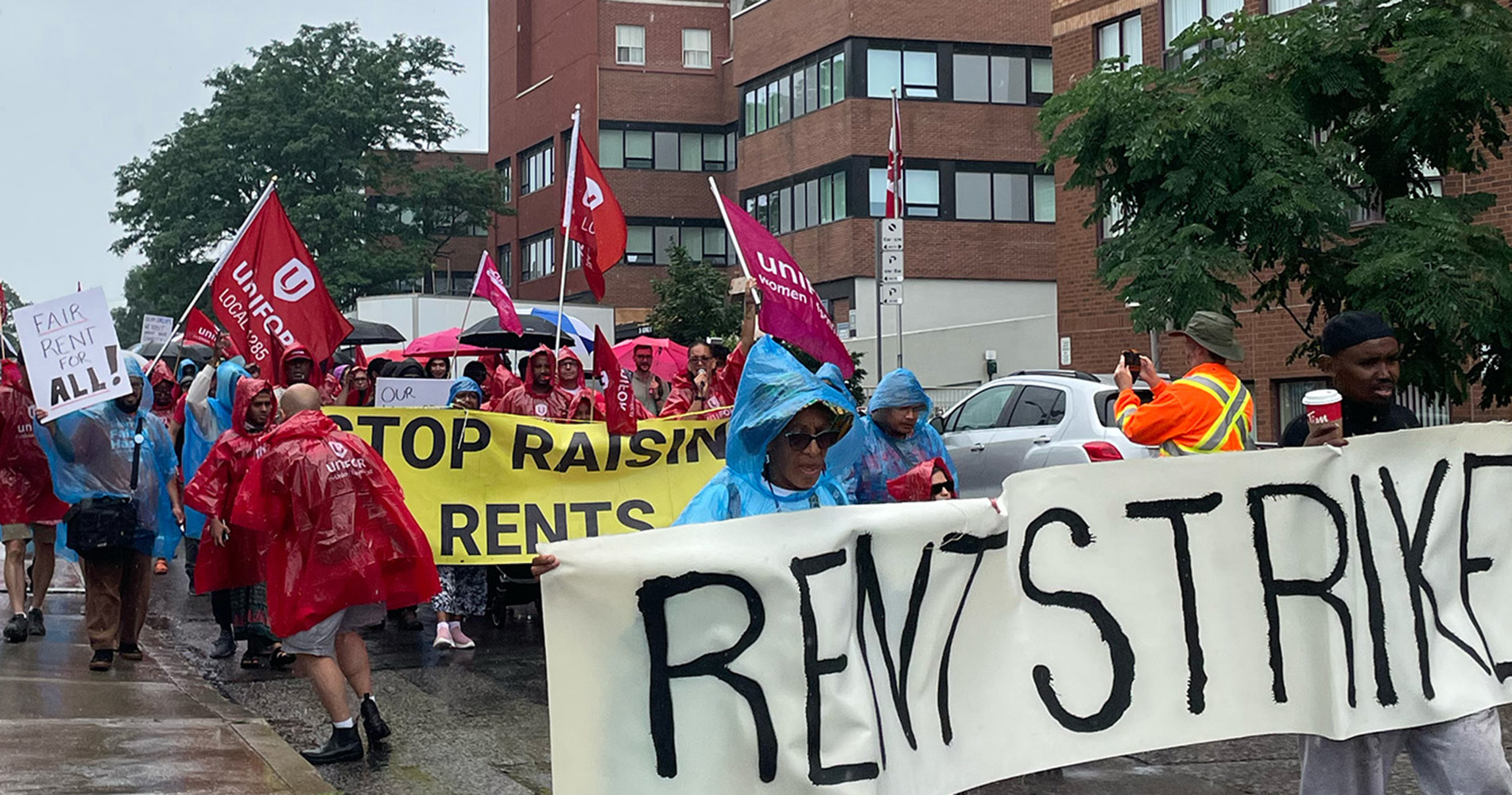
This issue of One Picket Line presents recent examples of solidarity actions between the labour and tenant movements, drawing on interviews with four organizers involved in three rent strikes in Toronto, three national labour unions, and two divestment campaigns. Labour can participate in housing struggles in many ways, but fortifying the frontline should be a priority, and that can be done in the very concrete ways discussed below.
Material support
Despite all the talk of housing affordability and the many civil society groups involved in housing advocacy, very little funding is directed to tenant organizing, which institutional donors, such as foundations, see as too political and adversarial. Labour unions understand that asking nicely doesn’t work. They also know it takes resources to move people. Examples of material supports include:
- Funding – donations for specific political actions and ongoing organizing support
- Lending office and meeting spaces
- Educational and training opportunities for tenant organizers
- Printing flyers, posters or other outreach materials
One of our interviewees was booked off on union duties for several weeks in order to canvass her building in preparation for a rent strike—which turned out to be one of the largest and most successful in Canada’s history.
Coalition building
For tenant organizers, mobilizing resources and support requires connecting with existing political networks in a city—a process that can take years. Long-established union locals and labour councils can speed this up, connecting tenant groups to prospective allies.
What does that mean in practice? Our interviewees identified the following actions:
- Directly connecting tenant organizers with organizations interested in coalition building
- Identifying unionized workers who are tenants in specific buildings and neighbourhoods
- Filing access to information requests for union pension fund holdings
- Introducing tenant organizers to active rank-and-file members
Bruno Dobrusin, a tenant organizer in Toronto, told us that “often it was the labour council that connected us with other activism in the city, and they helped us connect with the right person who could get things moving right away.”
Showing up
Unions know that moving people is hard work, and that’s even more true with limited resources. Tenant organizers told us that labour’s presence at tenant demonstrations and on picket lines boosted not only their numbers, but also morale among their ranks. We heard that it meant a lot, especially for the tenant union members who are unionized workers.
Those interviewees also provided us with some ideas of more ways labour can show up, such as:
- Participate in tenant demonstrations and picket lines
- Public endorsements of tenant union campaigns and actions
- Logistic and material support for demonstrations and occupations
Two interviewees noted that unions also benefit from participating in tenant actions. By being seen on the ground, shoulder to shoulder with their members, unions communicate to their members that they have their backs, not only at work but also in their community.
Outreach and political education
Labour unions can create space for their members to speak about tenant issues and tenant organizing. In doing so, they help break down the embarrassment some workers feel about their living conditions, shifting the focus from the individual to a collective concern. Ways labour unions can create these spaces include:
- Inviting union members who are part of tenant unions to present at meetings and conventions
- Tasking communications teams with amplifying tenant campaigns and political messages
- Tasking political education teams with creating courses and resources on tenant issues
- Creating local committees on housing
- Hosting neighbourhood-based workshops with union locals on tenant issues
Sharlene Henry, tenant and labour organizer in Toronto, told us, “I would love to see even a one-day training for folks about how our struggles are connected. Lots of tenants live with a sense of fear and shame about being tenants. But there is nothing wrong with it! We pay taxes, we shop local, we contribute to the community, we do all the same things.”
Consciousness raising
Interviewees mentioned that the dual involvement in labour and tenant organizing helps people to shift the focus from individual to collective issues. Both work precarity and housing insecurity act as disciplining forces, making people afraid of losing more, experiencing further deprivation.
“Experiencing job and pay uncertainty will get in the way of being mobilized for other issues” was how labour organizer James Infantino put it to us.
“The housing crisis has a disciplining effect,” said labour organizer Jack Copple in an interview. “Its sharpest expression is homelessness… a visible reminder of what can happen to you if you fall, and we could see it every day on the way to work. It reminds us that there is no safety net, you’ll end up out here in the street.”
But through engagement with tenant and labour organizing, it becomes clear there is just one economic system, one class of bosses-landlords who are double-dipping on workers: paying low wages and taking a huge chunk of those wages in the form of high rents. In some cases, it is literally the same corporation doing it.
One interviewee, after successfully leading a rent strike, decided she was ready to fight on both fronts: she took on a leadership position in her union, while continuing to organize her neighbours. Her labour union is stronger because of it.
Impacts
The first issue of One Picket Line presented estimates that nearly 1.4 million unionized workers are also tenants. This group is growing as new workers join unions, older workers retire, and within sectors with part-time work. In many cities, average wage increases for unionized workers have not kept pace with the rising cost of housing, meaning that much of unions’ collective bargaining gains are lining the pockets of landlords. Labour needs to step into the housing struggle in a big and concerted way. Through the actions above, we can build solidarity and amplify the impacts of our political actions.
About the authors
Vivienne Walz
Vivienne Walz is a graduate student in Community Economic Development at the School of Community and Public Affairs, Concordia University.
Ricardo Tranjan
Ricardo Tranjan directs the research program for the CCPA-Ontario. Ricardo’s expertise centres on Ontario public finances and the political economy of social policy, especially public education funding, income support programs, and rental housing. He is the author of multiple books, including The Tenant Class (2023).