
Share
This is an article from Our Schools/Our Selves. Read the entire issue.
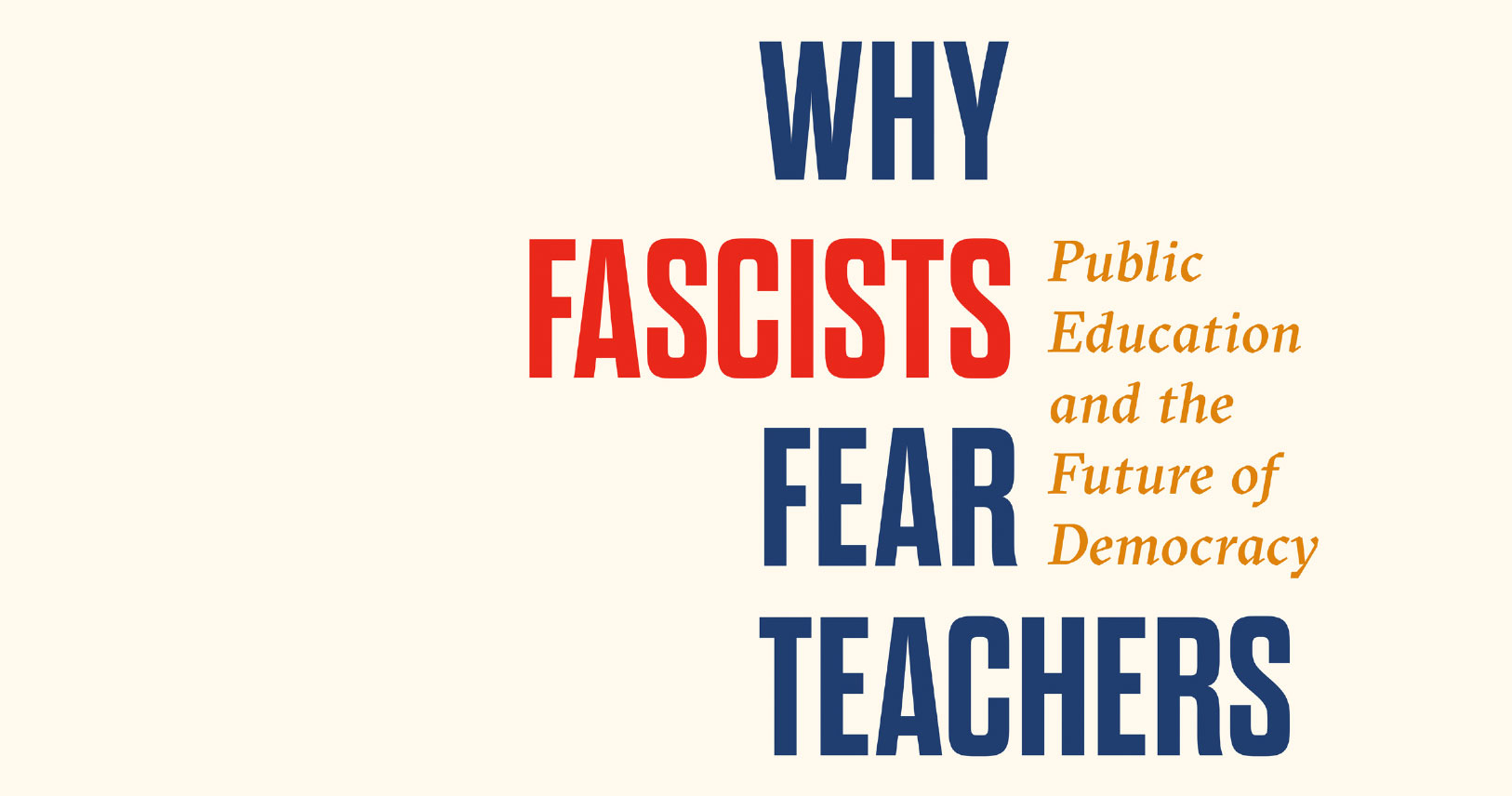
In the current political moment, teachers and public education are under attack in many parts of the world where far-right political movements are ascendant. As Randi Weingarten discusses in her latest book, Why Fascists Fear Teachers: Public Education and the Future of Democracy, this is a phenomenon with deep historical roots.
Weingarten is president of the American Federation of Teachers, the second-largest teachers’ union in the USA. Here she lays out what she sees as the main reasons fascists, authoritarians, the far-right, and the oligarch class (groups that are not entirely synonymous, but are allied in this particular moment) feel threatened by teachers and by the institution of public education, and why they attack teachers while working to dismantle public education.
Much ink has been spilled equivocating over whether U.S. President Donald Trump and other far-right governments can be called fascist, with many people preferring more ambiguous language. But a problem must be named and understood to be acted on effectively, and it’s refreshing to see someone of Weingarten’s stature speak frankly about what’s happening in the education landscape, and why.
In Jason Stanley’s 2018 book How Fascism Works: The Politics of Us and Them, which Weingarten cites extensively, Stanley clarifies that “fascist politics” does not necessarily lead to state-level fascism, but should be recognized nonetheless for the danger it poses to democracy. Weingarten addresses the reluctance to use the f-word with the statement, “The perfect definition of fascism will be clear in the rearview mirror—but by then it may be too late for our children and our country.”
This is a particularly good point to keep in mind in the Canadian context. While many people who were reluctant to label Trump a fascist have admitted they were mistaken and acknowledged the current reality, Canadians may be reluctant to acknowledge fascist politics in our own context. The broader concept of “fascist politics” can guide our reflections on how many of the trends and events described by Weingarten are echoed in Canadian education systems. Culture-war attacks on public education as an institution, accusations of ideological indoctrination levelled at teachers, and a relentless push for privatization in order to undermine and defund public education are all features of current education politics in Canada.
Weingarten opens with a historical overview of the Norwegian teachers’ resistance to the Nazi occupation in the 1940s, and the punishing consequences of that resistance. She then moves on to present-day authoritarian attacks on public education by Vladimir Putin, who has explained his reasoning with the statement, “Wars are won by teachers.” She also describes how far-right activist Christopher Rufo has pioneered modern-day attacks on American public education, prosecuting what he calls a “narrative war” on public education in order to sow distrust. Rufo is one of the architects of the right-wing Project 2025, which aims to reshape the U.S. government in order to enact a suite of right-wing policies. Rufo also invented the panic around supposed “critical race theory” in schools.
The remainder of the book outlines the four main motivations that fascists have for attacking teachers, illustrated by many examples from recent years.
First, teachers teach critical thinking, whereas fascism works to short-circuit critical thinking in favour of gut feelings of fear and rage. Angry and resentful people can be manipulated to believe the system is broken, and to place their trust in an authoritarian who promises to fix it. Fascists also understand that critical thinking makes young people more resistant to indoctrination and the types of simplistic messaging favoured by fascist politicians. Weingarten discusses measures that have been enacted in several states to restrict what teachers are allowed to teach, and identifies how teachers are fighting back.
Second, teachers (and public schools) create safe and welcoming communities for all children, while fascists oppose pluralism and seek to dehumanize various groups such as 2SLGBTQIA+students, Black students, and immigrants. Third, teachers fight for equity and opportunity for all children, while fascists believe in hierarchy and want to reinforce and widen existing class divides, many of which overlap with racial divides.
Finally, teachers build strong unions, which pose a threat to the oligarch class. Teachers’ unions are some of the largest in America, and are therefore singled out by powerful interests. Weingarten outlines the privatization tactics that the billionaire class has employed for decades to weaken teachers’ unions—expanding initiatives such as charter schools and school voucher programs. The hatred of unions stems in part from the political power these organizations hold, which can frustrate authoritarian ambitions. But Weingarten makes it clear how important teachers’ unions are to the overall quality of public education, as collective bargaining often involves negotiations around supports for students. These gains for the most vulnerable students frustrate the fascist goal of maintaining existing social divisions.
The book’s concluding section, titled “The Way Forward—For All” is unfortunately a little thin. Weingarten notes that she is writing this book in the early days of Donald Trump’s second term, and describes his intentions to dismantle the federal Department of Education—intentions that he has since translated into action. Weingarten paints a bleak picture of the consequences of these actions for the country’s most vulnerable students. She also gives a brief overview of how the Trump regime’s attacks on education extend to colleges and universities.
Weingarten notes that fascist politics continues to pose an existential threat to students, and to democracy. However, she doesn’t propose much in the way of action other than a statement that teachers will continue “to show up and stand up for the needs of our students.” This seems like a pretty weak stance for the head of one of the country’s largest unions. Weingarten finishes with some more thoughts on how public education and democracy are inextricably linked, but doesn’t seem clear on how we can collectively resist authoritarian attacks on the public education system.
Despite this shortcoming, Weingarten provides a valuable service in diagnosing the pathologies behind the current attacks on public education. Coming up with a cure will be the urgent task of not only teachers, but parents, student activists and citizens who want to save their democracy.
About the author
Heather Ganshorn
Heather Ganshorn is the Research Director of Support Our Students Alberta, a non-partisan, non-profit public education advocacy group fighting for the rights of all children to an equitable and accessible public education system. She is an academic librarian and the mother of two children in the public education system.