
Share
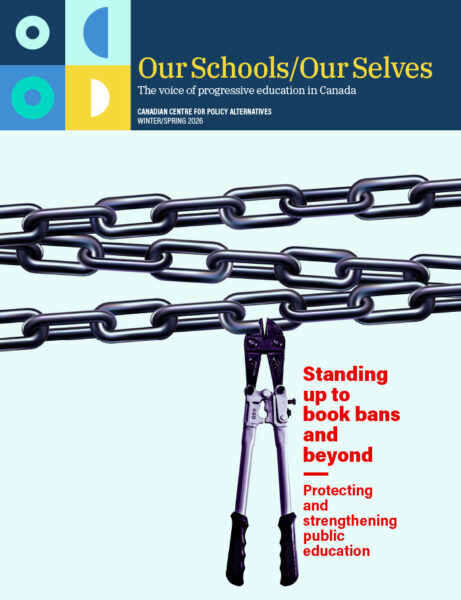
This is an article from Our Schools/Our Selves. Read the entire issue.
“Yeah, we need to invent a crisis, and that’s not just an act of courage; there’s some skill involved.” —John Snobelen, Minister of Education, Ontario 1995
People of a certain age may remember when then-Ontario Education Minister John Snobelen, (in)famously a high school dropout, was caught ruminating about the need to create a crisis in education to justify its overhaul. He also referred to students as clients, parents as customers, and teachers as “front line service providers” in an interview forebodingly titled “For Whom the Bell Tolls” shortly after assuming this key role in Mike Harris’s Common Sense Revolution.
A push-poll was conducted, clearly designed to whip up public sentiment against public education. The Education Quality Improvement Act (Bill 160), funding cuts and centralization of authority followed. And at the end of October 1997, unions and the public rallied in a two week period of strikes and protests across Ontario.
On November 10, the strike ended when, one by one, education union leadership instructed members to return to work—despite polling indicating a majority of the public supported the teachers. And on December 1, 1997, Bill 160 became law.
Cuts to public education In Ontario—or across Canada, for that matter, as provincial governments follow a similar template—did not begin in December 1997. And they certainly didn’t end when the Ontario Conservatives were voted out in 2003. But this period is a reminder of what’s at stake when we assume progress, or support for the public institutions that make progress possible, is a given. And it provides a useful and increasingly relevant roadmap of the regressive forces that have never vanished, particularly when it comes to limiting their influence and authority.
Public institutions and infrastructure hold a mirror up to society and are also expected to compensate for (or absorb) society’s inadequacies. The first role—as a mirror—reflects how the State has either invested in and supported communities, particularly those most vulnerable—or not. The second role is indicative of what happens when the State neglects its first responsibility, and how public services (and those who staff them) are expected to respond, often with fewer and fewer resources, in some cases as the last line of defence against the ferocity of neoliberalism.
Inequality is skyrocketing. Wages are not keeping pace with basic needs. Housing is increasingly financialized. Provincial and federal governments aren’t doing even the bare minimum to deal with the crisis in post-secondary education and training. Cuts to the federal public service stand to decimate programs that we all depend on—to massively increase funding to National Defence.
This is where public education is situated—at a time when provincial governments continue to underfund and underresource, as class sizes grow, as special needs programs are shortchanged, and as control is centralized.
And as educators, students and their families pay the price—in communities across the country.
The authors in this issue explore what students, educators and school communities are grappling with in the absence of provincial leadership that sees public education as a system and a service to be prioritized rather than a budget to be decimated.
From rising violence, to pronoun wars, to the denigration of certain degrees as akin to “basketweaving,” to book bans, to (more) cuts to student assistance, to governments using mechanisms to sidestep their legal obligations, public institutions are under attack.
But as these articles also demonstrate, workers are pushing back, in defense of their rights and in defense of the public education system and the students and communities it services.
It bears mentioning that 30 years later we are exactly where advocates warned us we would be when John Snobelen waxed poetic about creating a crisis in education. The difference is that subsequent provincial governments right across the country—within a federal framework that seems intent to willingly shrink to a bathtub sized version of itself (google Grover Norquist)—have steadily, relentlessly chipped away at the funding infrastructure that keeps our schools viable, and the democratic mechanisms that help ensure public responsiveness and community engagement, under the rhetorical guise of “efficiency” and “accountability.”
If we are to learn anything from the decades of activism, it is that progress is never a given, that the fight for justice and equality is ongoing, and that building empathetic and compassionate communities is a full time commitment.
We are as indebted as we were back in the 90s to those who continue to remind us, every day, in word and deed, that while the stakes are high, so too must be our standards when it comes to shaping the world as we want it to be….and what we must do to get there.
About the author

Erika Shaker
Erika (she/her) became Director of the National Office in 2020, but began her career at the CCPA in 1997 as director of the Education Project. Originally established to monitor corporate intrusion in public education, the project broadened its focus to include standardized testing, social justice and anti-racism education in schools, educational equity, school finance, child care and early childhood education, tuition and user fees, technology, surveillance and privacy, the arts, and community-based education. In 2000 she also became editor of Our Schools/Our Selves, the popular education journal founded in 1988. It provides commentary and analysis on a wide variety of education-related topics. Erika has a BA in History from McGill University and an MA in English (critical literary analysis) from the University of Guelph. Prior to coming to the CCPA, she worked in Washington DC researching the corporatization of childhood, and was one of the founders of UNPLUG (which became the now-defunct Center for Commercial-Free Public Education). She spends far too much time on social media.