

- Home
- Topics
- Regions
- Magazines
-
-
-
The Monitor
Read the latest issue about why it’s time to change the rules of the game for extreme wealth in Canada
-
-
-
-
Our Schools/Our Selves
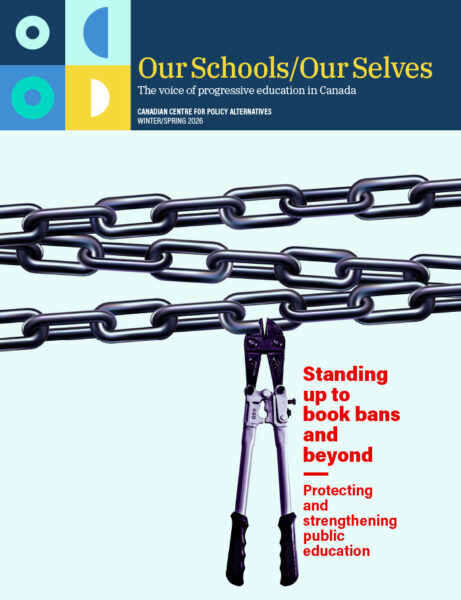
Read the latest issue, a guide to standing up to book bans and beyond, and how to protect and strengthen public education in Canada
-
-
-
-
- Media Inquiries
- Subscribe
- Legacy Gifts
- About
- Contact
- Donate Now
- Donate Now

Search results for “"http:/www.shutterstock.com/editorial”
-

Youth Voices: Supporting refugee youth through through community connections
I recently finished my Bachelor of Arts degree at the University of Winnipeg in Politics and International Development Studies, which included a practicum placement with CCPA. Throughout most of my degree, I volunteered with the university’s Local Committee of the World University Service of Canada (WUSC). WUSC is a national…
-
CCPA comments on the Omnitrax NAFTA lawsuit
Senior Trade Fellow Scott Sinclair, who directs the CCPA’s Trade and Investment Research Project, spoke to CBC Manitoba’s Ismaila Alfa on November 14 about Omnitrax’s threatened NAFTA Chapter 11 investor-state lawsuit against Canada. In its statement of intent to file a NAFTA claim, the U.S.-owned company says it’s unable to…
-
Resource Royalties: A Cure for Dutch Disease
I have the following op-ed in today’s Saskatoon StarPhoenix: Royalty hike cure for Dutch disease Premier Brad Wall calls federal NDP Leader Tom Mulcair “very, very divisive” for expressing concern that Canada’s overvalued petro-dollar is eliminating manufacturing jobs. In reality, Wall is being divisive by exploiting this legitimate concern to fan the flames…
-
A call to all BC political parties: time to commit to a poverty reduction plan
In early February, over 200 organizations and community leaders from across BC issued an open letter to BC political parties, calling on them to commit – prior to the May election –– to a comprehensive poverty reduction plan, with legislated targets and timelines. We were among the signatories. The time…
-
Path of Destruction
Canadian mining companies on rampage around the world Canada is the world’s leading mining nation. Sixty per cent of all public mining companies are listed on the Toronto Stock Exchange. About half of all mining capital is raised in Canada. Many Canadian mining companies have become notorious for damaging communities…
-
An Ugently Needed Change in Monetary Policy
Borrowing from Bank of Canada would make governments debt-free Through the publicly-owned Bank of Canada, which was established in 1935, the federal government can borrow money, essentially interest-free, and make such funds available not only for its own use, but also for provincial and municipal governments. Such borrowing helped Canada…
-
April 2008: Industry at a Crossroads (Part I)
Canada’s forest industry reeling from market, monetary shocks The Canadian forestry industry, long one of the stalwarts within the Canadian economy, is now at a precarious crossroads. “Crisis” is the term being used by union, business, and political leaders to describe the parlous state of the industry. An estimated 110,000…
-
Harper vs. Kyoto: where does that leave Québec?
On 12 December 2011, the Canadian Minister of Environment, Peter Kent, officially announced Canada’s withdrawal from the Kyoto Protocol. In effect, Canada will no longer be legally constrained to meet greenhouse gas (GHG) emissions reduction targets. According to Scott McKay, the Parti québécois’s Shadow Minister for the Environment, “the gap…
-
Tax haven based company buys more BC P3s: British Auditor General questions profits in such transactions
Two of British Columbia’s public private partnership (P3) projects have changed hands again and once again the new owner resides in a European tax haven. In a separate but related development, last Friday Britain’s Auditor General released a report questioning very high level of profits for some British P3 projects…
-
The Harper House Rules: An Intervention
Stephen: We recognize that no roommate is perfect, and from time to time we have all gotten on each other’s nerves. But you take the cake (and let’s be honest, sharing anything—including cake—is not exactly your thing). Because you have signed a sub-lease with a previous tenant (who, we might…
-
The Importance of the CCPA in Nova Scotia
In the policy milieu of the Maritimes, the Nova Scotia branch of the Canadian Centre for Policy Alternatives is showing itself to be a crucial progressive voice, by providing a viable alternative to austerity measures that target the most vulnerable. Watch these prominent Nova Scotians and CCPA stakeholders give their…
-
Site C is not necessary and if completed would raise British Columbians’ Hydro bills: submission
CCPA-BC submission reconsiders the economics of Site C dam READ THE FULL SUBMISSION HERE. Vancouver–The Site C dam is not necessary, and moving forward to completion is likely to have adverse impacts on BC Hydro and ratepayers of all classes. That is the conclusion of a submission to the BC…