


Share
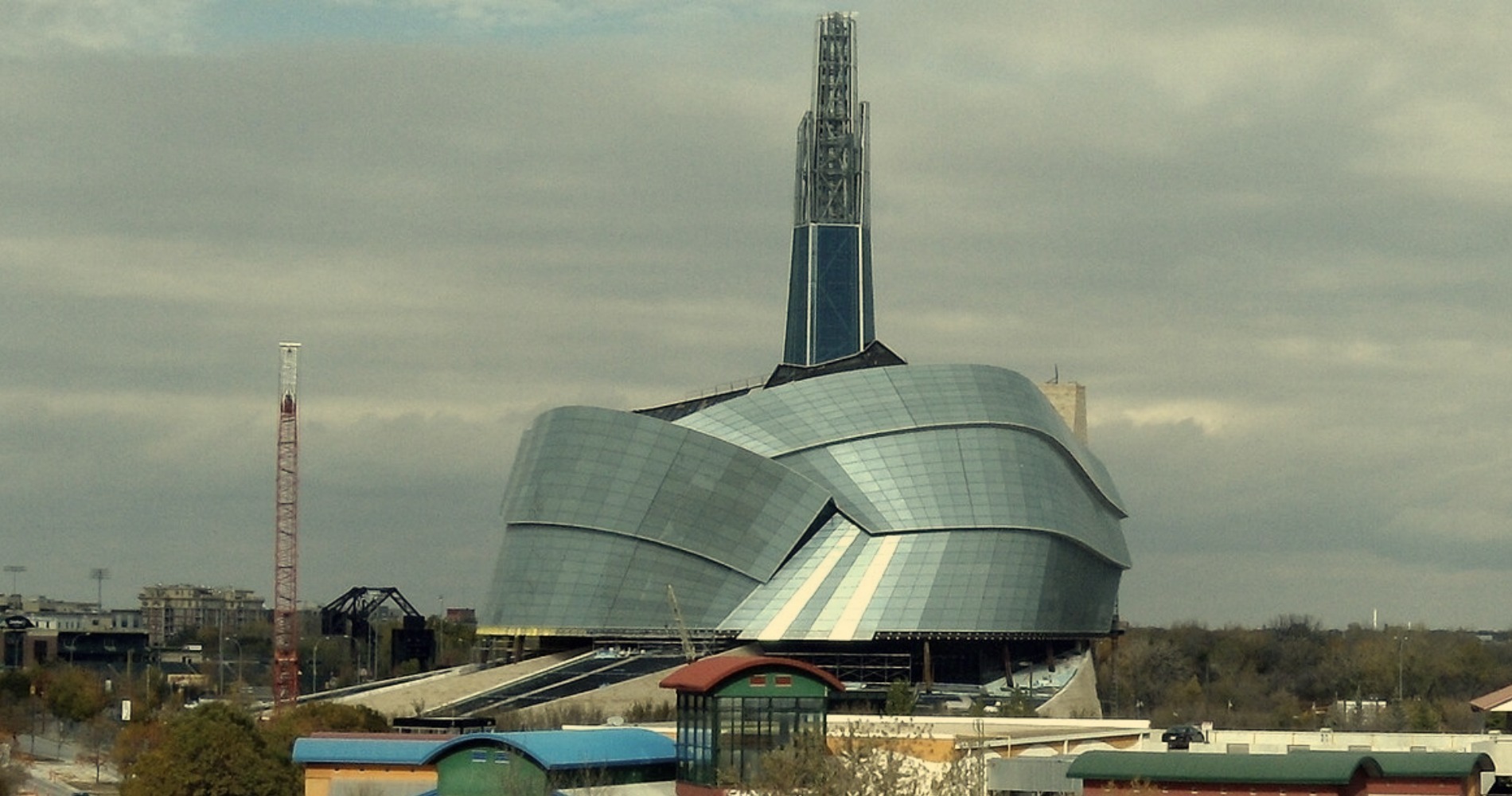
On June 27, the Canadian Museum for Human Rights (CMHR) opened Palestine Uprooted: Nakba Past and Present, an exhibition exploring Palestinian history and culture through photographs, video testimony, artifacts, art, and interactive displays. The museum describes the exhibition’s subject as the human rights violations associated with the “ongoing forced displacement and dispossession of Palestinians.” It is scheduled to be on display at the Winnipeg-based national museum until November 2028.
Uniquely, this exhibition was subjected to a sustained political campaign long before it even opened and any member of the public was able to see it. The Centre for Israel and Jewish Affairs (CIJA) began campaigning against it in November 2025, arguing that the museum had failed to consult the organizations it considered representative of Canada’s Jewish community. In May 2026, the Tel Aviv-based organization Shurat HaDin further escalated this campaign by threatening legal action and demanding that the museum pause the exhibition. Not least, Israel’s Ambassador to Canada wrote a letter to Prime Minister Carney demanding the exhibition be halted – an extraordinary attempt by a foreign diplomatic representative to influence the programming of a Canadian national museum.
Claims that “Jewish voices” were excluded should also be scrutinized. Jewish scholars participated in both the museum’s Palestinian Content Advisory Network (PCAN) and its broader consultations, while several Jewish organizations publicly supported the exhibition. No single organization can claim to represent all Jewish perspectives or demand a veto over how Palestinian history is presented. As with other exhibitions curated by the museum, PCAN also included people with lived experience as well as subject-matter experts, including co-author and PCAN member Yasmeen Abu-Laban. All this was in keeping with the museum’s standard practice of gathering expert input and centering the experiences of those suffering human rights abuses. Still, final choices and authority always remained with the museum, in keeping with curatorial independence.
The Canadian Museum for Human Rights, like all museums, should not be insulated from public debate. Indeed criticism from affected communities, scholars, visitors, and civil society organizations can help expose omissions, improve institutional practices, and contribute to the very reflection and dialogue that the CMHR was created to encourage. However, such concerted calls to pause or halt an exhibition before it has even opened are alarming. These calls cast a chill on both the free speech and creative independence of curators in future exhibitions at the Canadian Museum for Human Rights and other national institutions.
Worse still was the intervention of the Minister of Canadian Identity and Culture—the minister responsible for national museums—following the exhibition’s opening.
After visiting the museum, Minister Marc Miller told the Canadian Press that the exhibition had made an “error in curation.” He identified various issues he felt should be “rectified” and specifically objected to the fact that Hamas, while mentioned briefly in the short text accompanying the exhibition, was not discussed as he would like. Yet the exhibition is focused on the Nakba, that is, the mass displacement of Palestinians from their homes during 1947 and 1948, events that took place roughly four decades before Hamas was founded.
At the same time, Miller acknowledged: “It isn’t up to me to speak to, or insert myself in, the curation of any particular exhibit.” The contradiction is difficult to avoid. The minister said he should not insert himself into an exhibition’s curation and then did exactly that—publicly identifying what he considered curatorial errors and calling for them to be corrected.
Miller’s words cannot be separated from his office. He was not invited into the public debate because of personal expertise in history, museum studies, or exhibition design. His comments became national news precisely because he was the minister responsible for the federal museum portfolio. When such a minister labels particular curatorial judgments erroneous and calls for “rectifying” the exhibition, the museum’s curatorial independence is on the line.
What the Museums Act establishes
The policy architecture surrounding Canada’s national museums helps explain why that matters.
The CMHR is not a branch of the Department of Canadian Heritage. It is a Crown corporation established under the federal Museums Act. The museum’s statutory purpose is “to explore the subject of human rights… in order to enhance the public’s understanding of human rights, to promote respect for others and to encourage reflection and dialogue.” The Act expressly authorizes the museum to undertake research, organize exhibitions, and communicate knowledge related to that mandate.
The legislation also establishes a division of responsibility. The museum’s Board of Trustees is responsible for fulfilling its statutory purpose and managing its “business, activities, and affairs.” The director serves as chief executive officer, controls and supervises the museum’s work and staff, and is responsible to the board, not to the minister. Museum employees are not members of the federal public service.
The CMHR’s own corporate plan reflects this arrangement. It describes the museum as a Crown corporation governed by a Board of Trustees, with the board accountable to Parliament through the minister. It also identifies the development of curatorial practice and accountable content choices as an internal institutional responsibility.
The distinction between oversight and curation is essential. The minister and Parliament may examine expenditures, appointments, compliance with legislation, and institutional governance. They do not decide which historical terminology curators should use, or which political context must appear in an exhibition. Miller did not merely raise a procedural question. He publicly identified content he considered deficient, stated what he believed the exhibition should say and seemingly demanded that it be revised.
His intervention was especially damaging because it validated, and rewarded, an organized campaign that had already sought to stop the exhibition from even opening. CIJA quickly presented Miller’s comments both as a direct result of its political pressure and as confirmation that its warnings had been justified.
An accountability question
Defending curatorial independence does not require treating museum professionals as infallible. Museums make mistakes. Their research and interpretive choices should be open to scrutiny. Boards must oversee institutional policies, finances, and strategic direction, and curators should be able to explain the evidence and processes behind their work.
The policy issue at hand is not whether the exhibition is beyond criticism or whether Canadians must agree with all of it. Indeed, some have felt the exhibition language was too restrained in detailing the violence leading to Palestinian dispossession and displacement, and Palestinian Canadians have been clear, from well before the Canadian Museum for Human Rights opened in 2014, that they wanted a permanent exhibition in the museum, rather than the mere two years this is scheduled to run. The issue is not about criticism, but about who has the authority to make and revise choices.
To our knowledge, there is no clear recent Canadian precedent for a federal minister publicly identifying the wording of a particular exhibition at a national museum as a curatorial error and calling for its correction. Canada has experienced many public controversies involving museums, but direct ministerial criticism of the specific language and interpretation used in a current national museum exhibition appears highly unusual.
That makes it important to establish the appropriate boundary now, rather than waiting for political involvement in museum content to become routine.
A warning from the Smithsonian
The Smithsonian Institution in the United States offers a warning about what can happen when the boundary between public oversight and historical interpretation begins to erode.
In March 2025, President Donald Trump issued an executive order directing Vice-President JD Vance, through Vance’s position on the Smithsonian’s Board of Regents, to seek the removal of what the administration called “improper ideology” from Smithsonian museums. The order also directed officials to pursue restrictions on federal funding for exhibitions considered inconsistent with the administration’s preferred presentation of American history.
The administration subsequently reviewed museum materials and publicly criticized the Smithsonian’s presentation of subjects including race, slavery, gender, and national history. In July 2026, Smithsonian Secretary Lonnie Bunch rejected a White House report’s characterization of the National Museum of American History as promoting a “radical” leftist ideology and “extreme political activism,” while the Organization of American Historians described the government’s approach as an effort to make historical presentation serve a political agenda.
More recently, the Trump administration further escalated its campaign against the Smithsonian by ordering that the National Parks Service (which controls the sidewalks outside Smithsonian museums) post signs outside the National Museum of American History redirecting visitors to what is deemed to be “accurate information regarding America’s history.” This move clearly denigrates the museum, its exhibitions, and curatorial independence.
Marc Miller’s comments are not equivalent in scale to the Trump administration’s systematic intervention. However, the lesson of the Smithsonian case is about what happens when policymakers weaken institutional independence. Political authorities may begin by condemning particular interpretations, proceed to requesting changes, and may eventually use appointments or funding to shape what museums are even permitted to say.
Clarifying the boundary
The federal government should respond to the CMHR controversy by strengthening, rather than testing, the arm’s-length model:
- Minister Miller should clearly reaffirm that judgements about the historical framing and language of individual exhibitions belong to the museum’s established professional and governance processes.
- The Department of Canadian Heritage should develop guidance distinguishing legitimate ministerial oversight from involvement in programming and curation.
- National museums should adopt explicit curatorial independence policies to better educate the public about the important role curators play and the value of freedom from censorship. These policies should also explain the respective responsibilities of trustees, senior management, and curatorial staff; the role played by advisors; the role of donors; as well as the procedures for addressing alleged factual errors.
These kinds of safeguards are not meant to protect museums from public criticism or debate, or the importance of maintaining public trust. But they would ensure that criticism is considered through transparent, evidence-based processes rather than according to the political influence and power of the person or organization making it.
Now that it is open, visitors should see Palestine Uprooted: Nakba Past and Present. Indeed, many visitors may learn about the history and culture of Palestinian Canadians for the first time; others may debate what is there and not in the exhibition based on pre-existing understanding. But museum content ought not be halted in advance under threat of legal retaliation, and it also should not be rewritten at the direction of a minister in light of Canada’s Museums Act. Arm’s-length independence means little unless it protects institutions when content is contested.
This article is part of The Omatsu Files, a running column written in memory of Rick Omatsu, who was born in 1939 in Vancouver, on the cusp of WWII, which would change his life—a life that was sadly marked by racism. As a Japanese Canadian, in 1942, Rick was sent to the B.C. interior. After the war, the family was forced by the government to leave the province. The family relocated to Hamilton, Ontario, where Rick remained until his passing at age 82. The Omatsu Files is a space dedicated to the voices of young researchers from equity-deserving backgrounds who are focusing on issues of equity, diversity, inclusion, and anti-racism.
About the authors
Nir Hagigi
Nir Hagigi is an MA candidate in Political Science at York University and a Graduate Diploma student in Advanced Hebrew and Jewish Studies at the Koschitzky Centre for Jewish Studies. His research focuses on the history and migration of Tunisia’s Jewish communities. He is a graduate of Carleton University’s Global and International Studies Program.
Yasmeen Abu-Laban
Yasmeen Abu-Laban is Professor of Political Science and Canada Research Chair in the Politics of Citizenship and Human Rights at the University of Alberta. A member of the Palestinian Content Advisory Network for the Canadian Museum for Human Rights, her research examines citizenship, immigration, human rights, anti-racism, and the politics of Israel and Palestine.

