




Share
Fast facts
- This fall, Alberta’s new two-tier health care system takes effect.
- A new Abacus Data public opinion survey of 1,500 Alberta residents and 1,500 respondents from the rest of Canada shows widespread opposition to U.S.-style, two-tier health care, where physicians and private facilities can bill patients and the public system for medically necessary health care.
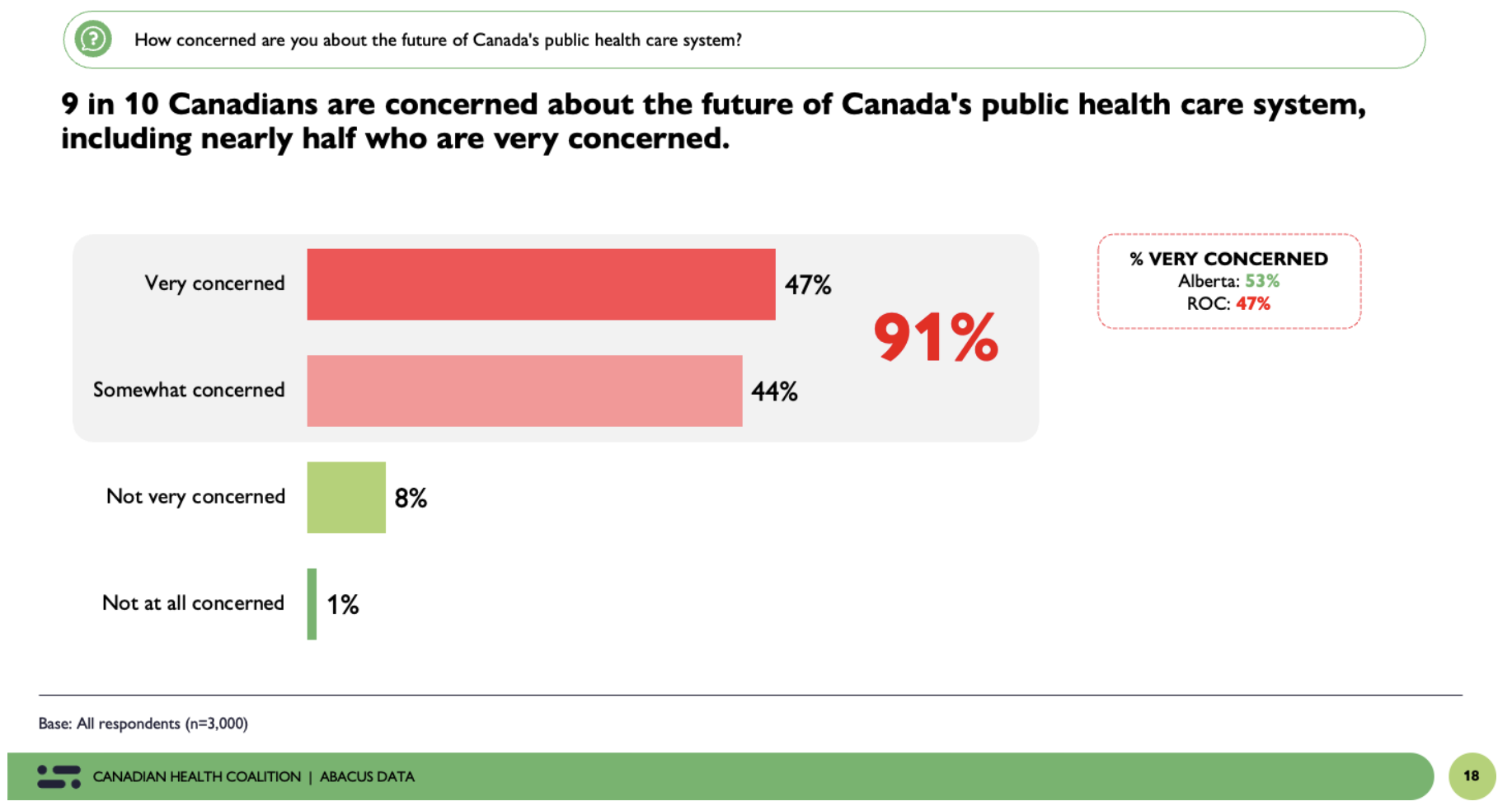
- Nine in 10 Canadians are concerned about the future of public health care—half of them worry about the cost of health care in the future.
- This national survey shows that the Alberta government is pushing a policy direction that is not aligned with the research evidence nor does it have support in Alberta and across Canada.
-
While the Alberta government continues to advance the idea that Albertans have distinct views from the rest of Canada, this poll finds that Albertans share similar views with the rest of the country.
- At 86 per cent of respondents, Albertans overwhelmingly believe universal health care based on need, not ability to pay, is a core Canadian value.
- Albertans also strongly believe (78 per cent) that public health care can meet the needs of Canadians if governments invest more in it.
- On the issue of whether corporations and doctors should have the unrestricted ability to charge patients for health care, Albertans are also on the same page with the rest of the country: 77 per cent disagree with that premise.
- A clear majority of respondents across Canada and in Alberta want public solutions to reduce wait times, including a focus on health care workforce expansion (65 per cent for all of Canada and 68 per cent of Albertans).
Canadians aren’t clamouring for U.S.-style health care
New public opinion research shows that Canadian residents strongly oppose the introduction of U.S.-style, two-tier health care by the Alberta government.
This fall, the Alberta government will bring Bill 11 (Health Statutes Amendment Act, 2025) into force. This legislation legislates a U.S.-style, two-tier health care system where physicians and surgeons can work in the public system and the private-pay market at the same time, charging patients for medically necessary health care, including surgeries.
On July 31, Alberta’s Bill 29 (Health Statutes Amendment Act, 2026) established a two-tier model for medical imaging, including MRI scans, where providers can charge wealthier patients out of pocket for faster diagnosis and treatment.
Together, Bill 11 and Bill 29 open the door to a U.S.-style private health insurance market for health care already covered under the public plan, which directly contravenes the Canada Health Act. The Alberta government likens its reforms to “European” health care, which careful analysis shows not to be the case.
The Alberta government claims that the public is frustrated with long health care wait times and that greater private-pay options will address these challenges. But a new national opinion survey challenges these arguments.
The 3,000-person Abacus Data survey (1,500 respondents in Alberta and 1,500 in the rest of Canada) conducted for the Canadian Health Coalition offers insight into Canadians’ opposition to Alberta’s U.S.-style health care model and preference for investments in the public health care system.
Our publications are available to all at no cost. Please support the CCPA and help make important research and ideas available to everyone.
Make a donation today.
Most Canadians are quite concerned about the future of public health care
When asked if they are concerned about the future of public health care, nine in 10 Canadians are concerned about the future of public health care (44 per cent are somewhat concerned and 47 per cent are very concerned). In Alberta, the share of residents who are very concerned jumps to 53 per cent. Only nine per cent of those surveyed are not concerned.
Long ER waits, workforce shortages, and access to providers—major concerns
Respondents across Canada identify the following as areas of major concern: emergency room delays (73 per cent), shortages of health care workers (72 per cent), wait times to see medical professionals, access to specialists (61 per cent), and the lack of long-term and assisted living (58 per cent).
Not far behind are concerns about having to pay out of pocket for health care (54 per cent) and the increased use of for-profit companies to deliver health care (45 per cent)—the very things that will increase under Alberta’s two-tier system.
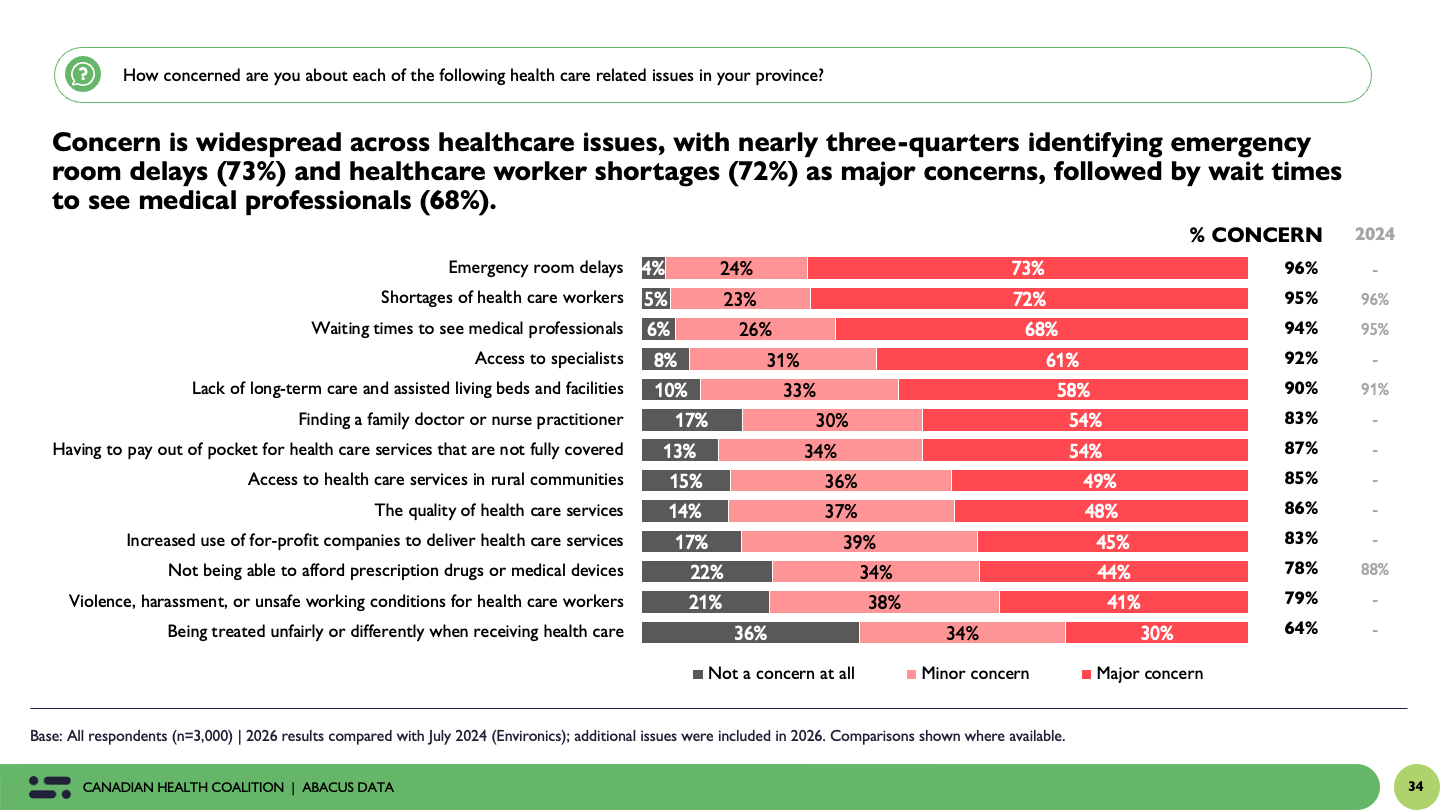
Among Albertans, the major concerns are very similar to those in the rest of Canada. Even among United Conservative Party (UCP) voters, concerns about having to pay out of pocket for health care (44 per cent) and increased for-profit health care delivery (33 per cent) are significant. Health care wait times remain a concern that transcend party affiliation.
Universal public health care is a core value in Alberta and across Canada
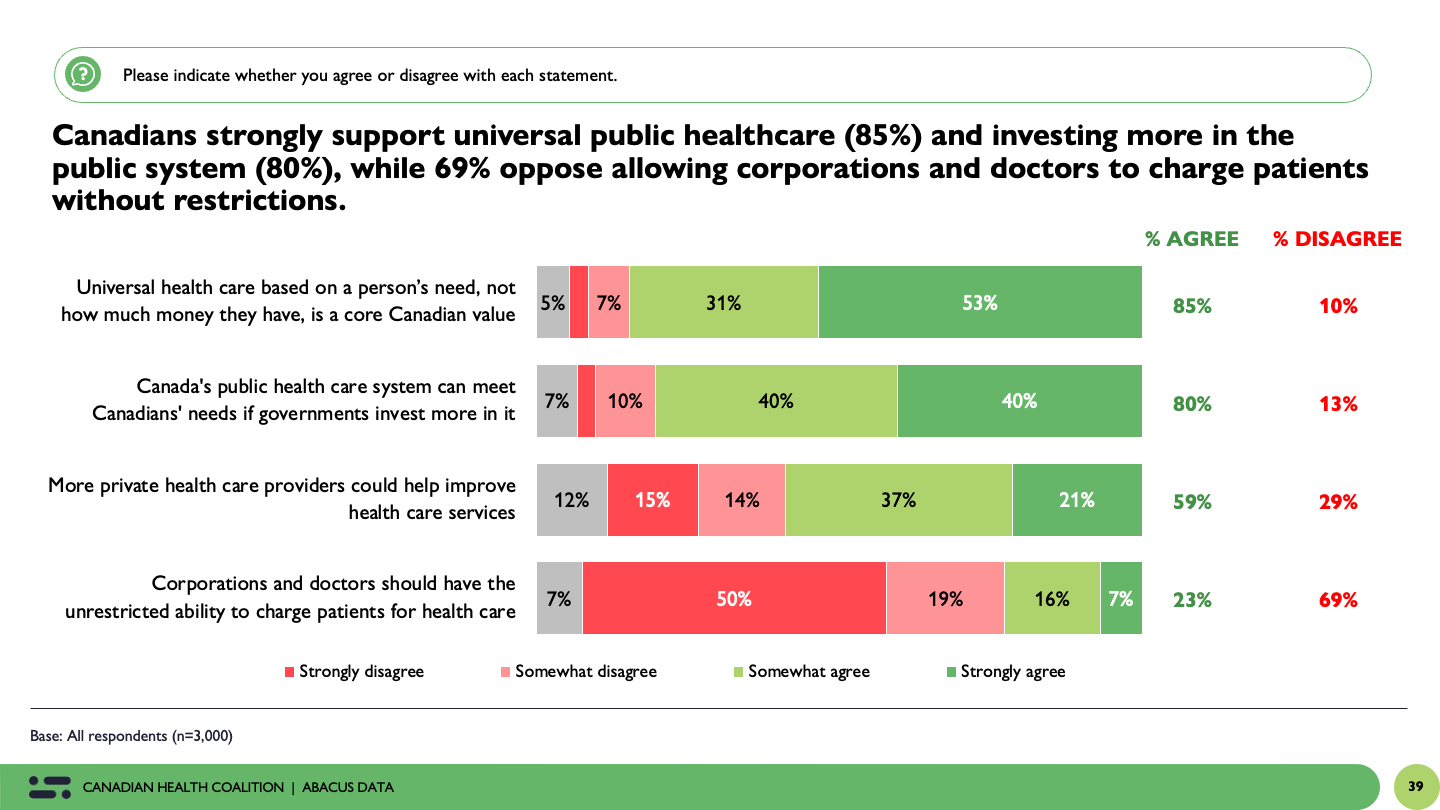
The vast majority of respondents across Canada (85 per cent) strongly support universal health care based on need, not ability to pay, and believe this is a core Canadian value. Eighty per cent believe that Canada’s public health care system can meet our needs if governments invest more in it.
Despite a significant body of research showing that for-profit health care delivery undermines—not strengthens—the public health care system, 59 per cent of respondents believe for-profit providers could be beneficial.
However, when it comes to private health care financing and two-tier health care, 69 per cent disagree that corporations and doctors should have the unrestricted ability to charge patients for health care, as is the case under Alberta’s new private-pay model.
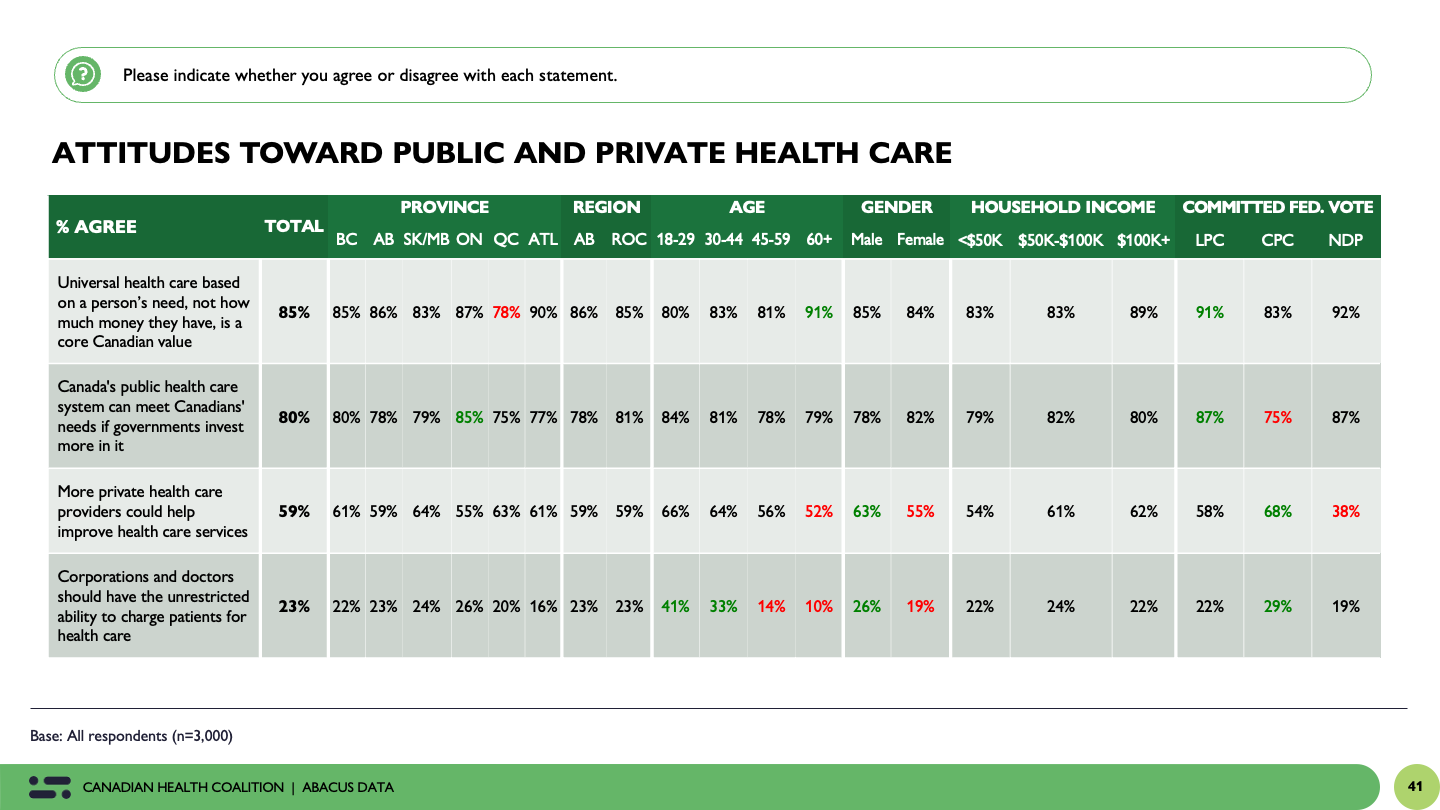
While the Alberta government continues to advance the idea that Albertans have distinct views from the rest of Canada, this poll finds that Albertans share similar views with the rest of the country. At 86 per cent of respondents, Albertans overwhelmingly believe universal health care based on need, not ability to pay, is a core Canadian value. Albertans also strongly believe (78 per cent) that public health care can meet the needs of Canadians if governments invest more in it.
On the issue of whether corporations and doctors should have the unrestricted ability to charge patients for health care, Albertans are also on the same page with the rest of the country: 77 per cent disagree with that premise.
Alberta’s U.S.-style reforms are advancing with very little public understanding of the significance
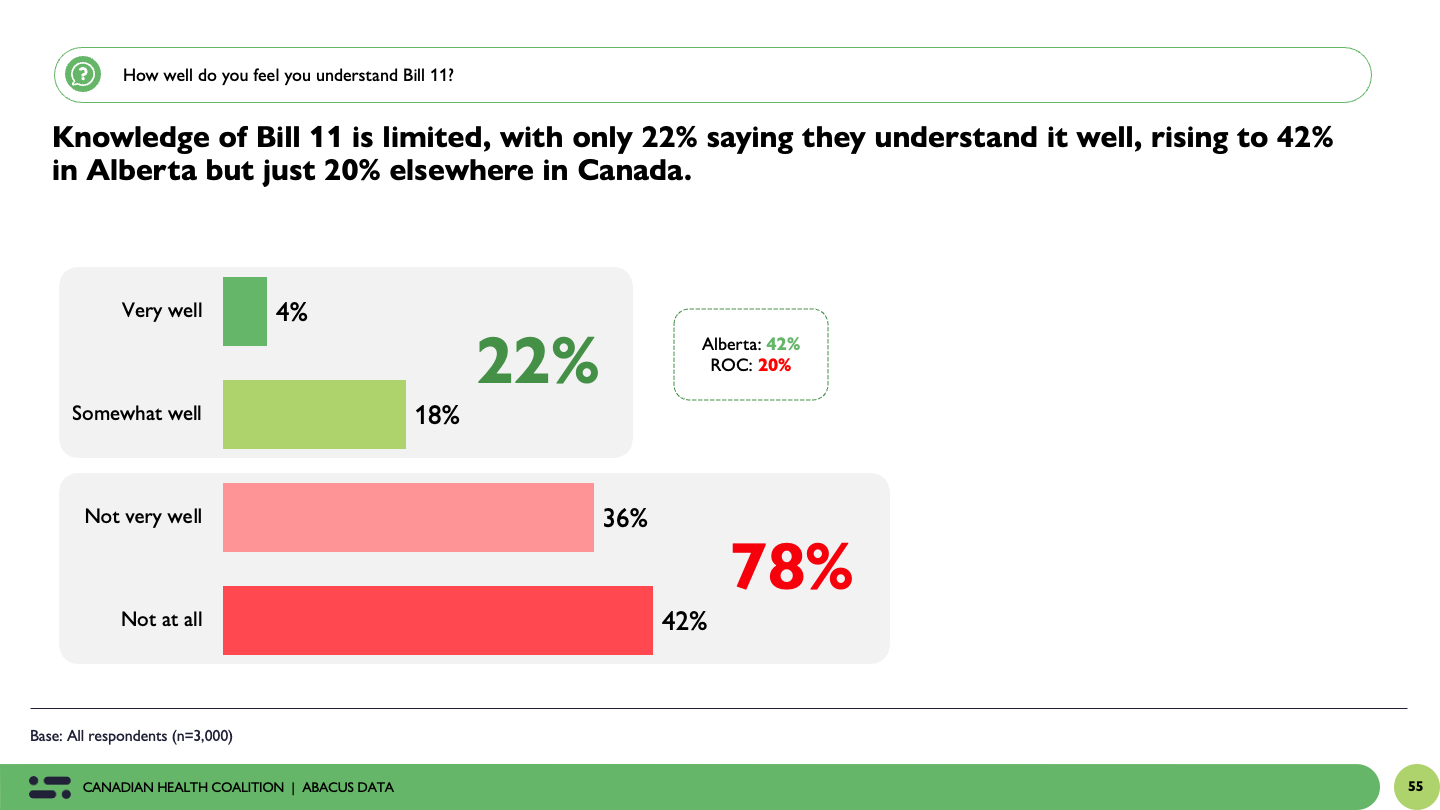
The Alberta government is rapidly advancing two-tier health care while the Canadian public has very little understanding of the legislation and its implications. Only 22 per cent of Canadians say that they understand the legislation well, which jumps to 42 per cent in Alberta. A majority of Canadians—78 per cent—don’t understand Bill 11.
This finding demonstrates that the Alberta government is benefitting from advancing a highly unpopular, but seismic shift in health care policy, amidst limited public knowledge on the topic. This raises significant concerns about the lack of a public discussion and the role of the federal government to help Canadians understand the grave implications of Alberta’s reforms. The federal government—if it believes in upholding the Canada Health Act—needs to play a leadership role in fostering a public discussion about the risks of a U.S.-style health care system.
Once Bill 11 is explained to Canadians, the majority oppose it
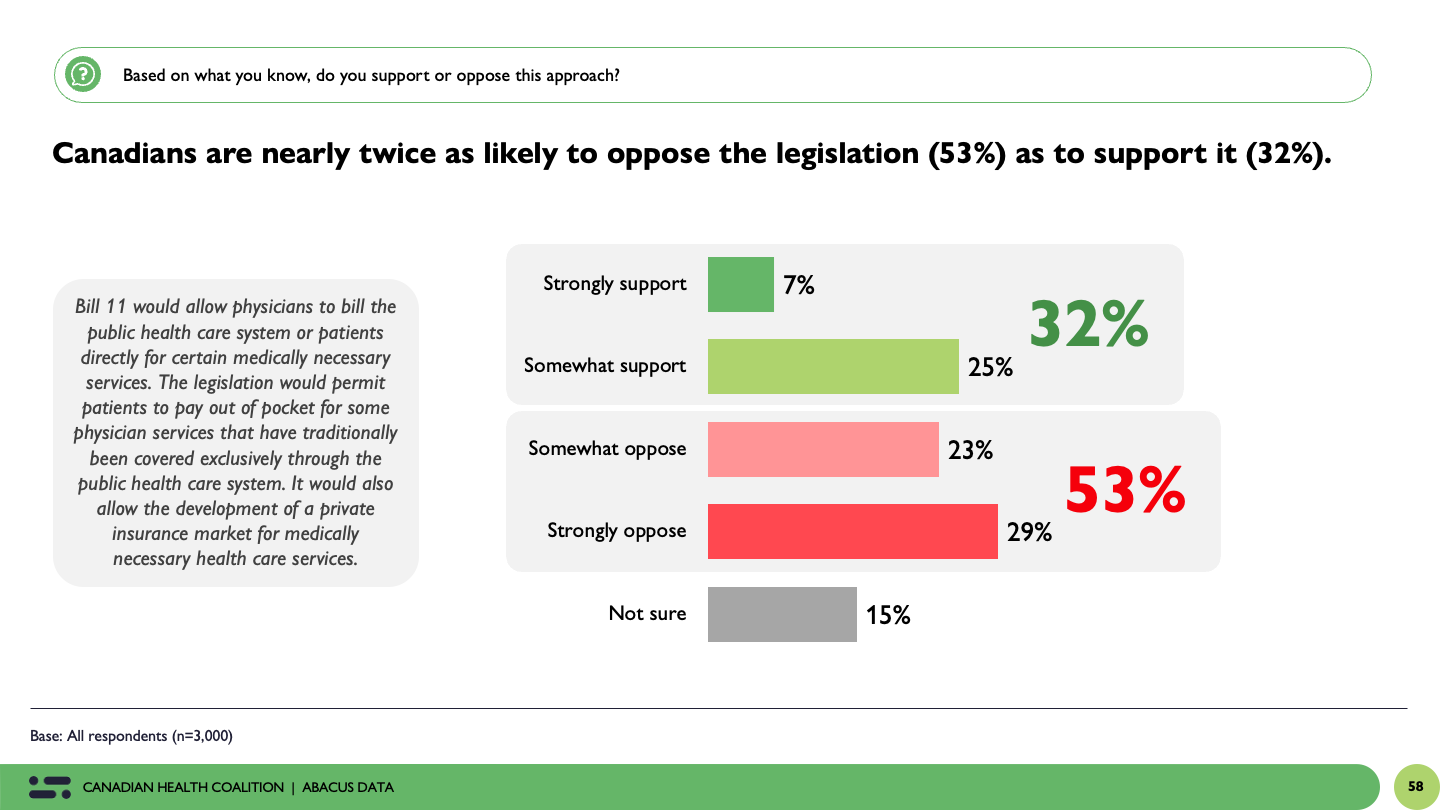
When Bill 11 is explained to the public—allowing doctors and private facilities to charge both patients and the public system for medically necessary care—53 per cent of respondents oppose it. While 32 per cent of Canadians support this approach, 15 per cent are not sure.
Canadians are concerned about U.S.-style, private-pay health care spreading to other provinces
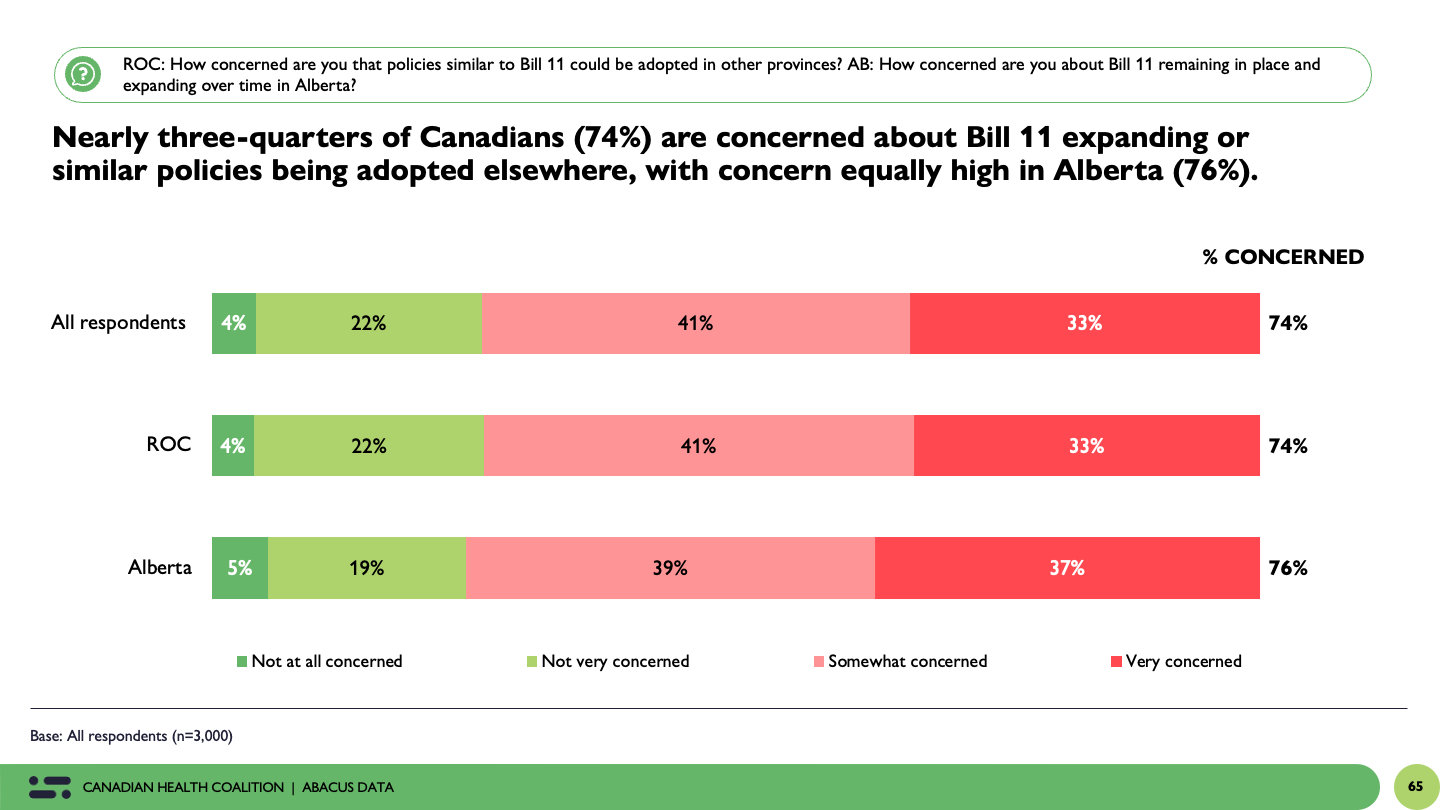
Nearly three-quarters of Canadians (74 per cent) are concerned about Bill 11 expanding or similar private-pay models spreading to other provinces. A greater share of Albertans (76 per cent) are concerned with this prospect. Only 26 per cent of respondents across Canada are not concerned. Clearly, this is an issue of national importance.
Alberta women, lower-income households, and even United Conservative voters are concerned about Bill 11
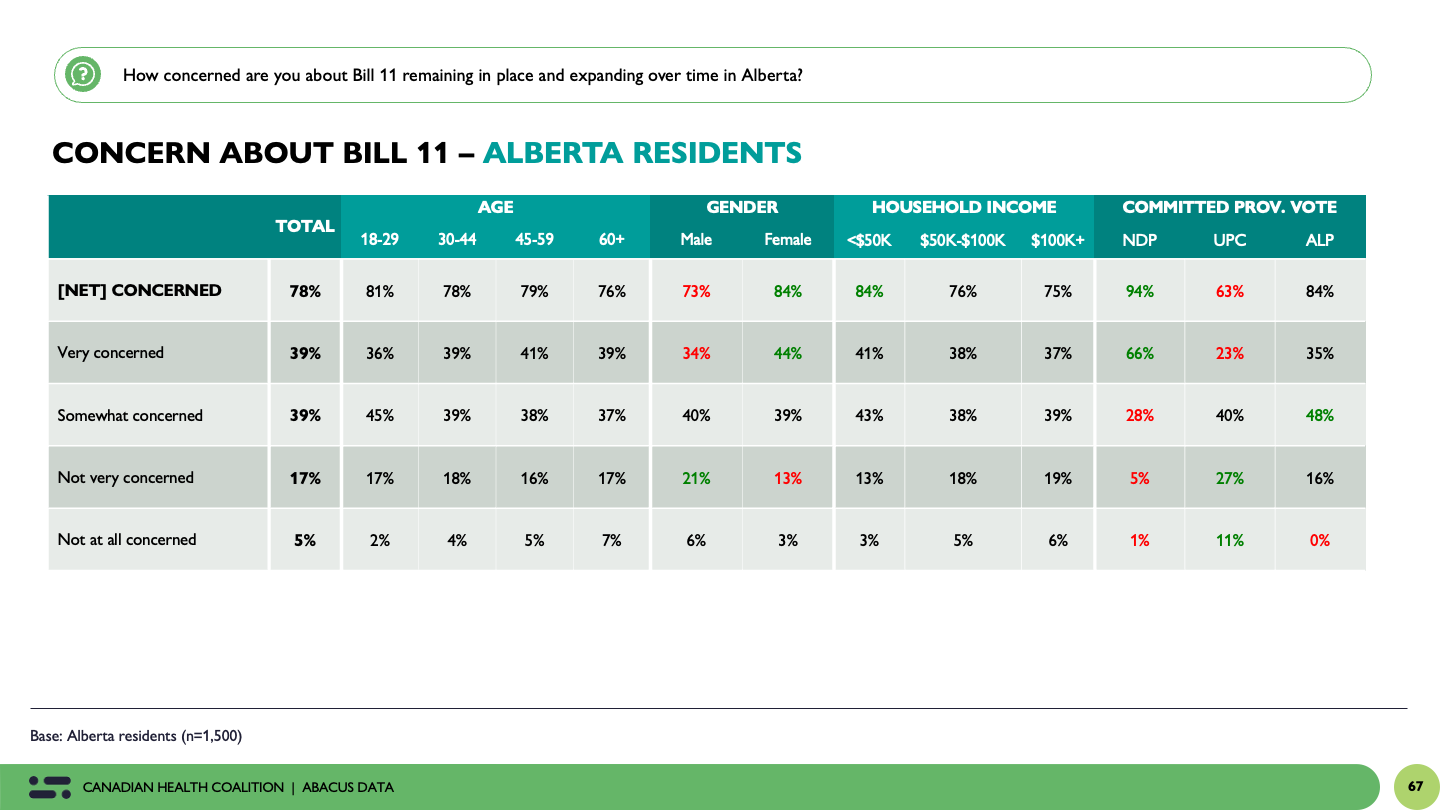
When drilling down into Albertans’ views on Bill 11, 84 per cent of women are concerned compared to 73 per cent of men. Lower-income households (less than $50k a year) are more concerned than higher-income households at 84 per cent, although three-quarters of higher-income households still remain concerned.
Interestingly, 63 per cent of UCP voters in the province are concerned about Bill 11 remaining in place and expanding over time. This suggests that as Alberta UCP voters learn more about Bill 11, they are not supportive of the health care reform directions of the United Conservative Party.
Across every area, Canadians are concerned about the consequences of Bill 11
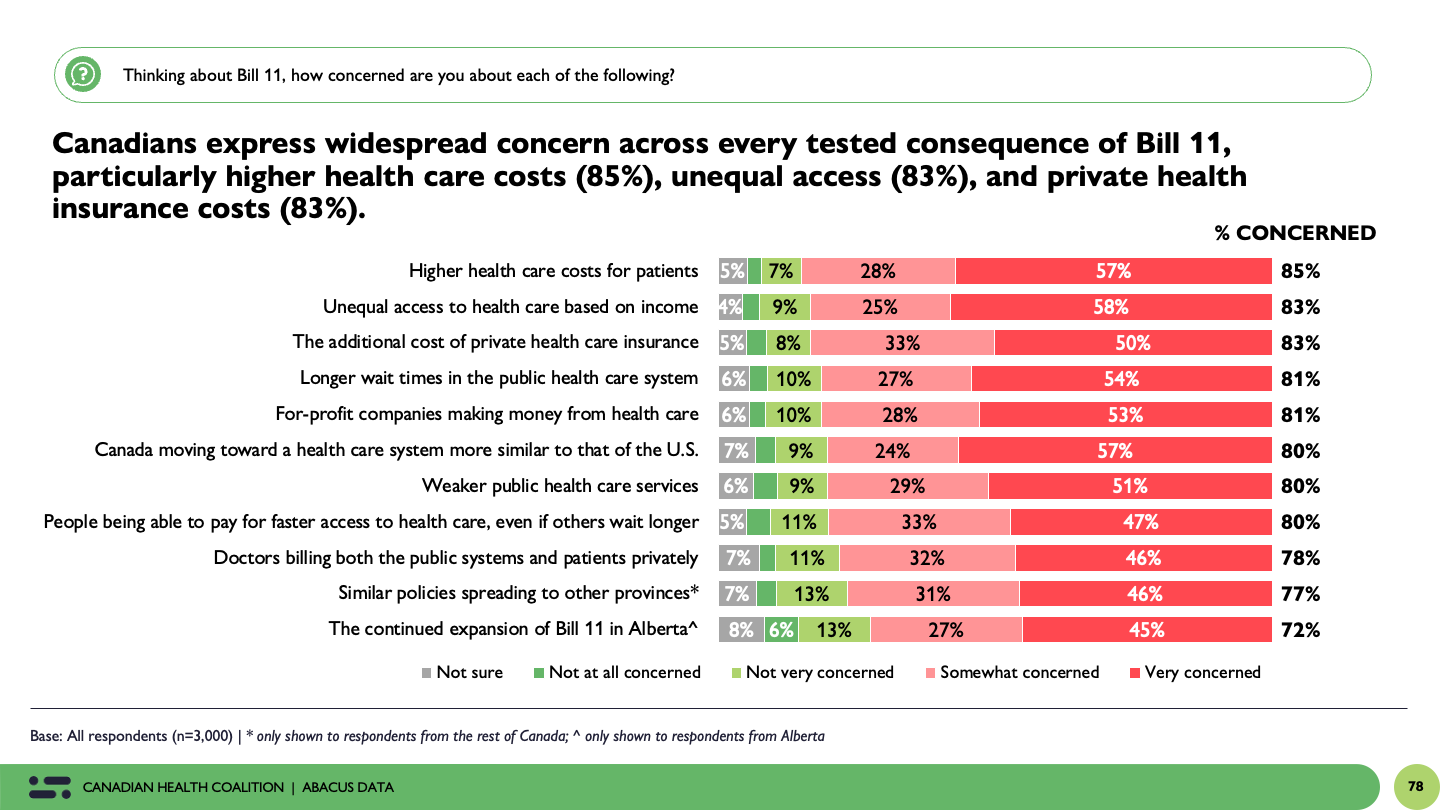
Canadians top concerns about Bill 11 include: higher health care costs (85 per cent), unequal access to health care based on income (83 per cent), the additional cost of private health care insurance (83 per cent), longer wait times in the public health care system (81 per cent), and for-profit companies making money from health care (81 per cent) top Canadians’ concerns about Bill 11.
Canadians and Albertans strongly favour evidence-based public solutions to reduce wait times
A clear majority of respondents across Canada and in Alberta want public solutions to reduce wait times, including a focus on health care workforce expansion (65 per cent for all of Canada and 68 per cent of Albertans).
Investing more in public health care, even if it requires additional funding, is the second-highest preferred solution, at 53 per cent across Canada and among 57 per cent of Albertans. Making better use of public operating rooms and better coordination of specialist referrals rank more highly among Albertans and across the country than allowing private clinics to provide more health care services.
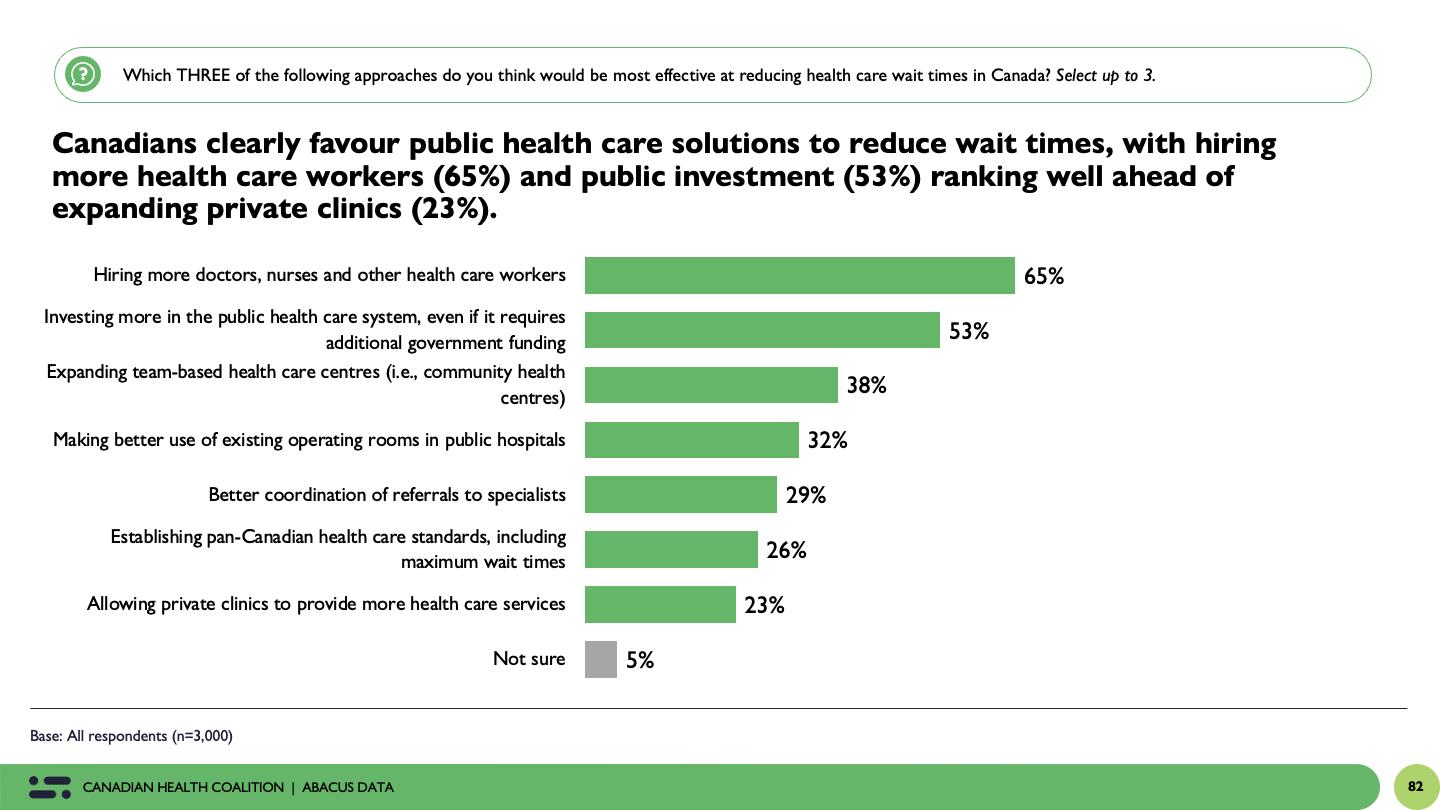
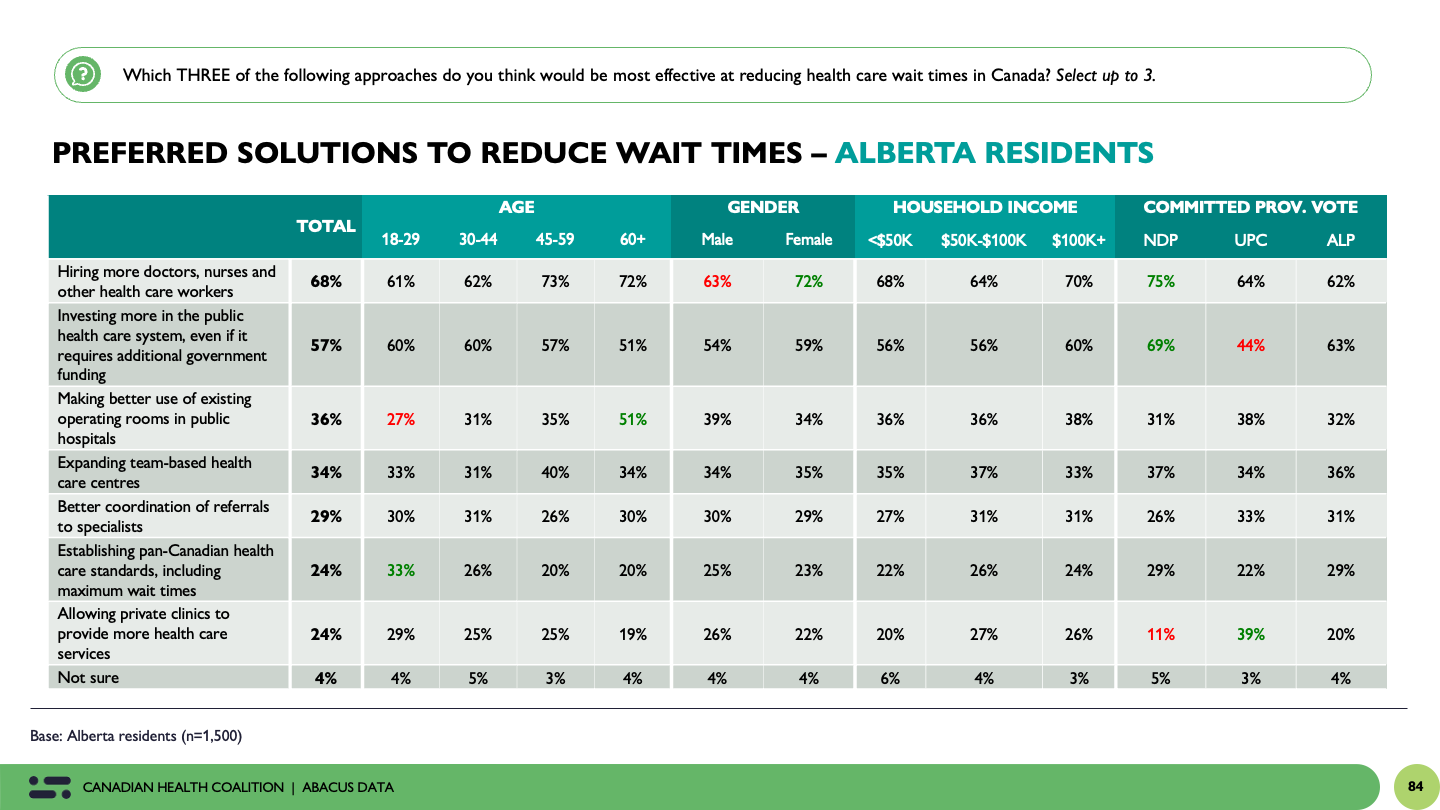
Canadians and Albertans believe strongly in evidence-based public solutions to health care wait times, and do not favour greater private, for-profit involvement.
This national survey shows that the Alberta government is pushing a policy direction that is not aligned with the research evidence nor does it have support in Alberta and across Canada.