
Share
Capitalizing on Crisis in Schools and Society
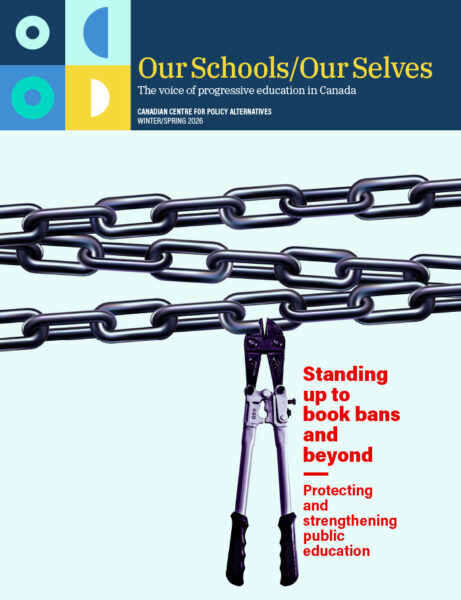
This issue of Our Schools/Our Selves examines some of the ways in which various crises in education (whether legitimate or manufactured) are taken advantage of—for financial, political or ideological gain. This provides an opportunity to explore versions of “disaster capitalism” from the perspective of education and educational institutions. How has the neo-liberal agenda played out in the education systems in Canada and the U.S.? How is it reshaping universities and academia? Does it have implications for the rise of private tutoring, the Turnaround initiative implemented in “struggling” schools, or the prevalent testing and standardization agenda? This issue also explores the role schools are playing—or have been told they must play—in order to address a number of “crises” (created, perceived or actual) in broader society. Of course, this often has a number of implications, predictable or unintended, for the school and its relationship with students, teachers and the community.
Attachments
Our Schools/Our Selves: Capitalizing on Crisis in Schools and Society — Excerpt
About the authors
Erika Shaker
Erika (she/her) became Director of the National Office in 2020, but began her career at the CCPA in 1997 as director of the Education Project. Originally established to monitor corporate intrusion in public education, the project broadened its focus to include standardized testing, social justice and anti-racism education in schools, educational equity, school finance, child care and early childhood education, tuition and user fees, technology, surveillance and privacy, the arts, and community-based education. In 2000 she also became editor of Our Schools/Our Selves, the popular education journal founded in 1988. It provides commentary and analysis on a wide variety of education-related topics. Erika has a BA in History from McGill University and an MA in English (critical literary analysis) from the University of Guelph. Prior to coming to the CCPA, she worked in Washington DC researching the corporatization of childhood, and was one of the founders of UNPLUG (which became the now-defunct Center for Commercial-Free Public Education). She spends far too much time on social media.