

Share
A new series of tariffs against Canada was unveiled by U.S. President Donald Trump on July 20. The tariffs are ostensibly a response to Canada’s retaliatory measures, which were introduced last year in response to Trump’s earlier tariffs. U.S. officials are using an arcane provision of U.S. tariff law to justify them, which will inevitably end up in court. (Note that these are not the “wildfire” tariffs Trump proposed recently due to smoke flowing across the border to the northeastern U.S..)
Tit-for-tat retaliation is obviously not helpful to anyone, and the new tariffs reiterate to Canada how unreliable a trade partner the U.S. can be. A few weeks earlier, the U.S. stated it would not renew the Canada United States Mexico Agreement (CUSMA) agreement negotiated in Trump’s first term. Technically that agreement remains in force for another decade, but following the trade rules has never really been an American thing. Even before Trump, politics drove trade policy.
The new tariffs are seeking to tighten the screws on Canada, in a bid to force concessions at the negotiating table for a new CUSMA deal. U.S. Trade Representative Jamieson Greer said the administration was looking to sign “interim deals” by the end of the year, while leaving some bigger issues to 2027. Trade protectionism has been a political winner for Trump and with the U.S. midterms on the horizon and the president on a losing streak, it is no surprise that he is once again threatening tariffs.
A new kind of tariff
The new tariff measures are a novel application of very old trade law, and stem from the Tariff Act of 1930. Section 338 enables the president to apply duties of up to 50 per cent to retaliate against countries “discriminating” against the United States. While the tariffs apply to only about $28 billion of Canadian exports (about five per cent of overall exports to the U.S.), this move may be testing the waters for future trade actions against other sectors of the Canadian economy or against other countries.
For Trump, this new over-reach is desired because the first wave of tariffs in early 2025 were struck down by the U.S. Supreme Court in February 2026. These were known as the IEEPA tariffs, falling under the 1977 International Emergency Economic Powers Act, which grants the U.S. president authority to regulate economic transactions once a national emergency has been declared.
It was under the IEEPA that the newly-inaugurated Trump administration claimed authority to impose tariffs on Canada and Mexico, based on a declared emergency related to purported imports of the opioid fentanyl and fears about immigration. Canada was later exempted from the IEEPA tariffs by virtue of the CUSMA. Trump‘s infamous “Liberation Day” tariffs on most countries of the world (and some bird-only islands) in April 2025 was also under the IEEPA.
Rather than IEEPA, it is sectoral tariffs that have had the most impact on Canada to date. Section 232 of the Trade Expansion Act of 1962 allows the President to impose tariffs, quotas or other restrictions to imports when an investigation determines they threaten national security. Tariffs under Section 232 have adversely affected Canada’s steel and aluminum sectors, automobile supply chains, and some copper products. This includes layoffs at Algoma steel and Stellantis moving future production south (discussed here).
U.S. tariffs have also targeted Canadian softwood lumber exports through anti-dumping and countervailing duties. These are trade remedies that can be imposed when U.S. officials deem a foreign country to be selling at below-market prices to drive out competition (called dumping) or illegally subsidizing their industries. Allegations in softwood lumber are a longstanding issue for U.S. forestry companies and predate Trump. The trade war has prompted forestry mill closures in British Columbia by Canfor and others.
A closer look at the new tariffs
The section 338 tariffs are thus the fourth wave of trade shocks for Canada. Officially, this is retaliation against Canada‘s retaliation to earlier U.S. tariffs in 2025. It also suggests that Canada‘s retaliatory actions hit a nerve—and thus fulfilled their purpose of inflicting some pain in certain U.S. places and industries.
The legal basis of the section 338 tariffs is the argument that Canada’s retaliatory measures discriminate only against the U.S., as opposed to another country. The three areas cited for violations are alcohol, dairy and automotive, but the US counter-measures include tariffs on a wide swath of Canadian exports.
The alcohol tariffs are the most clear retaliation due to the removal of U.S. liquor from the shelves of most Canadian provinces. As a result, the Section 338 tariffs would be applied on almost all liquor heading south.
In dairy, the U.S. claim is that Canada discriminates against American cheese relative to the European Union. But the tariffs are more of a harassment measure against Canada’s system of dairy supply management. This sector has been in the crosshairs for some time and is vulnerable to getting dismantled as Canada pursues a new trade deal. Currently, imports from the U.S. are tariff free up to a quota, after which they face a high tariff.
In autos, Canada responded to 25 per cent sectoral tariffs—intended to bring Canadian-based manufacturing to relocate in the U.S.—with equivalent tariffs on U.S. imports. These were needed to level the playing field to maintain the auto industry in Canada. Nonetheless, the US is arguing that Canada‘s response justifies the additional tariffs placed on a wide-ranging 18-page list of goods. These include a number of agricultural commodities and forestry products to clothing/textiles, hockey sticks to essential oils.
It’s tempting to try and parse the language of trade law and the specific details by sector, but the new tariffs are just Trump being Trump, using existing law in novel ways to expand the executive powers of the president. There will surely be a court challenge to these tariffs and possibly backlash in Congress. However, should the U.S. Supreme Court find these tariffs legal, they could confer upon the president new powers that could be used to apply leverage elsewhere.
The list of what’s not covered by these new tariffs is also important: energy, potash, critical minerals, fish and anything already covered by the section 232 tariffs are exempt. If Canada was to seriously retaliate, this list would be a good start.
Section 338 requires 30 days before any of these tariffs are implemented. That will give companies time to front-end the tariffs (as in early 2025) so there will likely be very minimal impacts on trade for the remainder of 2026. There is a high likelihood that once phones start ringing in Congress, there will be a move to exempt certain goods and/or lower the actual applied tariff, perhaps even abandon the whole thing. Who knows anymore?
The political context for the new tariffs is telling. President Trump has been on a losing streak with an ongoing war in Iran, low popularity at home amid rising costs overall and at the pump, with the U.S. midterm elections looming in the distance. Trump’s biggest political “wins” have come on trade and the application of tariffs to attack other countries, including long-time allies like Canada. Pushing the tariff button is one that Trump thinks will be a political winner for him.
The impact for U.S. consumers will be higher prices. Companies who import components and parts from Canada will face squeezed margins. The tariffs also perpetuate an aura of uncertainty about trade that undermines investment on both sides of the border.
Where to next?
Ultimately, the section 338 tariffs are part of the bigger play around CUSMA renegotiation. The United States chose on July 1 not to renew the agreement. By throwing his weight around, Trump hopes to pressure Canada into making concessions and signing an inferior deal. But is any commitment from Trump worth the paper it’s written on? At best, it’s a limited pass that could be revoked the next time the wind blows. Literally, in the case of wildfire smoke. Or any other whim of the president whose ego is so easily offended.
Thus far, Canada has made the right call by not feeling pressured to sign a bad deal, while buying time to expand other trade relationships and marshal massive public and private investment dollars into the country. And in spite of the tariff shock and disproportionate impacts in certain industries and places, the Canadian economy has held up much better than some thought possible in early 2025.
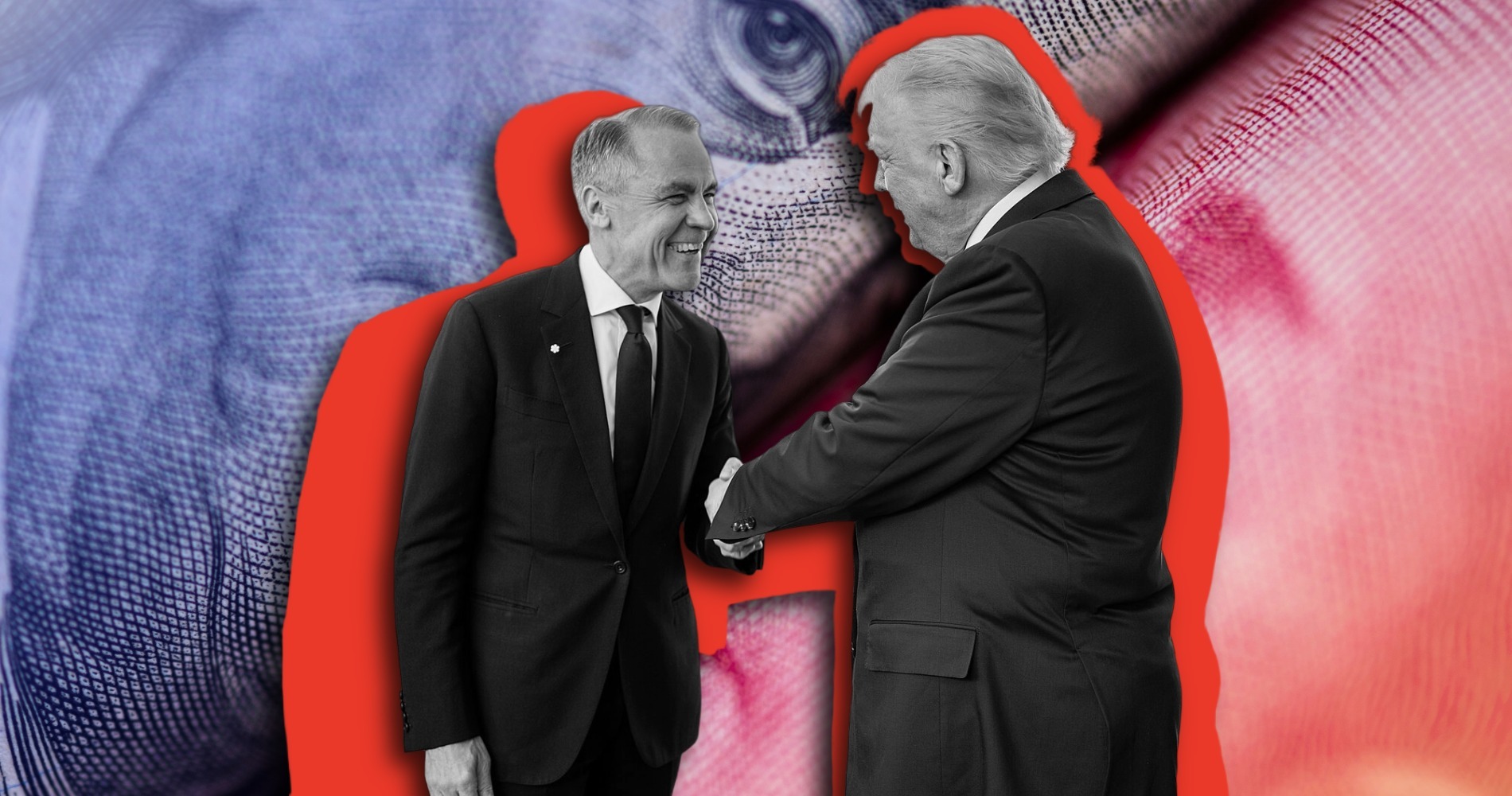
Prime Minister Carney says that Canada-U.S. negotiations will intensify, and that he is seeking a comprehensive agreement that includes the key sectors like autos, forestry, steel and aluminum that have been subject to new tariffs because they have strong lobbies in Washington. What Canada is willing to concede in order to get that deal is not yet clear, and will be a critical test of Carney’s leadership.
The bigger question is inside our own border, what we trade and with whom, and what we can do for ourselves to boost living standards. In the short term, the easy path has been to loosen the reins on environmentally-destructive resource megaprojects. The challenge for Canada has always been how to use creative trade and industrial strategies to develop more sophisticated, higher value goods and services that the rest of the world wants. On this front, we have a lot more work to do.
About the author

Marc Lee
Marc Lee is a Senior Economist with the Canadian Centre for Policy Alternatives. Marc joined the CCPA’s British Columbia office in 1998, and is one of Canada’s leading progressive commentators on economic and environmental policy issues. From 2009 to 2015, Marc led the CCPA’s Climate Justice Project (CJP), which published a wide range of research on fair and effective approaches to climate action through integrating principles of social justice. Marc continues to write about climate and energy policy, strategies for affordable housing, federal and provincial budgets and macroeconomics. Marc has an MA in Economics from Simon Fraser University and a BA in Economics from the University of Western Ontario. Marc is a past chair of the Progressive Economics Forum, a national network of heterodox economists. He also served as a Visiting Professor at Simon Fraser University’s School of Public Policy in 2024 to 2025.