


Share
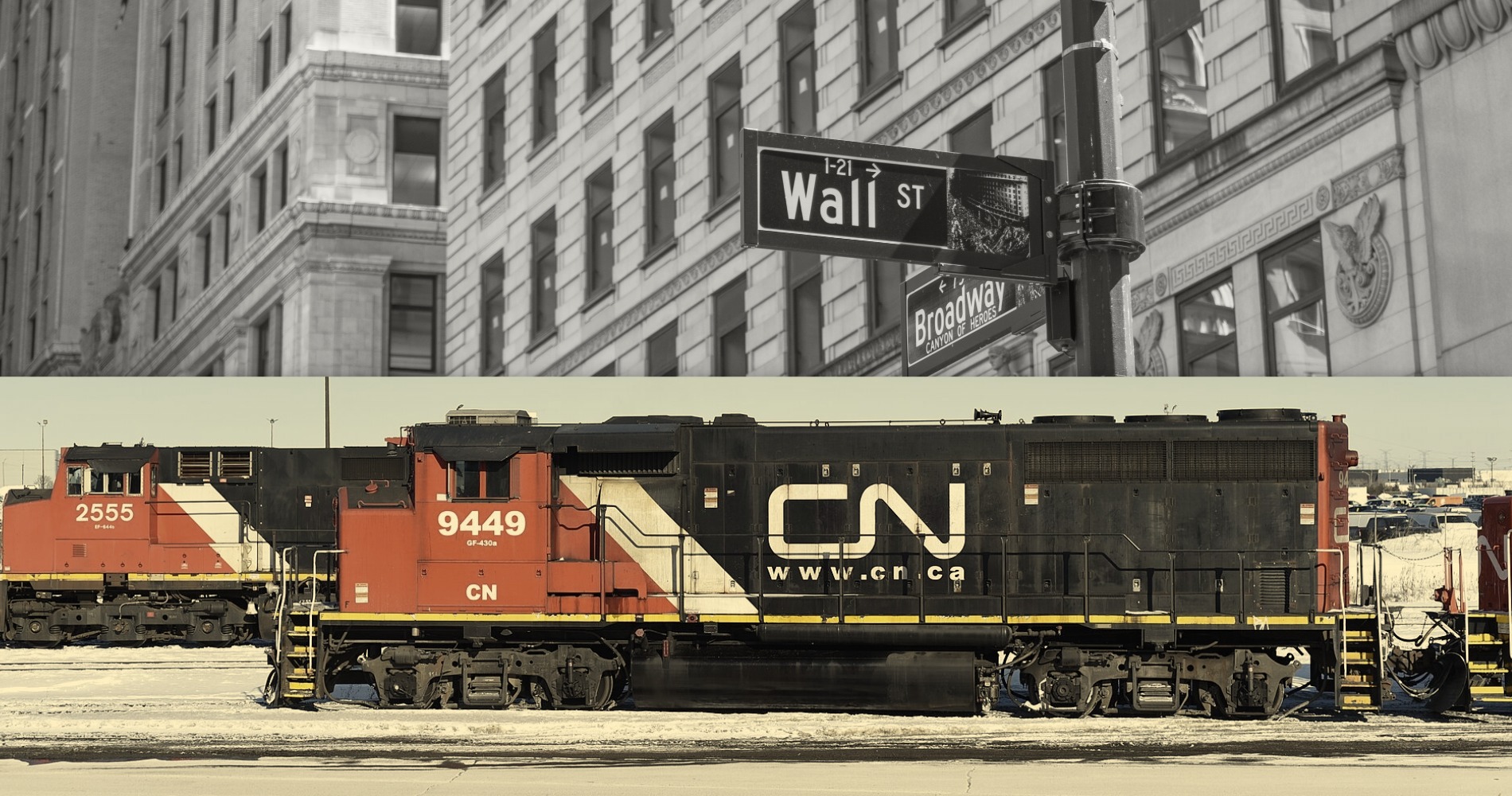
For nearly a century, Canadian National (CN) was a publicly owned crown corporation, providing all corners of Canada with rail service. That changed in 1995, when the federal government privatized CN via an initial public offering (IPO) of its stock. In 2025, CN commemorated 30 years as a private corporation. Along with Canadian Pacific (CP), CN is one of Canada’s two Class I railroads (defined by earning more than $1 billion in annual revenue, as of 2026). As the larger of the two, owning an outright majority of the nation’s rail network, CN has an outsized impact on the Canadian economy. Yet despite its stranglehold on the nation’s critical transportation infrastructure, CN’s private ownership has gone largely unquestioned since privatization.
CN management has largely framed the supposed “success” of privatization around two key metrics: the operating ratio (OR) and free cash flow (FCF). The operating ratio is a metric developed by the rail industry in the 19th century to measure railroads’ profitability by dividing operating revenues by operating expenses. For nearly two centuries, railroads have sought to lower their operating ratios, but with Wall Street’s heightened interest in railroad stocks in the past 20 years, that focus has turned into an obsession. Whereas an 80 per cent OR, or 80 cents spent per dollar of revenue, was standard for a long time, in recent years, railroads have sought to push the OR below 60 per cent. Free cash flow is a related metric, which is composed of operating cash flow (money that the railroad brings in from normal operations) minus capital expenditures.
These two accounting metrics have been closely tied to managerial pay for the past 30 years, and the drive to improve them has guided decision-making at the highest levels of the company. While CN’s performance has undoubtedly improved along these lines in the last 30 years, these two metrics are far from neutral. In order to deliver higher FCF to investors and achieve a lower OR, CN has hiked costs for Canadian shippers while suppressing wage increases for its unionized workforce. Because FCF includes capital expenditures, CN has also minimized its infrastructure investment and turned away from reinvesting in Canada, in favor of being more “comparable to U.S. railroads” by purchasing numerous U.S. railroads. All of this has led to real costs for Canadians.
Prior to CN’s initial public offering in 1995, it published a prospectus laying out its goal of “creating a competitive market-oriented railroad with performance levels comparable to major U.S. railroads.” Since privatization, few have questioned whether the initial goal of creating a “market-oriented railroad” was in and of itself a desirable one. Now, with 30 years’ distance from the privatization fervor that swept neoliberal governments around the globe in the 1990s, CN’s privatization deserves a closer look. Beyond the profitability metrics that Wall Street fawns over, was privatization the right choice for Canada, or would a return to public ownership be in the national interest? At a time when renewed industrial policy is particularly urgent due to U.S. tariffs, a strong rail network is more important than ever, making it a ripe time to revisit the railways’ role in the economy.
Prioritizing shareholders over workers
Immediately following privatization, CN began prioritizing its new shareholders—within less than a year, CN initiated its first dividend payout in 1996, delivering $99 million to shareholders. Since then, dividend growth has been explosive, with increases of between 10 and 30 per cent year-over-year every year from 1997 to 2019, with the exception of a seven per cent increase in 2010. After 30 years of growth, in 2025, CN paid out over $2 billion in dividends. CN’s wage growth for its unionized employees—on whose backs the company’s industry-leading OR and FCF metrics were achieved—is less stunning. In addition to reducing its workforce size over this period, general wage increases averaged three to four per cent over this period, save for an eight per cent increase in 2015.
The compounded impact of this disparity is dramatic. As shown in Figure 1, for every $100 in wages that a union worker earned in 1996 at CN, they earned $242 in 2025. Meanwhile, shareholders’ returns are in the stratosphere. For every $100 in dividends that they received in 1996, the same shares yielded over $5,314 in 2025. After inflation, based on the Canadian consumer price index (CPI), CN workers earn 32 per cent more than they did in 1996, while shareholders’ annual payouts have increased 2,799 per cent—before considering the impact of aggressive share repurchases. This comparison puts CN’s priorities in plain figures. If not for several strike threats by CN’s unionized employees, the company may well have provided wage increases at-or-below inflation.

Raising costs for Canadian shippers
Over the past 30 years, CN has not only put pressure on its workers, but it has also taken advantage of shippers by raising rates. Relative to freight rates for trucking or air freight, rail rates tend to be ‘sticker,’ meaning that the railways rarely lower rates after they’ve raised them significantly, even during economic downturns. This trend can be seen in Figure 2, which compares line-haul rail freight rates to the overall producer price index (PPI), air freight rates, and long-distance trucking rates. Over time, this compounds to make rail less competitive with other modes, and prices out small shippers.

The Railway Association of Canada (RAC) likes to paint a different picture, claiming that privatization and deregulation have given Canada “some of the world’s… lowest rail freight rates.” However, the RAC’s analysis does not evaluate actual freight rates, rather it looks at revenue-ton-miles (RTMs). This misdirection was highlighted by a coalition of Canadian rail shippers in a lengthy report rebutting the RAC’s claims. The RTM figure is influenced just as much by distance (miles), and commodity mix (the ton part of ton-miles being shaped by the weight of the commodity being carried), as by the actual freight rate. Canada’s railways haul freight longer distances than just about any other country on Earth. The RAC report compares Canadian, Russian, and U.S. rates to European, Indian, and Japanese rates, whose average distances are between a third and half the length. Consequently, the Canadian, Russian, and U.S. rates look significantly lower using RTMs. When looking at indexed rates alone, rather than RTMs, for the 2007-2021 period, Canadian rail rates rose by 36 per cent, 11 percentage points more than the 27 per cent for trucking or Canadian CPI.
Even under the RAC report’s own methodology, the RAC argument that Canadian freight rates are “11 per cent lower than the U.S.” is only the result of convenient happenstance in 2023. As seen in figure 8 in the RAC-commissioned report, between 2003 and 2014, Canadian rail freight rates were higher than those in the United States. This timing coincides with the period between 1998 and 2009, when E. Hunter Harrison’s tenure served as chief operating officer (COO) and later CEO of CN, pioneering the practice of precision scheduled railroading (PSR). PSR, despite what its name might suggest, has led to disinvestment, job losses, and shipper discontentment across the industry.
Harrison later served as CEO of CP and CSX, and towards the beginning of the 2010s, PSR began to permeate management practices at U.S. railroads. During this period, U.S. railroads began hiking their own freight rates and focusing on higher-margin traffic at the expense of smaller shippers, causing U.S. rates to once more exceed those in Canada. While more research is needed to paint a clearer picture of recent rate increases, Canada’s shippers have been clear about the burdensome hikes in freight rates from Class I railroads. These price increases make Canada’s industrial and agricultural products less competitive and raise prices for Canadian consumers.
Disinvesting in infrastructure
While raking in record profits, CN has prioritized paying out historic sums to its shareholders rather than reinvesting in its infrastructure. This is hardly a problem unique to CN, but it demonstrates that CN’s primary allegiance is to Wall Street, rather than the Canadian public, whose interest it once served as a crown corporation. Because free cash flow is so heavily factored into managerial compensation, there is an inherent incentive for managers to reduce capital expenditures to pad their own bonuses.
In 2022, CN paid nearly three times more in dividends and buybacks to its shareholders than it spent on capital investment in Canada and the U.S. combined, as seen in Figure 3. This ratio is almost identical to that of Union Pacific, the second-largest U.S. Class I railroad, showing how significantly Wall Street’s pressure has reshaped the rail industry. If the goal of privatization was indeed to bring CN’s performance in line with U.S.-based railroads, it appears to have been achieved with flying colours.

Since its 1998 acquisition of the Illinois Central Railroad, CN’s shareholder remuneration (total cash payments to shareholders, representing buybacks and dividends combined) has soared. Shareholder payments surpassed capital investment for the first time in 2005, and the two stayed roughly equal until the pandemic. Since 2021, CN’s stock buybacks have soared, leading to shareholder remuneration at over double the total value of capital investment in 2022 and 2023.

The numbers in Figure 4 paint a stark picture of management’s priorities over the past 30 years. Under its current structure, CN is spending billions of dollars annually on shareholder compensation—money that could instead be reinvested in infrastructure improvements if the railroad were still a Crown Corporation. These surplus billions produced by CN are evidently a triumph for the “market-oriented” railroad, but they also represent billions of dollars being sucked away from Canadian critical infrastructure to pay CN shareholders, like Bill Gates, who owns over 10 per cent of the company.
Turning from Canada towards the United States
Over the past century, substantial trackage has been lost on both sides of the border, across nearly every operating railroad. However, looking at Figure 5, displaying CN and CP-owned track in Canada since 1986, there was an intensified loss of thousands of kilometers of track that CN abandoned or sold in the years immediately surrounding privatization. At the same time, CN was actively expanding in the United States, acquiring Illinois Central in 1998, followed by Wisconsin Central in 2001.

CN has occasionally backtracked on its sale of Canadian routes, including the repurchase of 1,000 kilometers of track from the Mackenzie Northern Railway in 2006 that it had sold nine years prior. However, many of the routes that CN sold or abandoned were taken over by short lines or provincially-owned railroads like Ontario Northland.
Alongside track abandonments and sales, CN has contracted out or shuttered equipment maintenance capacity in Canadian shops. While this may produce short-term cost savings for CN, it undermines long-term service quality and equipment safety through the loss of in-house capacity and technical knowledge. In March 2026, Unifor won an arbitration decision ordering CN to reinvest in its own in-house maintenance capacity at the Transcona Wheel Shop. While one might think that keeping wheels trued and clear of flat spots would be in the company’s best interest, Class I railroads over the past few decades have shown that there are few corners they won’t cut for a better quarterly profit—even if it means destroying their own infrastructure.
Undermining passenger service
Closely related to CN’s underinvestment in track maintenance are its disastrous consequences for Canadian passenger service. Delays on VIA Rail, the majority of whose trains run on CN trackage, are widespread. The delays have worsened in the past few years after CN imposed restrictions on VIA’s new Venture trainsets due to loss of shunt issues—restrictions that VIA suspects are unnecessary. Similar issues have arisen for Amtrak on CN trackage in the United States.
Perhaps more embarrassingly, regarding Amtrak, CN has reduced its maintenance on the Rousses Point Subdivision in Quebec to such a minimal level that during hot summer months track speeds are restricted to 10 miles per hour. At such a low speed, it is impossible to run passenger service, causing Amtrak to cancel the Adirondack service between New York City and Montreal in 2023 and 2024. Because of CN’s obstinate refusal to maintain the trackage, which has little present freight volume, a foreign publicly owned railroad (Amtrak) paid CN to maintain its own trackage in order to restore service.
In addition to delays on the Toronto-Montreal-Quebec City Corridor, VIA’s flagship cross-country service, The Canadian, has been slowed over the past few decades due to CN-caused delays. The westbound train from Toronto to Vancouver had its runtime lengthened from an 80h55m scheduled journey in 1990, when The Canadian first switched from Canadian Pacific (CP) to CN tracks, to a 94h05m scheduled journey as of 2026. Despite this substantial schedule padding, trains are still routinely delayed by dozens of hours. These delays are almost entirely CN’s fault, resulting from a lack of capacity and a refusal to prioritize VIA’s passenger trains over their own freight. This problem is exacerbated in Canada because, unlike Amtrak in the U.S., VIA does not have a statutory right of preference over freight traffic—and even with that right, Amtrak has struggled with freight railroad trackage.
Restoring public ownership
While CN celebrates its 30th anniversary of privatization as a triumph of market-oriented railroading, it is at the same time cutting back on its already-limited capital investment due to tariff uncertainty. Now more than ever, Canada needs a strong domestic rail network, and CN is shying away from the job. They are cutting back on infrastructure investment so that they can maintain billions of dollars in stock buybacks. In the very same 2025 annual report announcing cuts to its capital program, CN also authorized the repurchase of up to 24 million shares— worth over $3 billion at current prices.
CN simultaneously gave shareholders a three per cent dividend raise, the lowest since privatization, but a raise nonetheless—and one that mirrors the wage increases in its current union contracts. The Railway Association of Canada claims that it is time for the Canadian Government to put “Canada’s public interest over self-interest.” The RAC blames interswitching for sending jobs to the U.S. and undermining capital investment in Canada. The truth is that both Canadian-based railroads are guilty themselves on both counts. Their pursuit of short-term profit and rosy operating metrics, whether OR or FCF have led them to disinvest in infrastructure and their workforces.
Looking frankly at the record of CN over the past 30 years, it is clear that Canada’s pain has been Wall Street’s gain. Management has employed selective financial metrics—repeated in the press—to paint privatization as if it were an inevitable, and beneficial, decision for Canada rather than the product of a certain socio-political moment or neoliberal ideology. In fact, these figures are not neutral, but rarely does anyone choose to look beyond CN’s own narrative, except during the occasional high-profile derailment—as opposed to the daily derailments that are barely questioned.
Part of this effort to paint a picture of privatization as a resounding success has been to restrict public access to information that might suggest otherwise. The railways have lobbied the government to avoid reporting or publishing key operating information. If you look at nearly any rail sector data from Statistics Canada, you will find that there is no company-level data since 2009 (for example: employee headcount). If we were to view railways as critical national infrastructure—or regulated utility companies—then we might expect more transparency and require more thorough data publication. Instituting such a requirement could be a prudent first step to reconsidering the railways’ place in Canada’s economy for the Carney Ministry’s broader reconsideration of industrial policy. At a bare minimum, it would allow the public to adequately assess CN’s performance for themselves.
Beyond fighting for better data access, we deserve to have a serious conversation about the role of critical rail infrastructure for the national economy. Should railroads exist to benefit a select group of shareholders or should their priority be quality service to customers, to the benefit of passengers and Canadian agriculture or industry? Renationalizing CN is not a silver bullet for the railroad’s problems, and the circumstances today are very different from 1919, when CN was first formed as a crown corporation, but it is clear that Wall Street’s influence has been harmful to Canada’s rail network. Short of renationalization, we should consider what sorts of regulations might be necessary to encourage CN to reinvest in Canada and treat its workforce with respect.
About the author
Maddock Thomas
Maddock Thomas is a researcher with the Public Rail Now campaign, working on policy issues including rail electrification, local transit funding, and national rail strategy. He previously founded and served as the president of the Brown University Labor Council.

