Fast facts
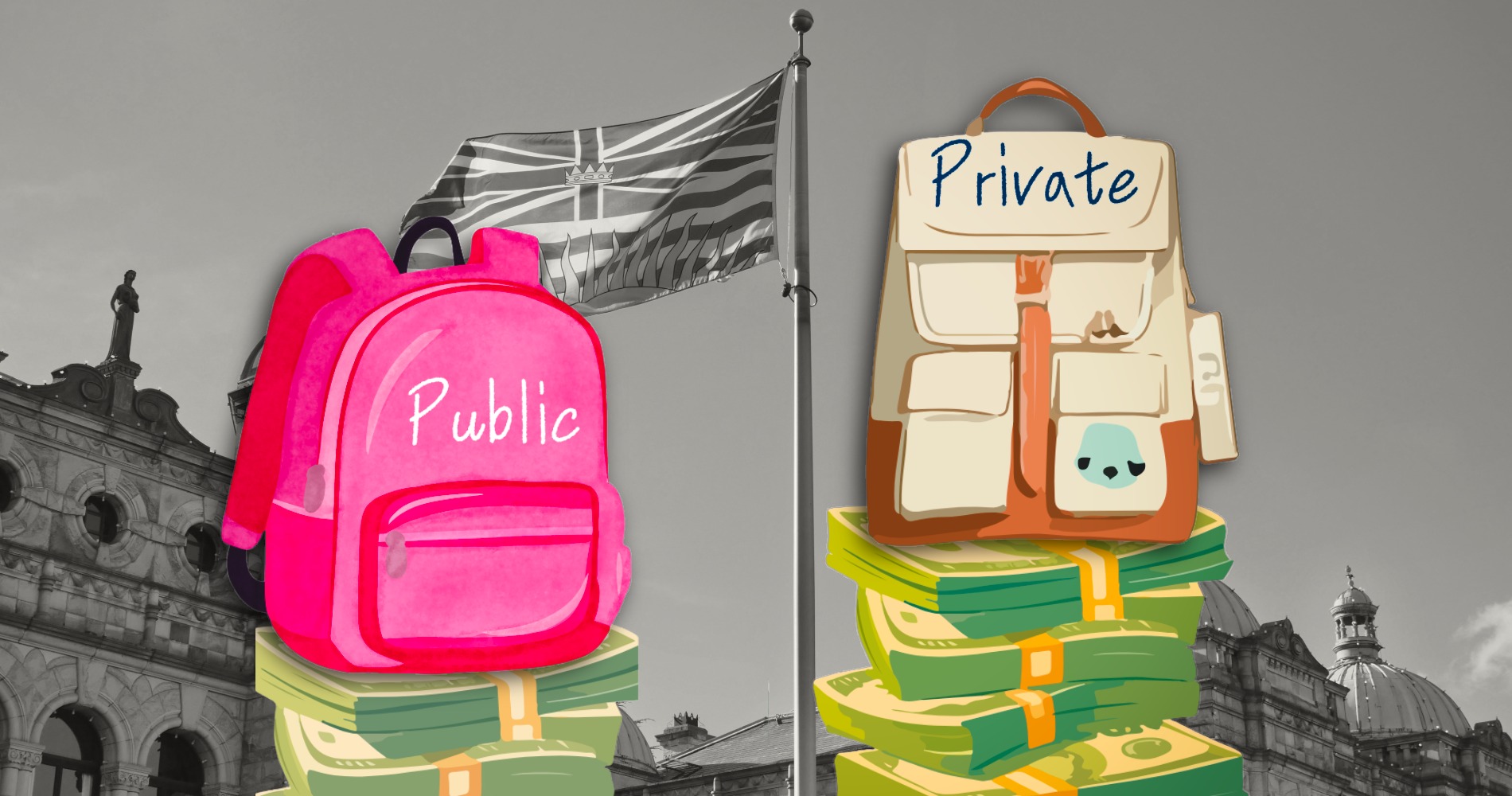
- Private school spending is increasing faster than public school per-pupil spending in BC, when analyzed on inflation-adjusted per-pupil terms: Between 1999-2000 and 2025-26, B.C. spending on public schools increased by 32 per cent compared to 50 per cent for private schools.
- B.C. public school spending as a share of GDP will decline from 1.96 per cent in 2016-17 to 1.89 per cent in 2025-26.
- At the same, public spending on private schools will remain stable at 0.14 per cent of GDP from 2016-17 to 2025-26.
- B.C. started subsidizing private schools in 1977 and has continued ever since.
- There is no justifiable reason—financially or ethically—to keep funding private schools at a time when public schools are facing real spending cuts by the provincial government.
There’s little relief in store for B.C.’s public K-12 education system following the B.C. budget.
In fact, along with other critical parts of the care economy, including health care and social services, B.C.’s K-12 spending plan is a doozy.
Fiscal year 2025-26 will close off with real spending cuts for B.C.’s public schools—with an increase of only 0.6 per cent in nominal terms (or $46 million) (Figure 1). This falls far below the rate of inflation and other cost drivers, including wages.

Budget 2026-27 offers $188 million for public schools, which translates into a 2.6 per cent annual increase over the previous year in absolute terms. Better than the previous year but still a far cry from what is needed to reduce class size and bring more supports into schools. The annual funding increases in 2025-26 and 2026-27 are among the lowest of the last 10 years.
Although the absolute spending on public schools remains much greater than private schools ($8.4 billion versus $604 million in 2026-27), annual funding increases for private schools over the last decade have outpaced public schools. Over the last decade (2016-17 to 2025-26), B.C. has subsidized private schools to the tune of $4.8 billion.
In six of the last 10 years (2017-18 to 2026-27), the rate of growth in public spending on private schools increased faster than spending on public schools in raw terms (Figure 1).
This is cause for concern.
To put this in perspective, at $604 million annually, B.C. funds private schools at roughly the same level of inclusive education for eight of the largest Metro Vancouver school districts combined (Surrey, Delta, Richmond, Vancouver, North Vancouver, Coquitlam, Burnaby, Maple Ridge-Pitt Meadows). Imagine how far more than half a billion dollars could go supporting smaller classrooms and adding more educational assistants to support students.
Private school real per-pupil spending increasing faster than public school spending
B.C. started subsidizing private schools in 1977 and has continued ever since. If private schools spend the same or less, per student, relative to neighbouring public schools, they receive 50 per cent of the public school per-student funding. If they spend more, they get an allocation of 35 per cent of the public school per-student funding.
As market-oriented policy shifts and cuts to public education in the 2000s encouraged private school enrolment, more and more public dollars went to subsidizing elite private schools—with tuition that only well-off families will be able to afford.
When analyzed on inflation-adjusted per-pupil terms, private school spending is increasing faster than public school per-pupil spending (Table 1). Between 1999-2000 and 2025-26, B.C. spending on public schools increased from $9,638 per pupil to $12,702 per pupil—an increase of 32 per cent. At the same time, private school real per-pupil spending increased from $4,027 to $6,058—or by 50 per cent. Public spending for private schools is increasing faster than public school spending on a real per-pupil basis.
As well, the gap is narrowing between private school real per-pupil spending as a share of public school spending. In 1999-2000, private school spending represented 42 per cent of public school real per-pupil spending. By 2025-26, this had jumped to 48 per cent.
Public subsidies for private schools are increasing faster than investment in public school students after adjusting for inflation and enrolment.

Declining investment in public education—while public investment remains stable for private schools
There are additional ways to analyze B.C.’s underinvestment in public education relative to the province’s capacity to invest in critical public services like education.
When measured as a share of B.C.’s economy, investment in the public education system has declined over the past decade.
In 2016-17, B.C. spent 1.96 per cent of GDP on the public K-12 system (Figure 2). This is expected to drop to 1.89 per cent of GDP in 2025-26. At the same, public spending on private schools held steady at 0.14 per cent of GDP from 2016-17 to 2025-26.

Increasing private school enrolment is a reflection of an under-resourced public system
Since the B.C. government started funding private schools—and as the province continues to underinvest in the public system—private school enrollment continues to climb.
Between 1999-2000 and 2025-26, private school enrolment as a share of the total B.C. K-12 enrolment has increased from nine per cent to 13 per cent. Enrolment in public schools declined from 91 per cent to 87 per cent. One in eight students now attend a private school in 2025—up from one in 11 in 1999.
Stop funding private schools, especially when public schools face austerity
There is no justifiable reason—financially or ethically—to keep funding private schools at a time when public schools are facing real spending cuts by the provincial government. Funding private schools contributes to widening economic inequality.
Families that can afford annual tuition of $37,300 at elite schools do not need to be subsidized by families who can barely afford housing and basic living expenses—to say nothing of the lack of supports in public school classrooms for students with disabilities.
This is an indefensible education policy at a time when the B.C. government must be investing in the potential of all students—and not diverting public dollars to subsidize the wealthiest in society.