

- Home
- Topics
- Regions
- Magazines
-
-
-
The Monitor
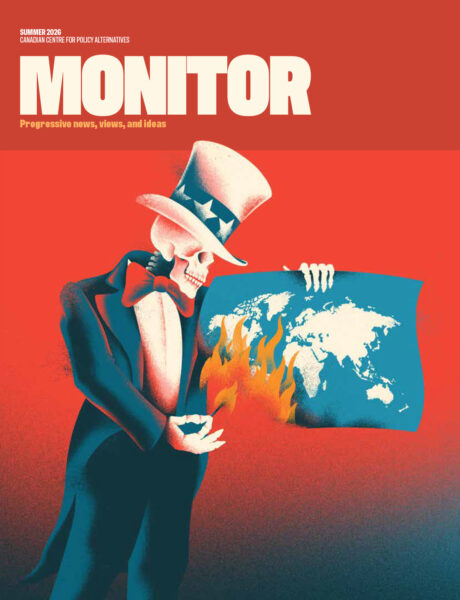
While world leaders are increasingly saying out loud that the postwar liberal world order is dead, the ruling classes in the Global North have an answer for what will come to replace it: fascism. Will they be able to implement their vision?
-
-
-
-
Our Schools/Our Selves
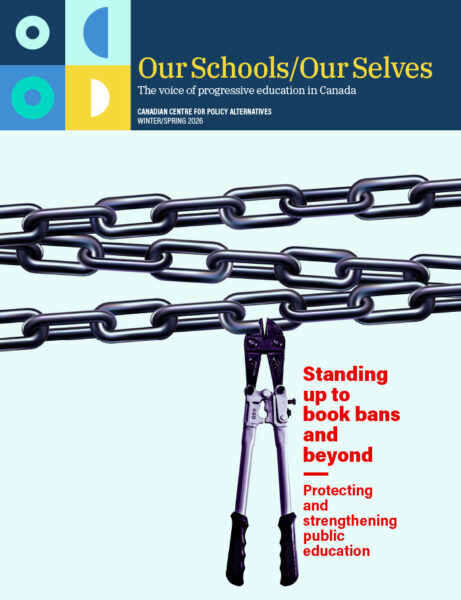
A guide to standing up to book bans and beyond, and how to protect and strengthen public education in Canada
-
-
-
-
- Media Inquiries
- Subscribe
- Legacy Gifts
- About
- Contact
- Donate Now
- Donate Now
Search results for “site/human rights”
-

June 2007: The Wrong “Solution” To Pollution
Nuclear power won’t clean up the Alberta tar sands The very biggest environmental issue in Canada is the Alberta oil sands project. Though only partially developed as yet, it covers 138,000 square kilometers of northern Alberta–an area as large as the state of Florida. At yet, only the surface oil…
-
Government Not Enforcing Health Laws
The provincial government recently stated that user charges for emergency health care services provided at the new False Creek Urgent Care Centre are legal. Minister of Health George Abbott says he would not have any basis for legal action because the doctors providing urgent care at the clinic are from…
-

Fast Facts: Counting women in
A gender-based analysis of homelessness International Women’s Day (IWD) will be celebrated this weekend. Although progress has been made regarding women’s rights and equality, the basic right to a safe and affordable home will be out of reach for too many women across the globe and here in Manitoba. IWD…
-
What should our government be spending money on?
One question that is missing from the public debate on deficits and debt is whether we’re getting the best bang for the stimulus buck. Even if we accept that it’s appropriate for governments to borrow and engage in deficit-financing during a recession, as I have argued here, we need to…
-
February 2007: “More Time For Daddy”
Quebec leads the way with its new parental leave policy Leave related to the birth or adoption of a child includes maternity leave, paternity leave, and parental leave. In Canada, there was a change in parental leave in 2001, which basically extended the leave from six months to approximately one…
-
Without Foundation
How Medicare is Undermined by Gaps and Privatization in Community and Continuing Care The Community and Continuing Care sector is fundamental to B.C.’s entire health care system. The sector’s significance can be traced to the 1991 Seaton Commission, which proposed a “closer to home” theme for health care restructuring. The…
-
A Key Neglected Tool For Economic Recovery
A different and improved money system is urgently needed An improved money system could provide governments in Canada and elsewhere with abundant funding, not only to enable us to pull out of the current recession, but also to meet the whole range of social needs that confront us — from…
-
Fast Facts: Community Economic Development in Manitoba and the Inclusive Economy
Manitoba is a province of economic growth and economic disparity. It is a province with low unemployment rates, diverse development, and incredible resource wealth. On the flip side, Manitoba has continuously had some of the highest child poverty rates in Canada, and the highest homicide rates, and Winnipeg has been…
-
Work Life: City of Winnipeg should study benefits of in-house waste collection
This fall Winnipeg City Council will determine the future of waste and recycling collection in our city. Current contracts with Emterra Environmental and Progressive Waste Services will expire in 2017. At least eight private companies have expressed interest in putting forward a proposal, and it will be up to council…
-
A Tale of Two Crises
Climate crisis far more threatening than economic crisis Most of us have become preoccupied with the deepening economic slump that has spread like a pandemic across the globe. Whether it can be controlled before morphing into a full-blown depression is the question preying on our minds. This concern is understandable,…
-
Protecting Canada’s world-class grain system
Well-functioning regulatory systems tend to be invisible, until tragedy occurs. It is only after someone dies from drinking contaminated water or eating tainted food, a bank fails or a highway overpass collapses that the general public realizes that something is wrong. Citizens rightly expect their governments to protect them and…
-
Making Sense of the CETA
An analysis of the final text of the Canada–European Union Comprehensive Economic and Trade Agreement Download 3.57 MB 128 pages This report demonstrates in detail how the Comprehensive Economic and Trade Agreement (CETA) deal is unbalanced, favouring large multinational corporations at the expense of consumers, the environment, and the greater…