

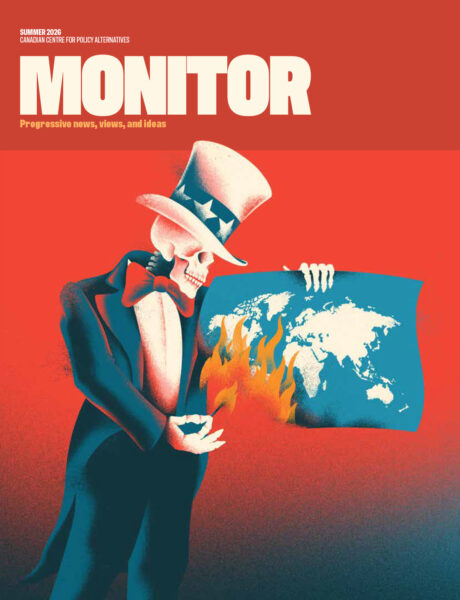

At the World Economic Forum in Davos earlier this year, Prime Minister Mark Carney offered a sobering diagnosis of the world Canada now faces. The rules-based international order that structured global politics for decades is weakening. Canada benefitted enormously from that system, he acknowledged, but it may no longer be able to rely on it.
If the old order is fading, Carney argued, Canada must adapt. The country should behave more like a true “middle power:” diversify its economic partnerships, deepen ties with countries beyond the traditional Western bloc, and prepare for a world shaped less by shared rules and more by great-power rivalry.
Few observers would dispute the diagnosis. The norms that once constrained the use of force have eroded for years, perhaps even decades. International law is applied selectively. Multilateral institutions struggle to restrain the actions of powerful states. The geopolitical landscape is increasingly shaped by raw economic and military power.
Trump’s return to the White House—and the renewed suggestion that Canada’s sovereignty itself could be negotiable—helps explain the urgency of Carney’s warning. But acknowledging the erosion of the rules, or even admitting that those rules were always unevenly applied, raises a deeper question: what does Canada actually do in such a world?
The U.S.-Israeli attack on Iran has provided the first real test.
Carney has acknowledged that the strikes appear inconsistent with international law governing the use of force. Yet he has stopped short of condemning them. His initial statement avoided any call for diplomacy and only shifted tone after criticism rose from within his own party. Speaking to reporters in Australia on March 4, he also refused to rule out Canadian military participation should the conflict widen.
The message should concern us. Canada recognizes that the rules are being broken, yet it is not prepared to defend them. Instead of appealing to principle, the government appears to be accepting “the world as it is, not as we wish it to be”—Carney’s own lamentation in Davos.
But there is something deeply contradictory about this position.
Economically, Carney argues that Canada must diversify to reduce dependence on the United States and build stronger ties with other partners. Politically and militarily, however, his response to crises like Iran suggests the opposite instinct: remain closely aligned with Washington and its allies, avoid confrontation, and hope that proximity to power continues to provide protection.
In other words, Canada is attempting to exit dependence economically while doubling down on it politically. That strategy cannot hold for long.
If the rules-based order is fracturing, the Western hierarchy that once gave Canada a measure of stability will erode with it. In a world governed increasingly by power rather than law, quiet alignment will not guarantee protection.
Expanding trade partnerships may reduce economic vulnerability in theory, but it does little to change the underlying geopolitical reality: Canada remains geographically adjacent to the most powerful military actor in the world. If international norms no longer restrain that power, we become especially vulnerable to its whims.
Playing small in the hope that stronger states will leave us alone is not a strategy. At best, it is a gamble. Yet this appears to be the underlying logic currently guiding Ottawa’s approach. Carney continues to reassure Washington by signalling stronger NATO commitments and refraining from outright criticism, hoping that cooperation will preserve Canada’s security within the Western alliance system.
Perhaps the calculation is that the current moment is temporary—that the turbulence of the Trump era will pass and that the familiar order will reassert itself. If Canada keeps its head down and avoids confrontation, maybe the storm will blow over. But this is a risky calculation.
If the world is indeed entering a more unstable period of great-power rivalry, then the strategy of quiet accommodation may prove not only ineffective but dangerous. Compliance has rarely purchased lasting security for less powerful countries. More often, it invites further pressure.
There is another path available to Canada—one that is both principled and more strategically coherent.
Ethics, at its most basic level, is about the relationship between what is and what ought to be. It is the framework through which societies judge existing behaviour against standards of justice, law, and legitimacy. Without that distinction, there is no basis for critique, no possibility of accountability, and no reason to expect better conduct in the future.
International law operates on ethical principles that underpin legal norms. It is not effective because it is always obeyed; it is effective because it establishes standards against which power can be judged and, at times, constrained. When those standards are abandoned entirely, the only remaining currency in international politics is brute force. And for middle powers like Canada, that is a dangerous development.
Canada has, at critical moments in the past, chosen to defend principle even under intense pressure. In 2003, Ottawa refused to join the invasion of Iraq despite pressure from Washington. That decision did not isolate Canada from the world. On the contrary, it strengthened Canada’s credibility as a country willing to act according to its own judgment and in compliance with international law.
Multilateral institutions were never designed to eliminate power from global politics. They were designed to constrain it and create predictable rules that even powerful states would feel a responsibility to adhere to. For middle powers, these institutions are part of the infrastructure of our security, and they are worth defending.
Prime Minister Carney now faces a test of what middle-power leadership actually means. If Canada believes in the value of international law and multilateral cooperation, that commitment must shape its foreign policy as much as its economic strategy. In a world increasingly governed by raw power, defending those rules is not only a matter of ethics and legal norms but of self-preservation.
About the author
Jasmine Ramze Rezaee
Jasmine Ramze Rezaee is the director of policy and community action at Right To Food Canada.

