


Share
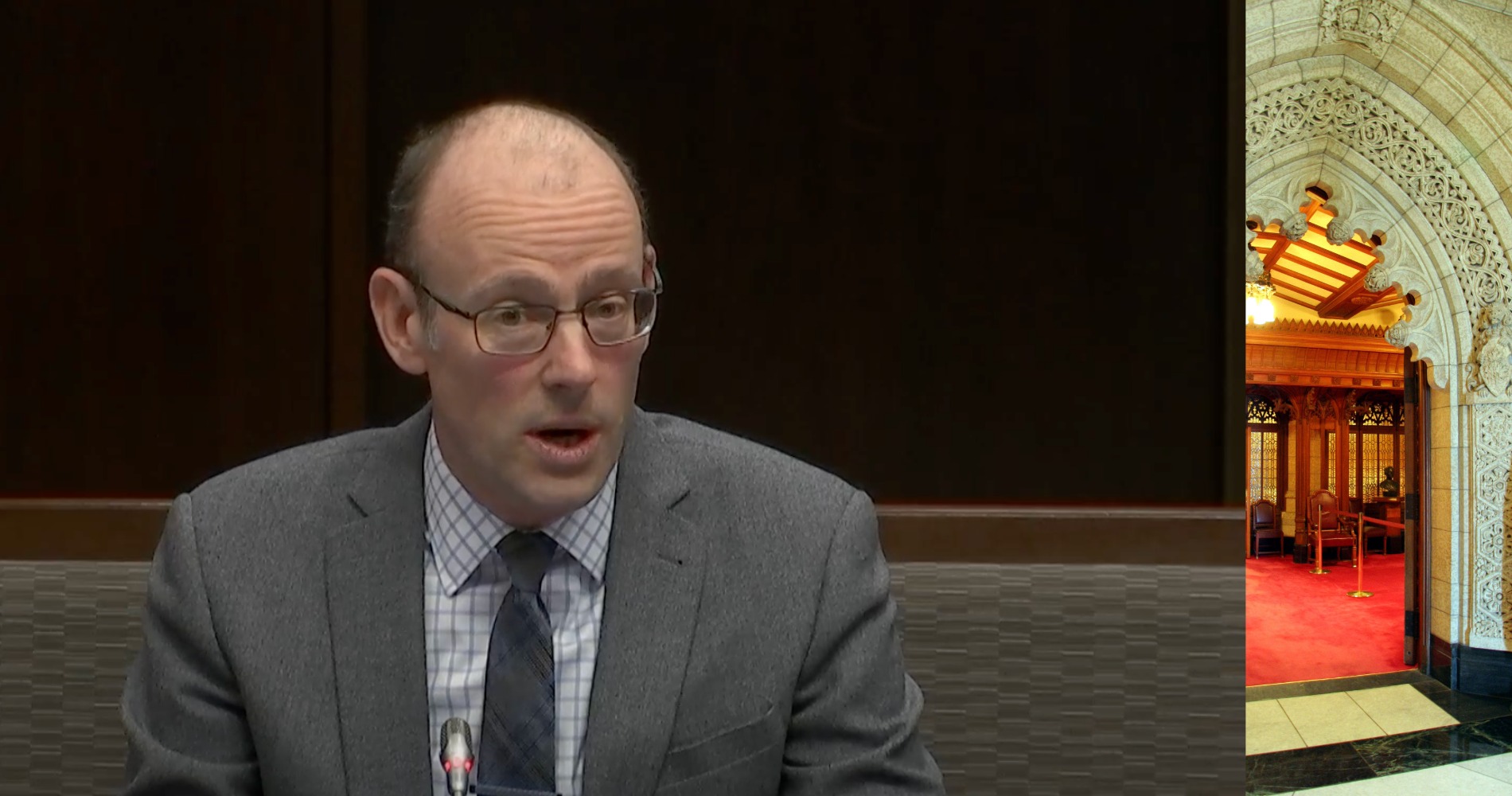
On Thursday May 28, CCPA Senior Economist David Macdonald spoke to the Senate Finance Committee about a number of ongoing federal policy projects under the banner of Bill C-30, which implements provisions of the Spring Economic Update. Macdonald’s remarks cover airport privatization, the lack of an excess profits tax on oil and gas companies during the Iran war, and the ongoing program of federal public sector cuts. His remarks are reproduced in the text below.
I’d like to thank the Committee for their invitation to speak to Bill C-30. I’d like to confine my remarks today to airport privatization, gas tax cut and a proposed oil & gas surtax and the impacts of the Comprehensive Expenditure Review.
Airport privatization
Bill C-30 set out important precursors to possible airport privatization by instructing airport authorities to assess the value of their airports. Why do this unless the government is planning a sell-off? Privatizing airports is a dangerous road. It takes a public, non-profit service and turns it into a private monopoly designed to squeeze passengers for profit.
We should be encouraging markets where they make sense. We have multiple airlines, and we should push them to compete more. That helps consumers. But you don’t have multiple major airports competing per city—usually, there’s just one. There is no market here and so no market forces that can improve efficiency through competition.
A single airport is a natural monopoly. If it’s a non-profit, then by design it doesn’t chase monopoly profits. If we sell it to a private company, that company will use the monopoly power to rake in monopoly profits for its investors.
To make matters worse, the spring update suggests the federal government might actually lower the rent it receives if it sells airports to new for-profit owners. That would be a direct handout to pad corporate bottom lines, with zero benefit to passengers. I’d encourage senators to reconsiders selling off our public assets—likely at fire-sale prices—just so private businesses can cash in at flyers’ expense.
Oil and Gas excess profits tax
The gas tax cut that will run through September will cost the federal government $2.4 billion. While the Iran war is terrible news for consumers, they’ve paid an extra $3.3 billion at the pump. But its great news for the oil and gas sector with high oil prices fueling outrageous profits there. Our internal oil and gas profit model been tracking these gains. Since the start of the Iran war in March, the oil & gas sector has already made $12 billion more in profits than they would have without the war.
In fact, over the course of this very one hour session, oil & gas raked in $10 million in excess profits. At current price levels, Oil & Gas corporations will make over $70 billion in excess profits this year alone.
I’d encourage this committee to consider an excess profits tax on that sector. We have very recent experience with an excess profits tax, it was called the Canada Recovery Dividend and it taxed excess profits from the banking sector that they made during the pandemic reopening. If we were to apply a similarly designed excess profits tax on oil & gas it would raise $1 billion a month for federal government. Given the pain at the pump, I’d ask you to consider the excess profits tax we implemented during the Second World War. There excess profits were taxed at 75 per cent. Such an approach would raise $4 billion a month for the federal government. These revenues could be used to help more Canadians get off of gasoline and oil all together with better support for heat pumps, charging stations and EV car subsidies.
“Comprehensive Expenditure Review” Cuts
I’d like to conclude with some of the impacts of the Comprehensive Expenditure Review in the two departments I’ve examined in some detail: Immigration Refugees and Citizenship Canada as well as Global Affairs. As you’ll recall the Comprehensive Expenditure Review was meant to find efficiencies at departments or close programs that weren’t being used. This is anything but what happened at the two departments I examined in detail.
At IRCC, the cuts weren’t about efficiencies at all, they were just good old fashioned service cuts and cost downloading. The costs of a housing program for asylum seekers was downloaded to the cities. A quarter billion a year in preventive health care was cut for refugees and settlement services to help new Canadians get jobs and learn English or French was cut by a third of a billion dollars, even as we accept more economic migrants.
When it comes to Global Affairs, it was Canadian Prime Minister Lester B Pearson who famously challenged wealthy nations like Canada to commit 0.7 per cent of their economic output to international aid. Unfortunately, funding cuts at Global Affairs are about to plunge our development assistance spending back to 1964 levels. The CER cuts dismantle Pearson’s legacy, we need to remember that most of Canada’s international goals cannot be achieved through military means.
Thank you for your time and I look forward to your questions
About the author

David Macdonald
David joined the CCPA as its Senior Ottawa Economist in 2011, although he has been a long time contributor as a research associate. Since 2008, he has coordinated the Alternative Federal Budget, which takes a fresh look at the federal budget from a progressive perspective. David has also written on a variety of topics, from child care to income inequality to federal fiscal policy. He is a regular media commentator on national policy issues, often speaking to the CBC, Globe and Mail, Toronto Star and Canadian Press. David received his BA from the University of Windsor and his MA from the University of Guelph, both in Philosophy. Follow David on Bluesky at @davidmaccdn.bsky.social

